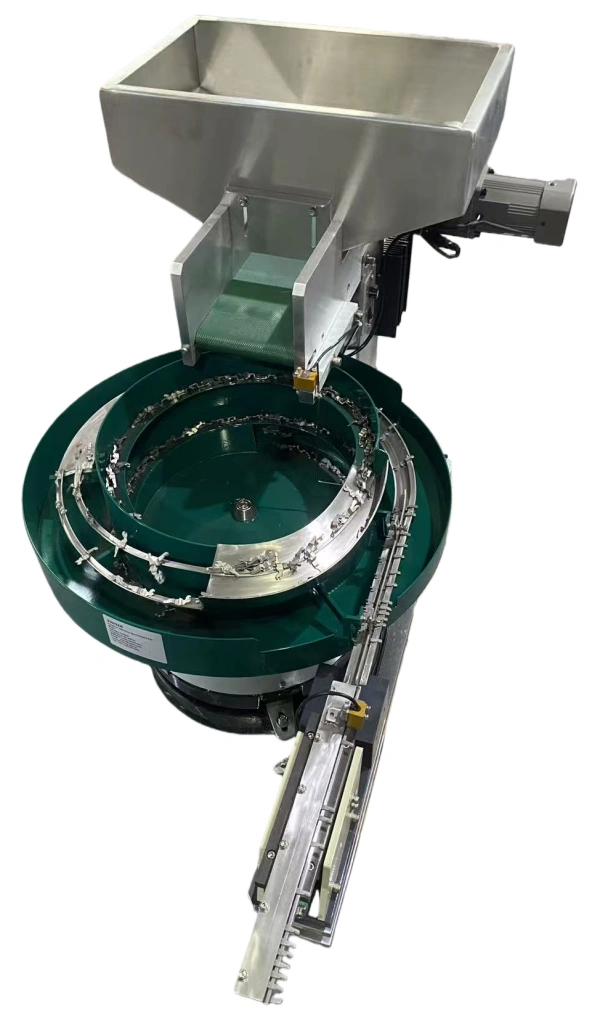
| Operating principle | Vibrates parts upward along a spiral track using electromagnetic or piezoelectric drives | Vibrates a flat or inclined screen deck using eccentric shafts or vibratory motors to separate material by size |
| Shape | Round bowl with a spiral track inside | Flat or slightly inclined rectangular deck (single or multiple decks) |
| Typical size | Bowl diameter: 200–1200 mm; handles parts up to ~50–100 mm | Screen deck: 600×1200 mm up to 3000×8000 mm; handles large volumes |
| Output rate | Parts per minute (e.g., 50–300+ parts/min) | Tons per hour (e.g., 1–500+ tons/hour depending on material) |
| Orientation capability | Yes – can orient parts in a specific direction (head‑up, notch‑right, etc.) | No – only separates by size; no orientation function |
| Typical applications | Feeding screws, caps, electronic components, pills to assembly/packaging machines | Screening sand, gravel, powder, grain, recycling waste in mining, chemical, food industries |
| Main wear part | Track / tooling; wears due to part friction | Screen mesh / media; wears due to abrasive material flow |
| Accuracy requirement | High – part orientation must be precise and repeatable | Moderate – separation is based on mesh size; ±5–10% tolerance common |
| การบูรณาการ | Usually integrated with assembly or packaging machines | Usually part of a processing line (crusher → screen → conveyor) |
| Cost range | Typically $1,000 – $20,000 (depending on complexity) | Typically $5,000 – $100,000+ (larger and heavier equipment) |


 Thai
Thai  English
  Spanish (Mexico)
  Czech
Czech  Arabic
  Russian
  German
  French
  Turkish
  Italian
  Ukrainian
  Polish
  Romanian
  Bengali
  Portuguese (Portugal)
  Japanese
  Korean
  Hebrew
  Uzbek
Uzbek  Hindi
Hindi  Slovak
  Vietnamese
  Portuguese (Brazil)
  Spanish (Peru)
  Spanish (Spain)
  Spanish (Venezuela)