
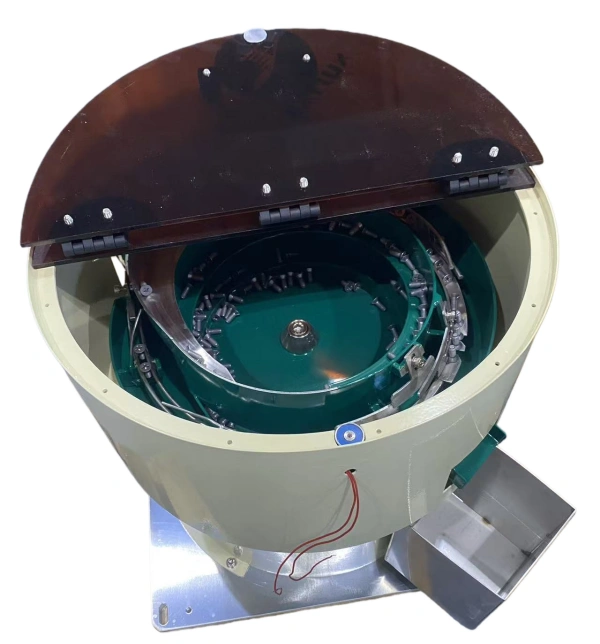
The main differences between a motor-driven hopper (e.g., a rotary table, screw feeder, or belt hopper) and a linear vibrator hopper (e.g., a vibrating storage hopper or linear feeder hopper) are as follows:
| Aspect | Motor-Driven Hopper | Linear Vibrator Hopper |
|---|---|---|
| Drive Principle | Uses a rotary motor (geared, stepper, or servo) to move material, typically via a screw, belt, rotating disc, or agitator. | Uses an electromagnetic or piezoelectric vibrator to shake the entire hopper or a linear tray, making material flow by vibration. |
| Material Movement | Positive, forced movement (mechanical pushing or rotating). | Material moves by bouncing, sliding, or flowing due to vibration, relying on gravity and friction. |
| Suitable Part Types | Can handle parts that are sticky, oily, delicate, or easily tangled, where vibration may cause issues. | Best for dry, free‑flowing, small, rigid parts (e.g., screws, capsules, electronic components). |
| Flow Control | Very precise, can be easily synchronized with sensors (start/stop, variable speed). | Good, but fine control at very low feed rates may be less stable (can be improved with frequency/amplitude control). |
| Úroveň hluku | Generally lower (only motor and mechanical meshing sounds). | Can be moderate to high (vibration and part‑to‑part impact). |
| Maintenance | Moderate (bearings, gears, motor wear). | Low (no moving parts except springs and electromagnetic coils). |
| Energetická efektívnosť | Moderate; power is always consumed when running, even under light load. | Very efficient; consumes power only to maintain vibration amplitude, often lower overall than a motor. |
| náklady | Higher (motor, speed controller, bearings, mechanical linkage). | Lower (simple structure, no complex mechanical linkage). |
| Typical Application | Feeding sticky, oily, or easily tangled parts; large storage capacity applications. | Feeding dry, clean, small parts; simple integration with vibratory bowls. |
Summary:
Use a motor-driven hopper when you need positive, forced feeding for parts that are sticky, oily, delicate, or easily tangled, and when precise flow control is required.
Use a linear vibrator hopper for dry, free-flowing, small parts where a simple, low-cost, and low-maintenance solution is desired, especially when directly feeding a vibratory bowl.
In many cases, a linear vibrator hopper is the standard choice for vibratory bowl systems because it matches the same vibration principle and is cost‑effective. A motor-driven hopper is used when the part characteristics make vibration feeding problematic.

 Slovak
  English
  Spanish (Mexico)
  Czech
Czech  Arabic
  Russian
  German
  French
  Turkish
  Italian
  Ukrainian
  Polish
  Romanian
  Bengali
  Portuguese (Portugal)
  Thai
Thai  Japanese
  Korean
  Hebrew
  Uzbek
Uzbek  Hindi
Hindi  Vietnamese
  Portuguese (Brazil)
  Spanish (Peru)
  Spanish (Spain)
  Spanish (Venezuela)