
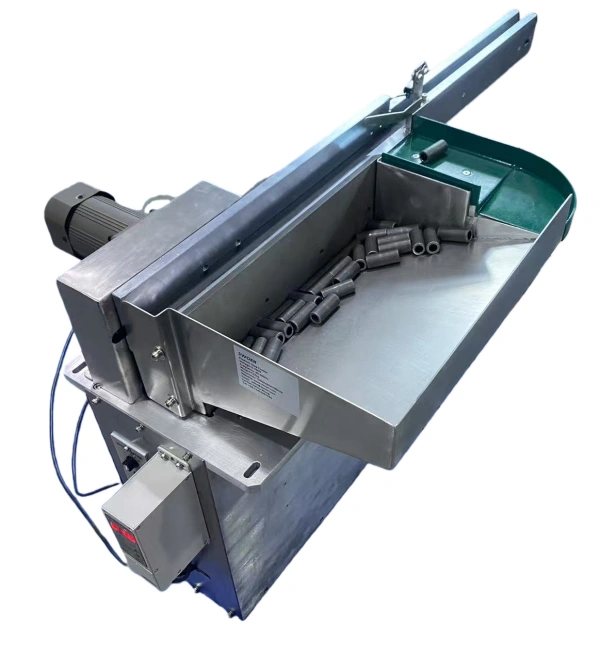
I. Structural Overview – Side-by-Side Comparison
| Funkcia | Vibračný miskový podávač | Pusher Feeder (Step Feeder / Horizontal Pusher) |
|---|---|---|
| Main structure | A spiral, cone‑shaped bowl mounted on a vibrating base | A hopper + a reciprocating pusher plate (or blade) sliding on a horizontal or inclined track |
| Drive mechanism | Electromagnetic drive + leaf springs (vibration) | Pneumatic cylinder, hydraulic cylinder, or electric motor + cam/ linkage |
| Part movement | Parts move upward along a spiral track via vibration (micro‑jumps) | Parts are pushed forward horizontally (or at an incline) by a reciprocating pusher plate |
| Orientation method | Passive – parts are oriented by mechanical tooling (wipers, slots, air jets) built into the track | Limited – parts are separated and pushed; orientation is often predefined by part geometry or downstream tooling |
| Wear parts | Leaf springs, electromagnet, track tooling, rubber mounts | Pusher plate, cylinder seals, slide rails, wear strips |
| Footprint | Compact – circular base (typically 300–1200 mm diameter) | Linear – longer footprint (typically 1–3 m in length, but narrower) |
| Typical height | Moderate – bowl height varies with diameter | Low – often compact in height (especially horizontal pushers) |
II. Detailed Breakdown of Each Structure
A. Vibratory Bowl Feeder Structure
Bowl body – A stainless steel or aluminum cone with a spiral track inside.
Base unit – Contains the electromagnet, leaf springs, and armature.
Riadiaci systém – A controller adjusts amplitude and frequency.
Tooling – Wipers, slots, air jets, and step gaps are installed on the track to orient parts.
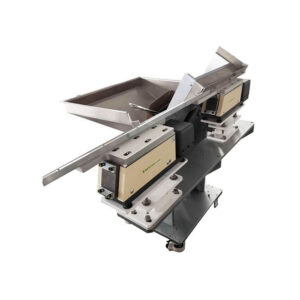
Linear feeder (optional) – A straight vibrating track attached to the bowl exit to transfer parts to the next machine.
Hopper (optional) – A large container above the bowl to hold bulk parts.
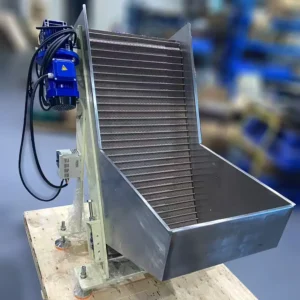
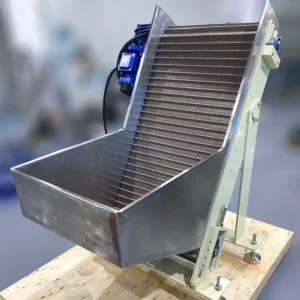
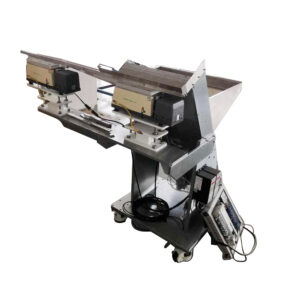
B. Pusher Feeder Structure
Hopper / magazine – A vertical or inclined bin that holds bulk parts in a stacked or layered arrangement.
Pusher plate / blade – A flat or contoured plate that moves back and forth to push the bottom‑most part out of the hopper.
Drive unit – A cylinder (pneumatic or hydraulic) or a motor‑driven cam mechanism that provides reciprocating motion.
Guide rails / track – Precision‑machined rails that guide the parts as they are pushed forward.
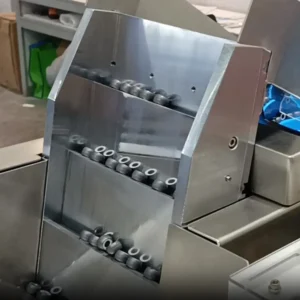
Separation mechanism – May include gates, fingers, or steps to separate stacked parts into single‑file flow.
Sensor / control – Optional sensors to detect part presence and synchronize pusher action with downstream equipment.
III. Visual / Operational Comparison
| Aspect | Vibračný miskový podávač | Pusher Feeder |
|---|---|---|
| Motion type | Vibratory (high‑frequency, small‑amplitude) | Reciprocating linear motion (low‑frequency, longer‑stroke) |
| Part flow direction | Upward spiral (3D path) | Horizontal or slight incline (2D path) |
| Part state during feeding | Parts bounce, slide, and tumble – work in progress | Parts are pushed in a controlled, stable manner |
| Ability to orient parts | Yes – via built‑in tooling | Limited – generally no active orientation; relies on part shape or pre‑orientation |
| Sensitive to part weight | Yes – heavier parts need more drive power | No – weight is not a major limitation |
| Sensitive to part stickiness | Yes – sticky parts clog the track | No – mechanical pushing overcomes adhesion |
| Part damage risk | Moderate – impact and friction can scratch parts | Low – gentle pushing with minimal impact |
IV. Structural Summary Table
| Component / Feature | Vibračný miskový podávač | Pusher Feeder |
|---|---|---|
| Primary structure | Bowl + vibrating base | Hopper + pusher plate + rails |
| Drive principle | Electromagnetic vibration | Pneumatic / hydraulic / electric linear actuation |
| Part flow path | Spiral (upward) | Linear (horizontal or inclined) |
| Orientation | Mechanical tooling on track | Not built‑in (may need pre‑orientation) |
| Wear parts | Springs, coil, track, mounts | Pusher plate, cylinder seals, slide rails |
| Footprint | Compact (round) | Elongated (linear) |
| Height | Moderate (bowl height) | Low (flat layout) |
| Best‑suited parts | Small, rigid, dry, non‑sticky parts | Springs, O‑rings, heavy parts, sticky parts, fragile parts |
| Speed range | 50–300+ parts/min | 10–60 parts/min (typical) |
| Cost range | $1k–$8k (standard) | $2k–$10k (custom) |
V. Key Structural Difference – In One Sentence
A vibratory bowl feeder uses vibration to move parts up a spiral track, while a pusher feeder uses a reciprocating mechanical plate to push parts along a linear path – the former is circular and passive, the latter is linear and active.

 Slovak
  English
  Spanish (Mexico)
  Czech
Czech  Arabic
  Russian
  German
  French
  Turkish
  Italian
  Ukrainian
  Polish
  Romanian
  Bengali
  Portuguese (Portugal)
  Thai
Thai  Japanese
  Korean
  Hebrew
  Uzbek
Uzbek  Hindi
Hindi  Vietnamese
  Portuguese (Brazil)
  Spanish (Peru)
  Spanish (Spain)
  Spanish (Venezuela)
Recenzie
Nikto zatiaľ nepridal hodnotenie.