
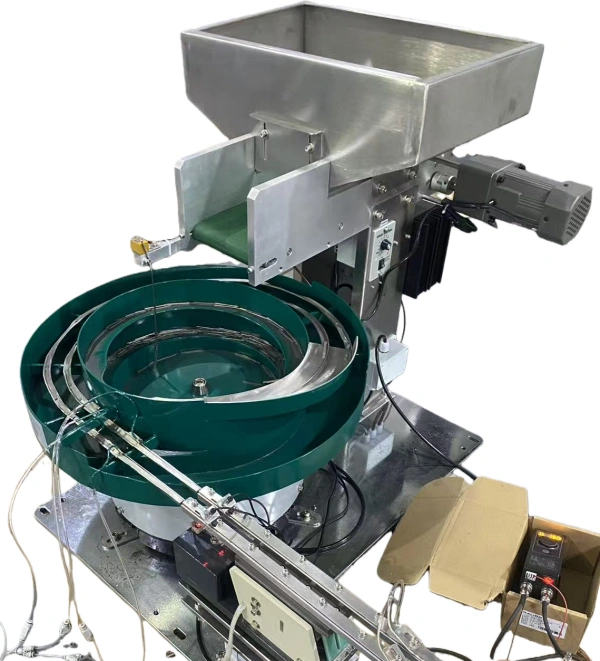
The answer depends on your specific application. Below is a structured comparison to help you choose.
I. Quick Overview
| 특징 | Vibratory Bowl + Linear Vibrator | Vibratory Bowl + Conveyor Belt |
|---|---|---|
| Common name | Bowl feeder + linear track (straight vibrator) | Bowl feeder + belt conveyor |
| Best for | Precise, high‑speed part transfer and orientation | Simple, low‑cost, non‑critical part transfer |
| 비용 | Higher | Lower |
| 속도 | Very high | Moderate |
| 정도 | High (parts stay oriented) | Low (parts may shift) |
| Maintenance | Moderate (springs, coils) | Higher (belt wear, tracking, cleaning) |
| Noise | Moderate | Low |
II. Detailed Comparison
1. Linear Vibrator (Straight Feeder)
| Aspect | Detail |
|---|---|
| How it works | Uses electromagnetic vibration to move parts along a metal track (same principle as the bowl). |
| Orientation retention | Excellent – parts maintain the orientation set by the bowl. |
| Typical speed | Can match bowl speed – up to 300+ parts/min. |
| Transfer distance | Usually 200–1500 mm (customizable). |
| Suitable for | Small, rigid parts (screws, electronic components, capsules). |
| Limitations | Not suitable for sticky, oily, or very heavy parts. |
| 완성 | Simple – bolts directly to the bowl base, often share the same controller. |
2. Conveyor Belt (Belt Feeder)
| Aspect | Detail |
|---|---|
| How it works | A motor‑driven belt carries parts forward. |
| Orientation retention | Poor – parts can roll, slide, or shift; usually requires side guides or vision correction. |
| Typical speed | Moderate – belt speed can be high, but part transfer rate is limited by bowl output. |
| Transfer distance | Can be long (1–10+ meters) with multiple drives. |
| Suitable for | Larger parts, heavier parts, parts that are already oriented, or parts that don’t need precision placement. |
| Limitations | Belt wear, tracking issues, and parts may pile up if not properly guided. |
| 완성 | Requires separate motor and controller; needs careful alignment with bowl exit. |
III. When to Choose Which
| Choose Linear Vibrator if… | Choose Conveyor Belt if… |
|---|---|
| Parts must remain oriented (e.g., for robot pick‑up or assembly). | Orientation is not critical – parts can be re‑oriented later. |
| Speed is high (> 150 parts/min). | Speed is low to moderate (< 100 parts/min). |
| Parts are small, dry, rigid (e.g., screws, pills, pins). | Parts are large, heavy, or delicate (e.g., castings, fruits, bulky items). |
| Transfer distance is short (< 2 m). | Transfer distance is long (> 2 m). |
| You want a simple, integrated system (same controller, no extra motor). | You need to drop parts from one level to another or transfer across a gap. |
| You need low maintenance and long life. | Belt replacement and tracking are acceptable. |
IV. Summary Table – Side by Side
| Comparison | Linear Vibrator | Conveyor Belt |
|---|---|---|
| Orientation | ✅ Excellent (fixed orientation) | ❌ Poor (parts shift) |
| 속도 | ✅ Very high | ⚠️ Moderate |
| 비용 | ⚠️ Higher | ✅ Lower |
| Transfer distance | ⚠️ Short (< 2 m) | ✅ Long (2–10+ m) |
| Maintenance | ✅ Low | ❌ Higher |
| Noise | ⚠️ Moderate | ✅ Low |
| Suitable parts | Small, dry, rigid | Large, heavy, any material |
| 완성 | ✅ Simple (share controller) | ⚠️ Needs separate drive |
| 내구성 | ✅ Long life (no moving parts except springs) | ❌ Belt wears over time |
V. Combined Use (Hybrid)
In some systems, both are used:
Bowl → Linear vibrator (orientation retention) → Belt conveyor (long‑distance transfer)
This gives you the precision of the linear vibrator and the reach of the belt conveyor.
VI. Final Recommendation
| Your Need | Recommendation |
|---|---|
| Orient parts precisely and feed them directly to a robot or assembly machine | ✅ Linear vibrator – best for precision and speed |
| Transfer parts a long distance or drop them into a bin | ✅ Conveyor belt – more cost‑effective for long distances |
| Mixed – orient first, then move far | ✅ Linear vibrator + belt conveyor in series |

 Korean
  English
  Spanish (Mexico)
  Czech
Czech  Arabic
  Russian
  German
  French
  Turkish
  Italian
  Ukrainian
  Polish
  Romanian
  Bengali
  Portuguese (Portugal)
  Thai
Thai  Japanese
  Hebrew
  Uzbek
Uzbek  Hindi
Hindi  Slovak
  Vietnamese
  Portuguese (Brazil)
  Spanish (Peru)
  Spanish (Spain)
  Spanish (Venezuela)