Variable Voltage (Variac) Controller This is the most basic and economical type. Working Principle: Uses a knob to adjust the output voltage to the electromagnet, thereby varying the amplitude of vibration. Characteristics: Pros: Simple, low cost, easy to use. Cons: Only controls amplitude, not frequency; offers limited control over feed stability. Appearance: Typically features a single large knob. Half-Wave / Full-Wave Controllers These are sub-types of variable voltage controllers, distinguished by their power output mode. Half-Wave: Uses only one half of the AC cycle. Vibration frequency equals line frequency. Gentler, suitable for light loads. Full-Wave: Uses the full AC cycle. Vibration frequency is double the line frequency. More powerful and provides smoother […]
Centrifugal Feeders excel at handling parts that are challenging for traditional vibratory bowls due to their gentle, high-speed, and tangle-free feeding action. Parts Prone to Tangling or Interlocking This is the most classic and advantageous application for centrifugal feeders. Examples: All types of springs (compression, extension, torsion), O-rings, jewelry chains, wires, small hardware chains. Reason: The combination of the rotating disc and stationary flappers effectively separates tangled parts, unlike vibratory bowls which can make the tangle worse. Delicate Parts Prone to Damage or Scratching The feeding process is smooth and impact-free. Examples: Plated parts, parts with high-gloss surfaces, plastic gears, medical devices, ceramic or glass components. Reason: Parts slide on the disc instead of being tossed, perfectly protecting their surface finish and structural […]
“Riveting Machine” is a broad term that typically refers to the following main types, each with its specific focus: Blind Rivet Guns – For One-Sided Riveting Description: Uses pull-through (pop) rivets. Operation is from one side of the workpiece. The mandrel is pulled, causing the rivet body to expand and clamp the materials. Primary Uses: Creating joints where access to the back of the workpiece is impossible (e.g., closed sections). Widely used in sheet metal (enclosures, cabinets), automotive, aerospace, and appliance assembly. Ideal for joining dissimilar materials. Compression Riveters – For High-Quality, High-Strength Riveting Description: Uses solid rivets. A massive, static pressure is applied to plastically deform (upset) the rivet tail, forming a second head. Primary Uses: Applications […]
The manufacturing of a step feeder focuses on creating a precise, reliable, and linear feeding mechanism tailored to specific parts. Part Analysis and Hopper Design Analysis: Precisely measure the part and analyze its behavior when stacked to design a hopper that prevents jamming and misorientation. Hopper Design: The hopper is custom-designed to match the part’s dimensions, ensuring stable feeding. Pusher and Pawl Mechanism Design Pusher/Pawl Shape: The pusher is shaped to match the part’s profile for smooth and stable pushing. Stroke Calculation: The pusher’s stroke is calculated to ensure one part is fed per cycle. Drive and Transmission System Selection Drive Methods: Pneumatic: Uses a cylinder. It’s cost-effective and simple. […]
The primary use of a rivet gun is to quickly and reliably create a permanent joint between two or more workpieces using the blind riveting process. It is a one-sided fastening technique, making it highly convenient to operate. Its core applications are demonstrated in the following aspects: Blind Fastening (One-Sided Operation) Description: The riveting process is completed entirely from one side of the workpiece. There is no need for access to the back, unlike bolts which require a nut or solid rivets which require bucking. Use: This makes it ideal for closed or semi-closed structures and situations where the back is inaccessible. Joining Dissimilar Materials Description: It can successfully join workpieces made of different […]
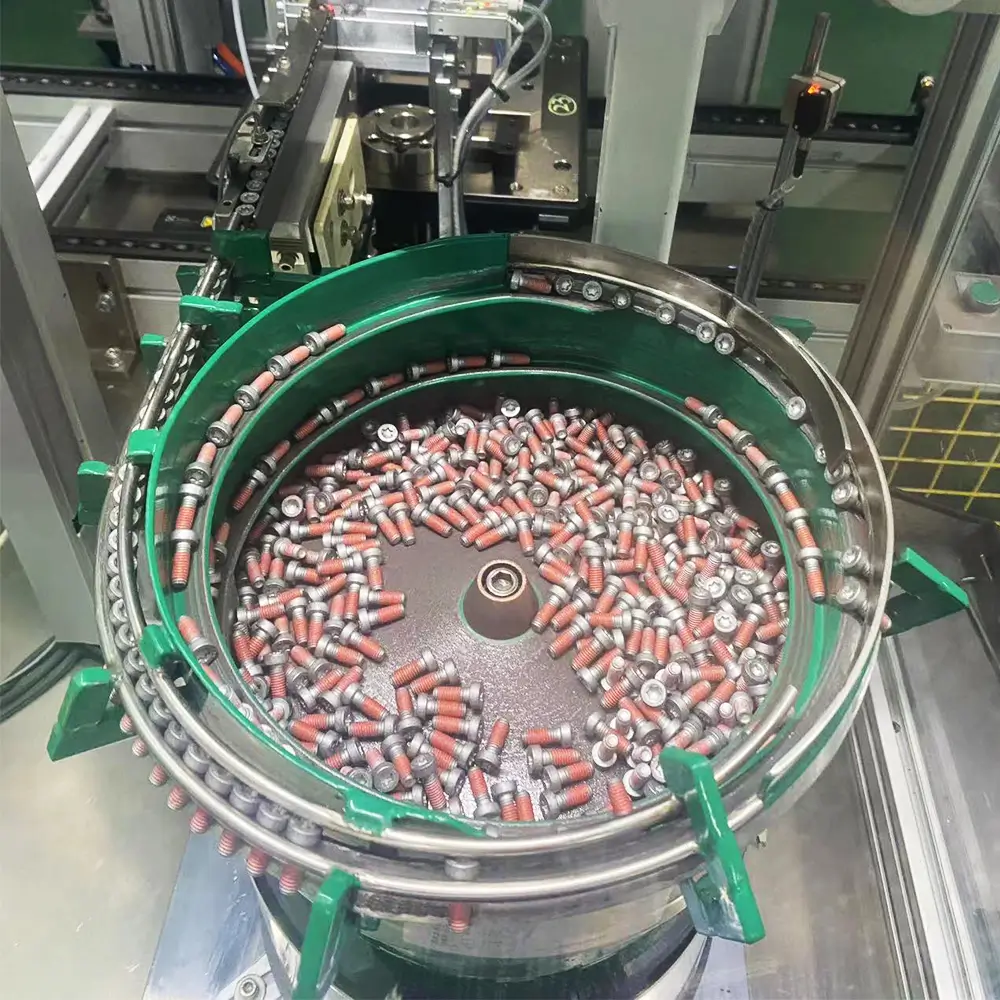
In fact, the vast majority of metal products are ideal candidates for vibratory bowl feeding. The technology was originally developed and perfected for handling metal components. Metal products typically possess all the ideal characteristics for a vibratory bowl: sturdiness, wear resistance, appropriate weight, and no static electricity. Standard Fasteners (The Most Classic Application) This is the largest and most traditional field for vibratory bowls. Examples: Screws, nuts, bolts, washers, rivets, pins, retaining rings. Reason: Regular shapes make them easy to orient; made from metals like steel or brass, they are sturdy and suitable for high-speed vibratory feeding. Electronic Components & Connectors Extremely widespread in PCB assembly and the electronics industry. Examples: Resistor, […]
Question 1: Springs Tangling or Knotting Phenomenon: Multiple springs hook onto each other and form a tangled clump in the bowl. Root Cause: The open ends of the springs catch on the coils of other springs. Solutions: Reduce Material Level: Maintain the minimum feasible number of springs in the bowl to reduce contact. Use a Swing Hopper: Replace the traditional linear feeder with a swing hopper that uses a rocking motion to feed springs, preventing tangling. Modify Track Design: Use a covered, narrow track that only allows one spring to pass at a time, physically preventing overlap. Use a Flexible Feeder: This is the ultimate solution. A vision system identifies already separated springs for a robot […]
The core advantages of step feeders are their gentle and quiet feeding method, which can effectively handle parts that are difficult for vibration bowls to manage. The following product types are particularly suitable: Parts Prone to Tangling or Interlocking These parts are the primary application for pusher feeders, as vibration bowls would cause them to become a tangled mess. Springs: All types of springs (compression, extension, torsion). O-Rings & Seals: Rubber or silicone items that easily nest into each other. Chains & Necklaces: Metal chains that are highly prone to tangling. Wires & Cable Segments: Short pieces of wire that can intertwine during vibration. Delicate Parts Prone to Deformation or Scratching The […]
The core advantage of vibratory bowls is their ability to sort, orient, and feed a large volume of small, sturdy parts at high speed and in an automated manner. Standard Fasteners This is the most classic and widespread application for vibratory bowls. Examples: Screws, nuts, bolts, washers, rivets, pins. Reason: These parts are typically made of metal, making them sturdy and suitable for vibration; their regular shapes make them easy to orient using bowl tooling (e.g., grooves, wiper blades). Electronic Components Vibratory bowls are standard equipment in processes like PCB assembly. Examples: Resistors, capacitors, inductors, diodes, transistors, connectors, LEDs. Reason: The parts are small, required in large quantities, and perfectly suited for the high-speed feeding of […]
1、 Comparison of Working Principles and Characteristics Characteristic vibration feeder pusher/feeder The working principle utilizes the electromagnetic drive and resonance principle to generate small vertical torsional vibrations in the disk body, and through inertia and friction, the parts move forward along the spiral track and complete orientation. It is usually a linear motion mechanism (cylinder, electric push rod) that pushes the disorderly stacked parts forward one by one through reciprocating push claws or push plates. Core functions include sorting, orientation, transportation separation, counting, and transportation Advantage 1. Complex orientation: It can arrange messy parts in a unified and specific direction through clever mechanisms on the track. Continuity: The feeding process […]