
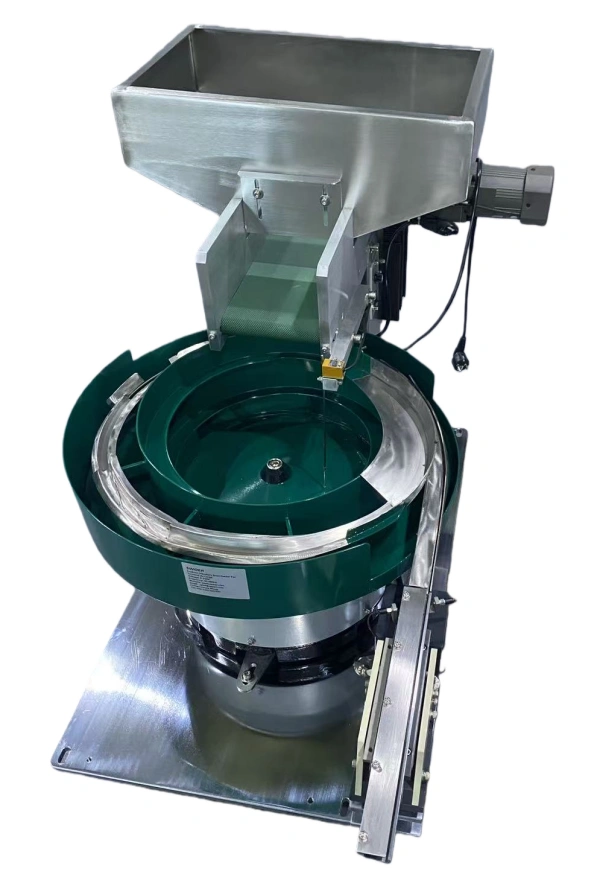
How Should a Vibratory Bowl Be Made for Oily Products?
If you must use a vibratory bowl for oily parts, the following design modifications are recommended:
1. Surface Treatment & Materials
| Measure | Purpose |
|---|---|
| PTFE (Teflon) coating | Reduces friction and prevents oil from sticking to the track. |
| Stainless steel bowl (SUS304 or SUS316) | Resists oil‑related corrosion and is easy to clean. |
| Hydrophilic / oil‑repellent coating | Special coatings that repel oil (e.g., oleophobic coatings). |
| Smooth surface finish (polished) | Minimizes surface roughness where oil can accumulate. |
2. Track & Bowl Geometry
| Measure | Purpose |
|---|---|
| Wider track | Reduces clogging from parts sticking together. |
| Steeper incline | Helps parts slide rather than stick. |
| Air jet assistance | Nozzles blow parts free if they stick. |
| Special wiper blades | Designed to scrape off excess oil before it accumulates. |
| Self‑draining bowl design | Allows excess oil to drain out of the bowl (e.g., small drainage holes or a sloped bottom). |
3. Drive & Vibration Settings
| Measure | Purpose |
|---|---|
| Higher amplitude | Provides more energy to overcome sticking forces. |
| Lower frequency | Gives parts more time to separate before the next pulse. |
| Vibration direction adjustment | Fine‑tune the leaf spring angle for optimal forward movement. |
4. Upstream / Downstream Additions
| Measure | Purpose |
|---|---|
| Oil removal station before the bowl | Clean parts before they enter the bowl (e.g., air blow, ultrasonic cleaning). |
| Ionizing blower | Removes static charge that can make oil‑coated parts cling. |
| Drip tray / oil collection system | Catches excess oil that drains from the bowl. |
5. Regular Maintenance
| Task | Frekvencia |
|---|---|
| Clean the track with solvent | Daily or weekly (depends on oil level). |
| Inspect and replace coatings | When PTFE coating wears off (every few months to a year). |
| Clean drainage holes | Daily to prevent clogging. |
III. When a Vibratory Bowl is Not Recommended for Oily Products
For heavily oiled, sticky, or wet parts, alternative feeding methods are often more reliable:
| Alternative | Výhody |
|---|---|
| Pusher feeder | No vibration; pushes parts mechanically; oil does not affect performance. |
| Centrifugal feeder | Continuous rotary motion; less affected by oil adhesion. |
| Flexible feeder + vision + robot | Parts are scattered and picked by vision; no oil‑sticking issues on tracks. |
| Belt conveyor with side guides | Simple, low‑cost, and oil‑resistant belts available. |
IV. Summary Table
| Aspect | Recommendation |
|---|---|
| Can oily products be used? | ✅ Yes, but with special design. |
| Best surface coating | PTFE (Teflon) or oleophobic coating. |
| Track design | Wider, steeper, with air jets and drainage. |
| Vibration settings | Higher amplitude, lower frequency. |
| Maintenance | Frequent cleaning required. |
| Better alternatives | Pusher feeder, centrifugal feeder, flexible feeder. |

 Slovak
  English
  Spanish (Mexico)
  Czech
Czech  Arabic
  Russian
  German
  French
  Turkish
  Italian
  Ukrainian
  Polish
  Romanian
  Bengali
  Portuguese (Portugal)
  Thai
Thai  Japanese
  Korean
  Hebrew
  Uzbek
Uzbek  Hindi
Hindi  Vietnamese
  Portuguese (Brazil)
  Spanish (Peru)
  Spanish (Spain)
  Spanish (Venezuela)