
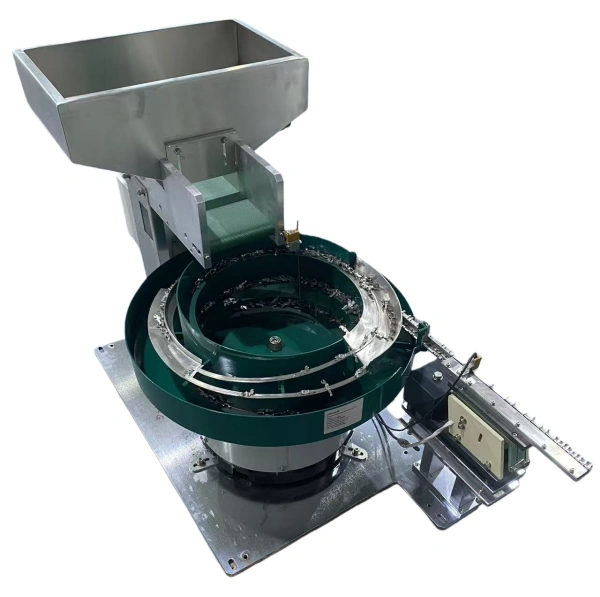
For oversized products, is a vibratory bowl feeder or a pusher feeder better?
I. Comparison of Suitability for Oversized Products
| Factor | Vibračný miskový podávač | Pusher Feeder |
|---|---|---|
| Typical part size range | Small to medium (usually < 50 mm in diameter / length) | Can handle larger parts (50–200+ mm, depending on design) |
| Maximum part weight | Typically 1–3 kg per part (some designs up to 5–10 kg) | Can handle heavier parts (10–50+ kg, with appropriate cylinder/power) |
| Part geometry | Works best with symmetrical, non‑tangling shapes | Works with a wider range of shapes, including irregular or asymmetric parts |
| Orientation capability | Excellent (can orient parts in a specific direction) | Limited (orientation usually required before feeding) |
| Feeding speed | Very high (hundreds of parts per minute) | Moderate (typically 10–60 parts per minute) |
| Jamming risk | Higher – oversized parts can block the track and bowl | Lower – simpler flow path, less likely to jam |
| Damage risk | Higher – parts may collide and scratch | Lower – gentle pushing motion |
| náklady | Higher for large custom bowls | Lower for simple pusher designs |
II. Why a Pusher Feeder Is Better for Oversized Parts
No strict size limit – A pusher feeder can be designed to handle almost any size by scaling the hopper, pusher plate, and cylinder.
Low jamming risk – The part moves in a straight line or simple path; there are no spiral tracks to get stuck on.
Gentle handling – The pushing action is less aggressive than the vibration and bouncing in a bowl, so large parts are less likely to be damaged.
Simpler design for large parts – A vibratory bowl for oversized parts would be enormous, heavy, and expensive; a pusher feeder is much more practical.
III. When a Vibratory Bowl Feeder Might Still Be Considered
| Condition | Explanation |
|---|---|
| Parts are not truly “oversized” | If the part is still ≤ 50 mm and ≤ 1 kg, a vibratory bowl may work. |
| Orientation is critical and complex | If the part must be fed in a specific orientation (e.g., logo up, flange forward), a vibratory bowl can achieve that – but a pusher feeder cannot. |
| Very high speed is required | If you need hundreds of parts per minute and parts are still manageable, a vibratory bowl may be worth the extra cost. |

 Slovak
  English
  Spanish (Mexico)
  Czech
Czech  Arabic
  Russian
  German
  French
  Turkish
  Italian
  Ukrainian
  Polish
  Romanian
  Bengali
  Portuguese (Portugal)
  Thai
Thai  Japanese
  Korean
  Hebrew
  Uzbek
Uzbek  Hindi
Hindi  Vietnamese
  Portuguese (Brazil)
  Spanish (Peru)
  Spanish (Spain)
  Spanish (Venezuela)