
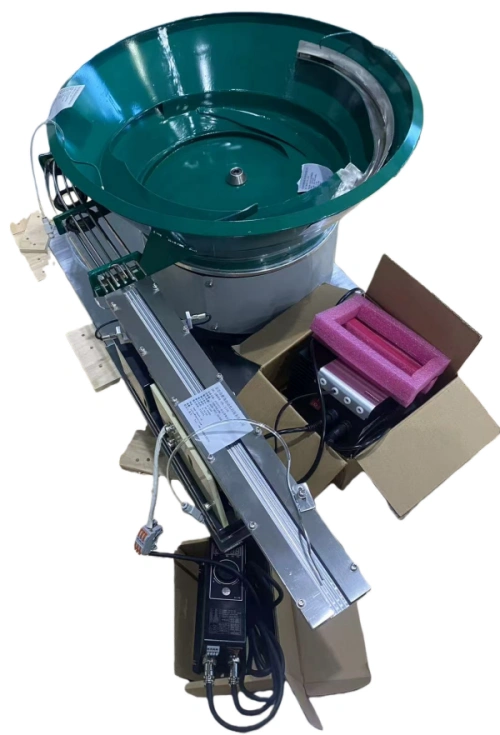
What is the Function of a Vibratory Bowl with a PLC?
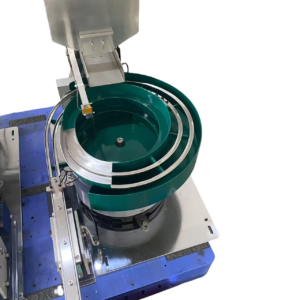
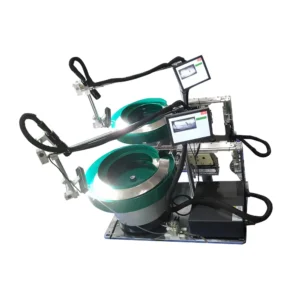
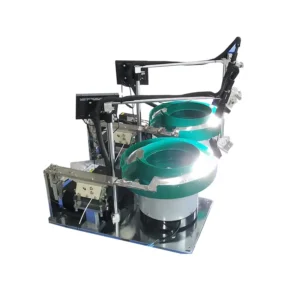
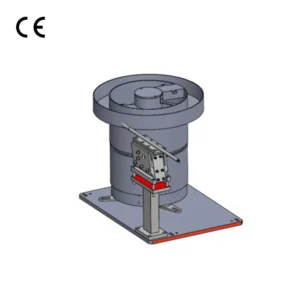
Integrating a Programmable Logic Controller (PLC) with a vibratory bowl feeder transforms it from a simple on/off device into an intelligent, responsive, and fully integrated component of an automated production line. The main functions are as follows:
I. Core Control Functions
| Function | Description |
|---|---|
| Start / Stop Control | PLC commands the bowl to run only when parts are needed, preventing overfeeding and reducing energy waste. |
| Speed / Amplitude Adjustment | PLC can change vibration intensity (via analog output or communication with a digital controller) to match part type or feed rate requirements. |
| Timed / Intermittent Operation | PLC runs the bowl in bursts (e.g., 2 seconds on, 1 second off) to prevent jamming or to synchronize with a downstream machine’s cycle. |
II. Integration with Sensors
| Function | Description |
|---|---|
| Part Presence Feedback | PLC receives signals from sensors (photoelectric, fiber optic, proximity) at the discharge or pick‑up point. When parts are present, the PLC stops the bowl; when parts are absent for a set time, the PLC restarts the bowl. |
| Jam Detection | A sensor detects parts backing up or stopping. The PLC can stop the bowl, sound an alarm, or attempt a reverse‑pulse (if supported) to clear the jam. |
| Low / High Level Control | Sensors in the bowl or supply hopper tell the PLC when to request more parts from an upstream elevator or hopper gate. |
III. Synchronization with Downstream Machines
| Function | Description |
|---|---|
| Machine Request | A downstream machine (e.g., robot, assembly press, packaging machine) sends a “part needed” signal to the PLC. The PLC then runs the bowl to deliver one part, then stops. |
| Pick‑and‑Place Coordination | The PLC ensures that a part is waiting at the pick position exactly when the robot or pick‑and‑place mechanism arrives. |
| Batch Counting | The PLC counts parts fed from the bowl and stops the bowl when a batch target (e.g., 100 pieces) is reached, then signals the operator or downstream process. |
IV. Data Collection and Monitoring
| Function | Description |
|---|---|
| Production Counting | PLC accumulates total parts fed per shift, per day, or per job. Data can be displayed on an HMI or sent to a higher‑level system (MES, SCADA). |
| Run Time / Idle Time Logging | PLC tracks how long the bowl runs vs. how long it is idle, helping calculate OEE (Overall Equipment Effectiveness). |
| Alarm and Fault Logging | PLC records faults (e.g., jam, no parts, sensor failure) with time stamps for troubleshooting. |
V. Safety and Interlocking
| Function | Description |
|---|---|
| Emergency Stop Integration | PLC receives the E‑stop signal and immediately removes power from the bowl drive. |
| Guard Door Interlock | If a safety guard or enclosure door is opened, the PLC stops the bowl to protect the operator. |
| Overload / Vibration Monitoring | With advanced sensors, the PLC can detect abnormal vibration (e.g., from a broken spring) and shut down the bowl to prevent damage. |
VI. Multi‑Bowl Coordination
| Function | Description |
|---|---|
| Sequential Feeding | PLC runs multiple bowls in sequence (e.g., Bowl A feeds 10 parts, then Bowl B feeds 5 parts, then Bowl C feeds 20 parts). |
| Master / Slave Synchronization | One bowl acts as the master; others follow its start/stop commands based on assembly line demand. |
Summary Table: PLC Functions on a Vibratory Bowl
| Function Category | Specific Role |
|---|---|
| Basic control | Start/stop, speed adjustment, timed operation |
| Sensor integration | Part presence, jam detection, level control |
| Downstream sync | Machine request, pick coordination, batch counting |
| Data collection | Production counting, run time logging, fault recording |
| Safety | E‑stop, guard interlock, overload detection |
| Multi‑bowl | Sequential feeding, master/slave coordination |
 English
  Spanish (Mexico)
  Czech
Czech  Arabic
  Russian
  German
  French
  Turkish
  Italian
  Ukrainian
  Polish
  Romanian
  Bengali
  Portuguese (Portugal)
  Thai
Thai  Japanese
  Korean
  Hebrew
  Uzbek
Uzbek  Hindi
Hindi  Slovak
  Vietnamese
  Portuguese (Brazil)
  Spanish (Peru)
  Spanish (Spain)
  Spanish (Venezuela)
Reviews
There are no reviews yet.