
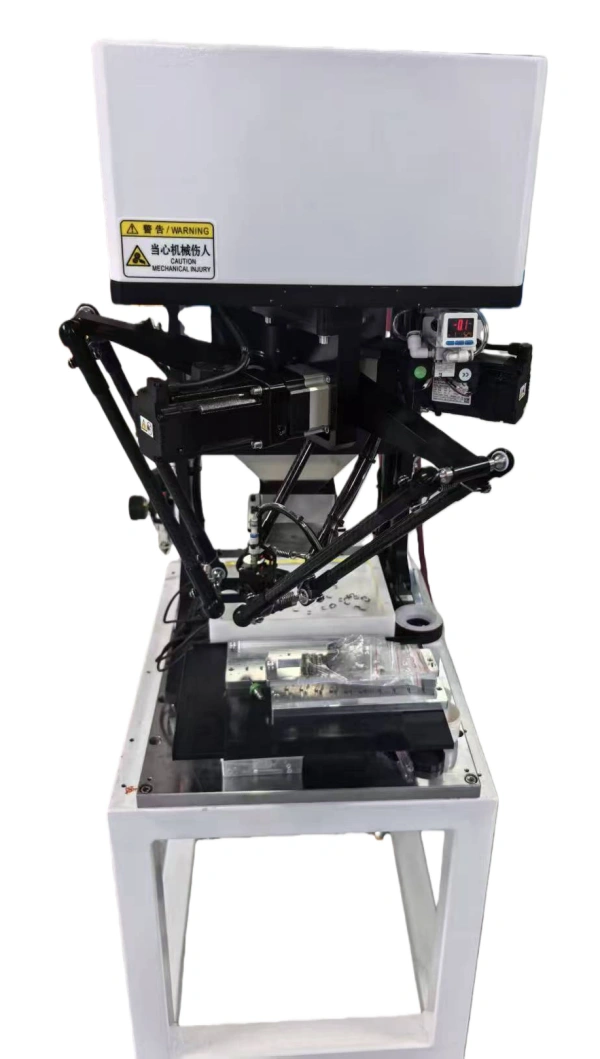
What is the difference between a parallel robot and a 4‑axis robot?
I. Clarification: “4‑Axis Robot” Typically Means SCARA
In industrial robotics, the term “4‑axis robot” almost always refers to a SCARA robot (Selective Compliance Assembly Robot Arm), which has four axes of motion:
| Axis | Motion |
|---|---|
| Axis 1 | Rotation about the vertical axis (waist) |
| Axis 2 | Rotation about the vertical axis (arm) |
| Axis 3 | Linear motion (vertical Z‑axis) |
| Axis 4 | Rotation about the vertical axis (wrist / theta) |
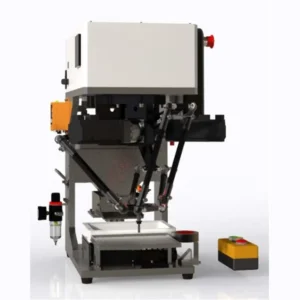
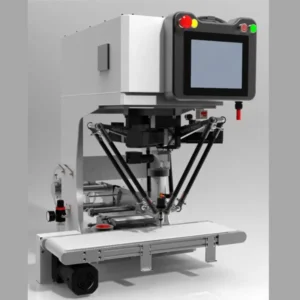
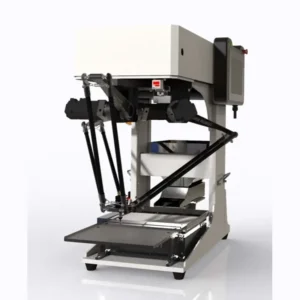
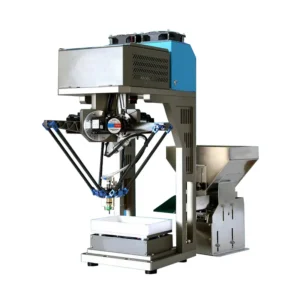
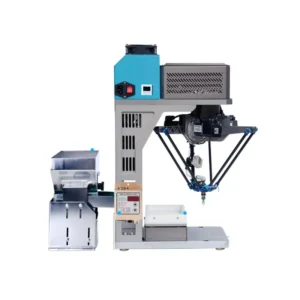
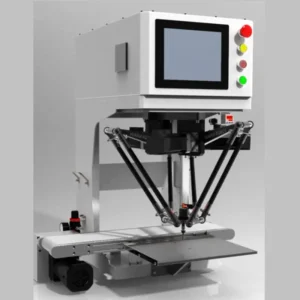
A parallel robot (also called a delta robot or spider robot) typically has 3 or 4 axes as well, but the structure and motion generation are fundamentally different.
II. Structural Differences
| Aspect | Parallel Robot | 4‑Axis SCARA Robot |
|---|---|---|
| Kinematic type | Parallel (closed‑loop) – multiple arms drive the same moving platform | Serial (open‑loop) – links are connected end‑to‑end |
| Motor position | Motors are fixed on the base frame | Motors move with the arm |
| Arm weight | Lightweight arms (low inertia) | Heavier arms (higher inertia) |
| Stiffness | Very high, especially in the vertical direction | Good vertically, but some compliance (which is actually a feature for assembly) |
III. Performance Differences
| Performance Aspect | Parallel Robot | 4‑Axis SCARA Robot |
|---|---|---|
| Speed | Extremely high – up to 10 m/s, accelerations up to 10–15 G | High – typically up to 5–7 m/s, accelerations around 2–5 G |
| Cycle time (300mm pick‑place) | 0.3 – 0.5 seconds | 0.5 – 0.8 seconds |
| Repeatability | ±0.05 – 0.1 mm | ±0.01 – 0.02 mm (often more precise) |
| Payload | 1 – 10 kg (typically 1–3 kg for high speed) | 5 – 20 kg (standard), up to 50 kg+ |
| Workspace shape | Dome‑shaped, limited horizontal reach | Cylindrical, with a wider horizontal reach |
| Reach / working radius | Typically 400 – 1600 mm diameter | Typically 300 – 1000 mm radius (600–2000 mm diameter) |
IV. Application Differences
| Capability | Parallel Robot | 4‑Axis SCARA Robot |
|---|---|---|
| Best‑fit application | High‑speed pick‑and‑place, sorting, packaging | Assembly, screwdriving, pick‑and‑place, dispensing |
| Complex paths | Limited to simple pick‑place motions | Can handle moderate complexity (e.g., insertion, gluing) |
| Compliance (for assembly) | Very rigid – not compliant | Designed with some compliance (especially in Z‑axis), ideal for tight‑tolerance assembly |
| Heavy payload | Not suitable (light only) | Suitable for medium payloads |
| Conveyor tracking | Excellent – very fast response | Good – can track conveyors, but slower than parallel robots |
| High‑mix / flexible | Often used with vision for mixed parts | Also works with vision, but changeover may involve mechanical adjustments |
V. When to Choose Which
| Choose a Parallel Robot if… | Choose a 4‑Axis SCARA Robot if… |
|---|---|
| You need maximum speed (200–300 picks/min) | You need moderate speed but higher payload |
| You are picking light items (cookies, pills, small electronic parts) | You are handling assembled parts, larger components, or medium‑heavy items |
| Your application is simple pick‑and‑place (no complex angles) | Your application includes screwdriving, dispensing, or press‑fit assembly |
| You need a large working area relative to footprint | You need a precise, compact, upright machine |
| You are in packaging, food, or pharmaceutical lines | You are in electronics assembly, automotive parts assembly, or general manufacturing |
VI. Summary Table: Parallel Robot vs. 4‑Axis SCARA
| Feature | Parallel Robot | 4‑Axis SCARA Robot |
|---|---|---|
| Structure | Parallel (closed‑loop) | Serial (open‑loop) |
| Speed | Very high | High |
| Cycle time | 0.3 – 0.5 s | 0.5 – 0.8 s |
| Repeatability | ±0.05 – 0.1 mm | ±0.01 – 0.02 mm |
| Payload | 1 – 10 kg | 5 – 20+ kg |
| Workspace | Dome (small horizontal reach) | Cylindrical (large horizontal reach) |
| Best for | High‑speed sorting, packaging | Assembly, screwdriving, dispensing |
| Compliance | Very rigid (no flexibility) | Some compliance (good for assembly) |
| Cost (typical) | Moderate to high | Moderate (often lower than parallel robots) |

 English
  Spanish (Mexico)
  Czech
Czech  Arabic
  Russian
  German
  French
  Turkish
  Italian
  Ukrainian
  Polish
  Romanian
  Bengali
  Portuguese (Portugal)
  Thai
Thai  Japanese
  Korean
  Hebrew
  Uzbek
Uzbek  Hindi
Hindi  Slovak
  Vietnamese
  Portuguese (Brazil)
  Spanish (Peru)
  Spanish (Spain)
  Spanish (Venezuela)
Reviews
There are no reviews yet.