
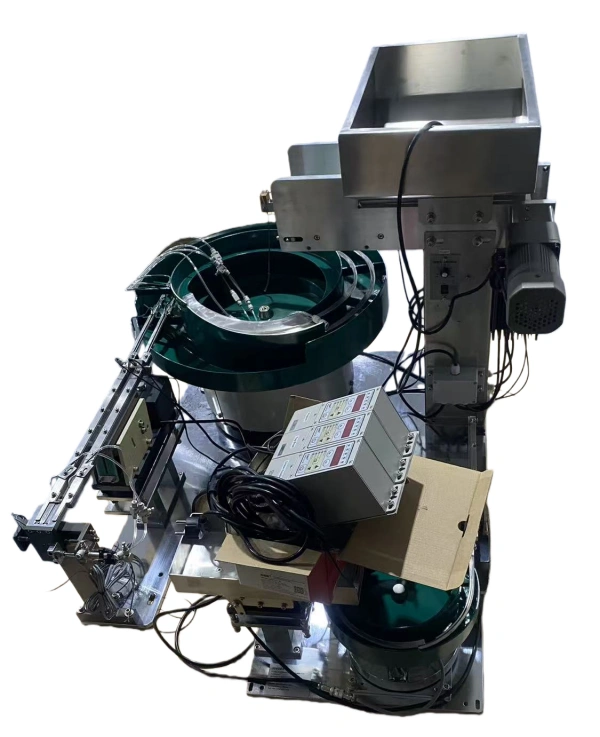
I. Products That Typically Require a Soundproof Enclosure Product Type / Characteristic Reason for High Noise Hard, heavy metal parts (e.g., steel screws, bolts, nuts, rivets, pins) Metal‑to‑metal contact generates loud impact noise. Small, rigid parts (e.g., bearings, small gears, machine components) High‑frequency impacts produce sharp, irritating sounds. High‑speed feeding applications (e.g., feeding at 300+ parts/min) Faster bowl operation increases both vibration noise and part‑to‑part collision noise. Large bowl with high amplitude (e.g., feeding parts > 50 mm) Larger bowls and higher vibration energy produce louder mechanical noise. Parts with sharp edges or rough surfaces (e.g., stamped metal parts, formed components) Rough surfaces increase friction noise and part‑to‑part scraping. Parts that tumble or bounce (e.g., disc‑shaped […]
カテゴリーアーカイブ: Flex Feeder
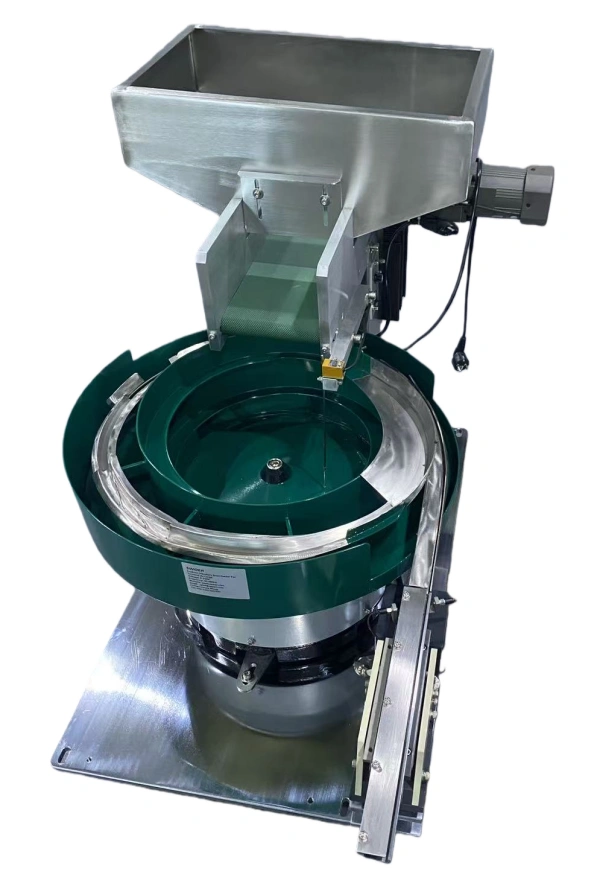
How Should a Vibratory Bowl Be Made for Oily Products? If you must use a vibratory bowl for oily parts, the following design modifications are recommended: 1. Surface Treatment & Materials Measure Purpose PTFE (Teflon) coating Reduces friction and prevents oil from sticking to the track. Stainless steel bowl (SUS304 or SUS316) Resists oil‑related corrosion and is easy to clean. Hydrophilic / oil‑repellent coating Special coatings that repel oil (e.g., oleophobic coatings). Smooth surface finish (polished) Minimizes surface roughness where oil can accumulate. 2. Track & Bowl Geometry Measure Purpose Wider track Reduces clogging from parts sticking together. Steeper incline Helps parts slide rather than stick. Air jet assistance Nozzles […]
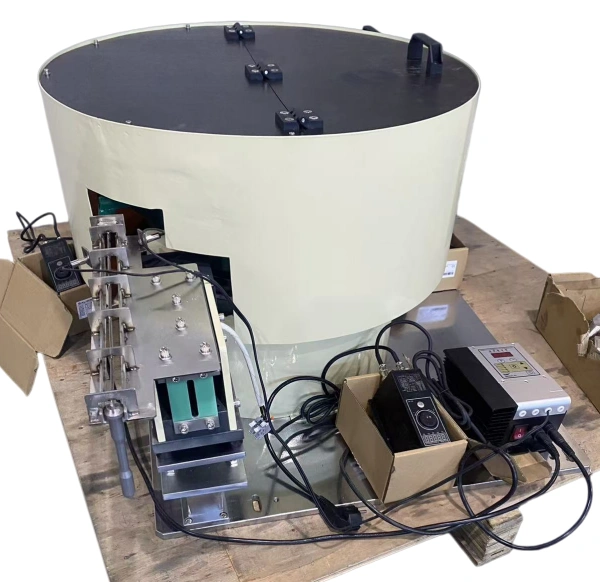
Sensors play a critical role in automating and stabilizing the operation of a vibratory bowl feeder. Their main functions are as follows: I. Part Presence Detection (Feedback Control) Start/Stop Control Sensor detects when parts are present at the discharge point or linear track. Sends a signal to the controller to stop the bowl (prevents overfeeding). When parts are absent for a set time, the sensor signals the bowl to start again. Downstream Machine Request Sensor at the pickup station detects that a part has been taken (e.g., by a robot or assembly machine). Triggers the bowl to advance the next part into position. II. Part Quality and Orientation Verification Correct Orientation Check Sensor (often a fiber optic or […]
Answer: It depends on the specific type of spider robot being referred to. I. Industrial Spider Robots (High-Speed Parallel Robots) Typically do NOT contain built-in lithium batteries. Power Source: They are powered directly from the industrial electrical grid (e.g., 220V or 380V AC) via cables, with internal power supplies converting AC to DC for the control system and servo motors. Reason: Designed for 24/7 continuous operation; batteries would add weight, reduce dynamic performance, and increase maintenance needs. II. DIY / Educational / Consumer Spider Robots (Biomimetic Walkers) Commonly DO contain lithium batteries. Battery Types: Often use LiPo or Li-ion batteries (e.g., 7.4V 2200mAh LiPo packs, 14500 Li-ion cells). Reason: Need for portability; lithium batteries […]
Thread coating machines, while essential for reliable automated application, face several challenges in practical use: I. Technical & Process-Related Pain Points Adhesive Consistency Issues Description: Adhesive viscosity can change with temperature, humidity, or age, leading to inconsistent flow, stringing, or clogging. Impact: Results in uneven coating, waste, and frequent downtime for cleaning. Nozzle Clogging and Dripping Description: Fast-curing adhesives can cure inside the nozzle tip, causing blockages. Residual adhesive may also drip between cycles, contaminating parts or machine surfaces. Impact: Requires frequent manual cleaning; causes rejects from unwanted adhesive spots. Achieving 360° Thread Coverage Description: Ensuring adhesive reaches all thread roots evenly, especially on complex or fine-pitch threads, is technically […]
1. High-Precision, High-Speed Pin Insertion Function: Replaces manual labor to insert various metal or plastic terminals into predetermined positions with extreme speed and repeatable accuracy. Value: This is its core function, ensuring consistency and reliability in mass production. 2. Automated Assembly of Multiple Connector Types Function: Handles pin insertion for various complex connectors, such as: PCB Connectors: Inserting pins into plated through-holes. Wire-to-Board / Wire-to-Wire Connectors: Inserting crimped terminals into plastic housings. Rectangular, Circular Industrial Connectors. Value: Meets the automation needs for connector assembly in electronics, automotive, appliance industries. 3. Integrated Crimping, Staking, or Soldering Support Function: Many machines integrate downstream processes to complete electrical/mechanical connections: Crimping: Ensures reliable electrical […]
The working principle of an industrial camera can be summarized in four core stages: 1. Light Acquisition Process: Light reflected from or emitted by the target passes through the industrial lens into the camera. Key: The lens collects and focuses the light to form a sharp optical image on the internal sensor. 2. Photoelectric Conversion Process: This is the core step. The focused light strikes the image sensor. Key: The sensor (typically a CCD or CMOS chip) contains millions of individual photosites. Each photosite (pixel) converts the received light intensity into a proportional weak analog electrical signal (voltage). 3. Signal Processing & Digitization Process: The analog signals from the sensor are weak and continuous, requiring processing. Key Steps: Amplification: Internal circuits amplify the signal. Digitization: An Analog-to-Digital […]
A complete flexible feeder system is a sophisticated assembly typically comprised of the following core modules and components: Core Vibration & Dispersion Module Vibratory Platform / Feeder Base: Generates multi-axis micro-vibration to scatter parts uniformly. Flexible Feeding Tray / Plate: The removable work surface on the platform. Pin Tray: Features an array of pins to stabilize parts. Textured/Coated Tray: Surface with specific friction properties. Magnetic Tray: Holds ferromagnetic parts. Platform Controller: Adjusts vibration frequency, amplitude, and operational modes. 1.Vision Recognition Module Industrial Camera: High-resolution area scan camera (CCD/CMOS). Industrial Lens: Selected for field of view and working distance. Lighting System: Critical for feature enhancement. Ring Light, Bar Light, Dome Light, […]
Superior Flexibility for Rapid Changeover Description: Its core advantage. Switching from Part A to Part B requires no mechanical retooling. Advantage: Simply load a new vision program. Changeover time is reduced from hours to minutes, ideal for high-mix, low-volume production. Extremely Gentle on Parts Description: Operates on a “scatter, identify, pick” principle. Advantage: Parts experience no forced orientation, friction, or impact, eliminating tangling, scratches, and deformation. Perfect for delicate, high-value parts. Handles Traditionally Difficult Parts Description: Does not rely on part geometry for mechanical sorting. Advantage: Easily feeds tangle-prone springs, O-rings, soft parts, and complex, asymmetric, or unstable parts that challenge traditional bowls. High Intelligence and Integration Description: Inherently designed for vision-guided robotic systems. Advantage: […]
A complete flexible feeder system is an integrated mechatronic device consisting of the following key functional modules and components: I. Core Vibration and Handling Module Vibratory Platform/Feeder Base: Generates micro-amplitude, multi-axis vibration to scatter parts. Flexible Feeding Tray/Plate: The removable surface placed on the vibratory platform. Pin Tray: With an array of pins to stabilize parts. Textured/Coated Tray: Surface with a specific friction coefficient. Magnetic Tray: For ferromagnetic parts. Platform Controller: Adjusts vibration frequency, amplitude, and mode. II. Vision Recognition Module Industrial Camera: Typically a high-resolution area scan camera. Industrial Lens: Selected based on field of view and accuracy requirements. Lighting System: Critical for highlighting part features. Ring Light, Bar […]
 Japanese
  English
  Spanish (Mexico)
  Czech
Czech  Arabic
  Russian
  German
  French
  Turkish
  Italian
  Ukrainian
  Polish
  Romanian
  Bengali
  Portuguese (Portugal)
  Thai
Thai  Korean
  Hebrew
  Uzbek
Uzbek  Hindi
Hindi  Slovak
  Vietnamese
  Portuguese (Brazil)
  Spanish (Peru)
  Spanish (Spain)
  Spanish (Venezuela)