
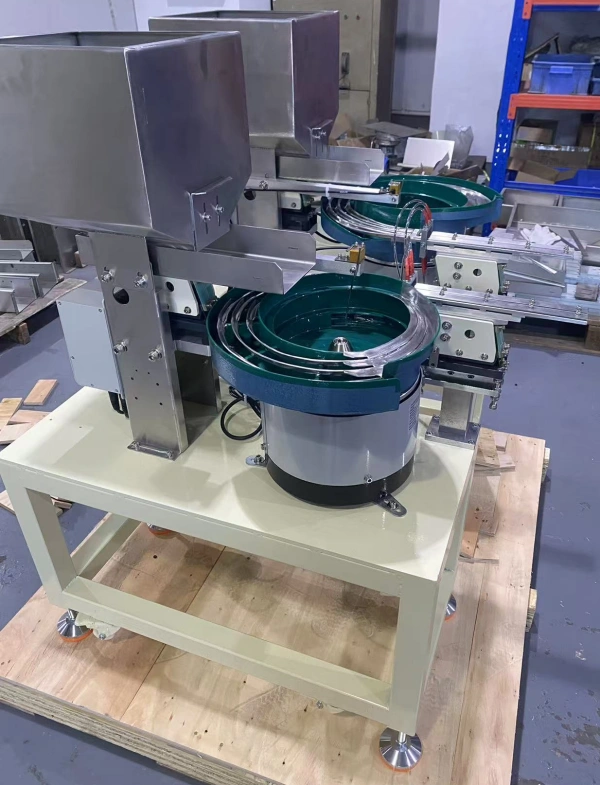
While vibrating screens are essential equipment for particle size separation, they face several challenges in practical applications. The main pain points are as follows: I. Technical & Performance Pain Points Screen Mesh Blinding / Clogging Description: Fine particles become lodged in the screen openings, reducing open area and screening efficiency. Impact: Decreased throughput, frequent cleaning downtime, inconsistent product quality. Screen Mesh Wear and Breakage Description: Continuous abrasive action from materials causes screen media to wear out or tear, especially with hard or sharp particles. Impact: Frequent screen replacement costs, unplanned downtime, risk of oversize particles passing through. Inefficient Fine Particle Separation Description: Screening fine materials (e.g., below 100 mesh) becomes […]
カテゴリーアーカイブ: Customized Machine
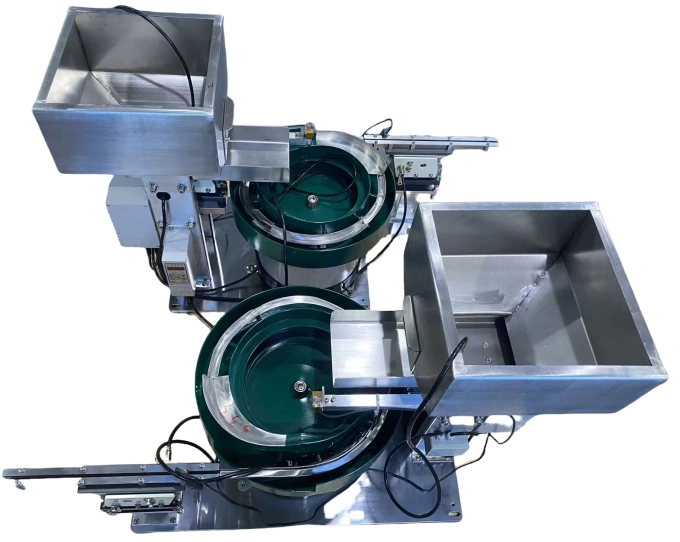
A vibrating screen is a piece of screening equipment that uses vibration to separate materials by particle size. Its main functions are as follows: I. Particle Size Classification Function: Separates materials into different particle size ranges based on mesh aperture. Application: Classifies raw materials into multiple grades (e.g., coarse, medium, fine) for downstream processes. II. Scalping / Coarse Separation Function: Removes oversized materials (contaminants or oversize particles) from the feed stream. Application: Protects downstream equipment from damage or ensures feed material meets size specifications. III. De-dusting Function: Removes fine dust or powder from granular materials. Application: Improves product cleanliness and reduces dust emissions in processing lines. IV. De-watering Function: Removes […]
An optical inspection machine is a sophisticated system integrating optics, mechanics, electronics, and software. Its main components can be categorized as follows: I. Imaging & Optics Module Industrial Camera: The core sensor (typically area scan or line scan CCD/CMOS). Industrial Lens: Determines field of view, working distance, and magnification. Lighting System: Critical for highlighting features. Light Source Types: LED, halogen, or fluorescent. Lighting Configurations: Ring light, bar light, dome light, coaxial light, back light, dark field illumination. Light Controller: For intensity and strobe control. Optical Filters: Polarizing, color, or band-pass filters to enhance contrast or suppress glare. II. Mechanical & Handling Module Machine Frame / Base: Rigid structure providing stability and […]
A thread coating machine is an integrated system designed for precision application of adhesives or sealants to threaded fasteners. Its main components can be categorized as follows: I. Adhesive Delivery & Dispensing System Adhesive Reservoir / Pressure Tank: Stores and supplies the coating material (e.g., anaerobic adhesives, thread sealants, PTFE pastes). Dispensing Valve: Controls the precise flow of adhesive. Spray Valve: For applying thread lockers or sealants via atomized spray. Dispensing Nozzle: For bead application; often angled or specially designed to reach thread roots. Jet Valve: For non-contact, high-speed micro-dosing. Fluid Pressure Regulator: Maintains consistent adhesive pressure for uniform output. Adhesive Feed Lines & Fittings: Tubing and connectors resistant to […]
A thread coating machine is specialized equipment designed to automatically apply adhesives or sealants to threaded fasteners. Its core function is to enhance the reliability of threaded connections by replacing manual application with precision automation. The main functions can be summarized as follows: I. Core Functions: Locking and Sealing Preventing Loosening Description: Precisely applies anaerobic adhesives or thread lockers into the thread roots. This increases friction between mating threads, effectively preventing loosening caused by vibration or impact. Application: Enhances the reliability of screws, bolts, and pneumatic components. Ensuring Effective Sealing Description: Applies thread sealants or liquid PTFE to fill microscopic gaps in thread interfaces, creating a reliable seal against gas or liquid […]
I. Technical Challenges Stringent Environmental Demands Sensitive Lighting: Ambient light changes, reflections, and shadows interfere with results, requiring strict lighting control. Vulnerability to Vibration: Mechanical vibrations cause image blur, necessitating costly isolation measures. Inherent Detection Limitations Blind Spots & Dead Angles: Internal structures, deep recesses, and back sides are often impossible to image. Material & Color Limitations: Transparent, mirror-like, dark, or variably colored objects are difficult to image, leading to high false reject rates. Ambiguous Defects: Subtle scratches, gradual color shifts, and texture variations are hard to quantify algorithmically. Complex Setup & Maintenance Tedious Parameter Tuning: Requires skilled engineers to adjust lighting, optics, and algorithm parameters iteratively. Frequent Calibration & […]
An optical inspection machine is a sophisticated system comprising the following key components, categorized by function: I. Imaging & Optics Module Industrial Camera: The core sensor (typically area scan or line scan CCD/CMOS). Industrial Lens: Determines field of view, working distance, and magnification. Lighting System: Critical for highlighting features. Light Source: LED, halogen, or fluorescent lights. Lighting Configurations: Ring light, bar light, dome light, coaxial light, back light. Light Controller: For intensity and strobe control. Filters: Optical filters (e.g., polarizing, color) to enhance contrast or suppress glare. II. Mechanical & Handling Module Machine Frame / Enclosure: Rigid structure to house components and isolate from vibration. Part Handling System: Conveyor Belt / […]
A spider robot (high-speed parallel robot) is a highly integrated system consisting of the following key components and modules: I. Mechanical Structure Components Base Platform (Static Platform): The fixed mounting frame, typically ceiling or gantry-mounted. Moving Platform (End-Effector Platform): The lightweight platform that moves in space and carries the tooling. Drive Arms (Active Arms): Usually 3 or 4 arms, each directly connected to a servo motor. They perform rotational motion. Forearm Links (Passive Arms): Lightweight rods (often carbon fiber or aluminum) that connect the drive arms to the moving platform via spherical joints. Spherical Joints / Universal Joints: Critical low-friction joints at both ends of the forearm links, enabling complex spatial […]
Packaging machines encompass a wide range, but their core functions typically include: 1. Metering and Filling Function: Precisely measures product quantity/weight and fills it into containers. Application: Counting pills, weighing food, volumetric filling of liquids into bags, bottles, cans. 2. Forming and Sealing Function: Forming: Shapes flat material (film, cardboard) into containers (bags, boxes). Sealing: Reliably seals packages via heat sealing, crimping, capping, lidding, stapling. Application: Making and sealing plastic bags, cartons, etc. 3. Labeling and Printing Function: Labeling: Automatically applies labels. Printing: Prints date codes, batch numbers, barcodes directly on packaging. Application: Ensures product identification, traceability, and compliance. 4. Wrapping and Bundling Function: Wraps individual items or multi-packs with film or paper. Application: Individual candy wrappers […]
I. Bucket Elevator Loading: Buckets at the bottom scoop or receive material from an inlet. Lifting: Buckets attached to a belt or chain are carried vertically upward. Discharging: At the top, buckets tip over, dumping material into the feeder hopper. Returning: Empty buckets return down to the bottom for the next cycle. Characteristics: High capacity, suitable for granular, small parts. II. Screw Elevator (Spiral Lifter) Loading: Material enters through a bottom inlet. Conveying: A rotating helical screw pushes material up a stationary tube or trough. Discharging: Material is discharged from the top outlet into the bowl. Characteristics: Compact, enclosed, good for dusty or tangle-prone materials. III. Reciprocating/Vibratory Lifter Carrying: Material is placed […]
- 1
- 2
 Japanese
  English
  Spanish (Mexico)
  Czech
Czech  Arabic
  Russian
  German
  French
  Turkish
  Italian
  Ukrainian
  Polish
  Romanian
  Bengali
  Portuguese (Portugal)
  Thai
Thai  Korean
  Hebrew
  Uzbek
Uzbek  Hindi
Hindi  Slovak
  Vietnamese
  Portuguese (Brazil)
  Spanish (Peru)
  Spanish (Spain)
  Spanish (Venezuela)