
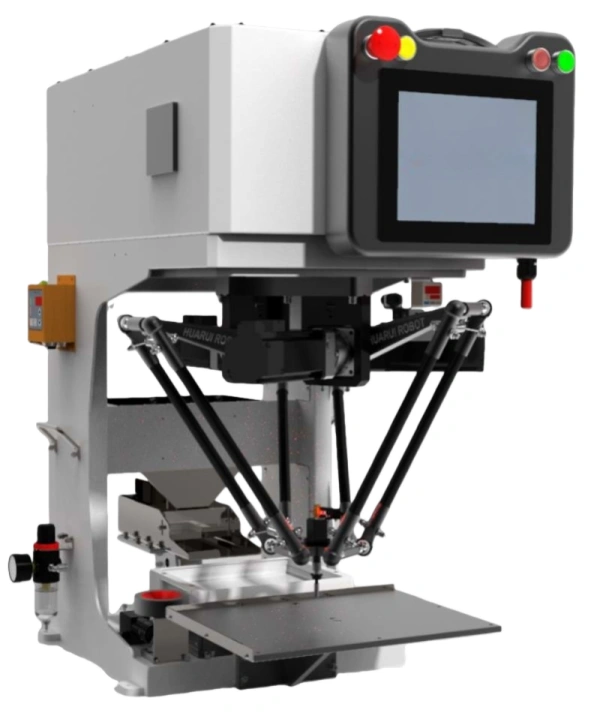
I. Components of a Parallel Robot
A parallel robot (also known as a delta robot or spider robot) consists of the following main components:
| Component Category | Specific Parts |
|---|---|
| Mechanical structure | Base frame (static platform), moving platform (end-effector platform), drive arms (active arms), forearm links (passive arms), spherical joints / ball joints, universal joints |
| Drive & actuation | Servo motors (one per arm), servo drives / amplifiers, precision reducers / gearboxes (low-backlash, e.g., harmonic or planetary) |
| End-effector / tooling | Tool mounting flange, suction cups / vacuum grippers, pneumatic or electric grippers, vacuum generator (venturi), custom fingers / jaws |
| Control & sensing | Motion controller (runs inverse kinematics), teach pendant / programming interface, encoders (position/velocity feedback), vision system (camera + processor) (optional), part presence sensors |
| Electrical & auxiliary | Electrical control cabinet (houses controller, drives, PLC, power supplies), cable & hose management (cable carriers, connectors), safety equipment (light curtains, E-stops, fencing) |
II. How Often Should Components Be Replaced?
Replacement intervals depend on operating hours, load, environment, and maintenance quality. The following are typical guidelines for a parallel robot operating 2 shifts (16 hours/day) under normal conditions:
| Component | Typical Replacement Interval | ملحوظات |
|---|---|---|
| Spherical joints (ball joints) | 8,000 – 12,000 hours (~1.5 – 2.5 years) | Most wear‑prone part; inspect every 3–6 months for play. |
| Forearm links (passive arms) | Only replace if damaged (crack, bend) | Carbon fiber arms are durable unless impacted. |
| Synchronous belts (if used) | 10,000 – 15,000 hours (~2 – 3 years) | Inspect for cracks, wear, or loosening. |
| Servo motors | 30,000 – 50,000 hours (~5 – 8 years) | Replace bearings if noisy; motors often last the robot’s life. |
| Gearboxes / reducers | 15,000 – 25,000 hours (~3 – 5 years) | Backlash increases over time; replace when positioning accuracy degrades. |
| Vacuum cups / suction pads | 3 – 12 months | Depends on part abrasiveness and oil exposure; inspect weekly. |
| Gripper jaws / fingers | 6 – 24 months | Wear from friction with parts; replace when grip becomes unreliable. |
| Encoders | Rarely replaced (often with motor) | Failure is uncommon; replace only if faulty. |
| Cables (motor power, encoder, air tubing) | 15,000 – 25,000 hours (~3 – 5 years) | Flexing cables in cable carrier wear over time; inspect for cracks. |
| Springs (if used in end-effector) | 500,000 – 1,000,000 cycles (~1 – 3 years) | Replace when spring force weakens or when part drops. |
| Main controller battery (for memory backup) | 1 – 3 years (or per manufacturer) | Replace before battery low alarm to avoid losing parameters. |
III. Factors That Shorten Replacement Intervals
| Factor | Effect |
|---|---|
| Heavy payload (near max capacity) | Accelerates wear on joints, motors, and gearboxes. |
| High acceleration / cycle rate | Increases stress on spherical joints and belts. |
| Dusty or abrasive environment | Wears joints and bearings faster. |
| Corrosive atmosphere (chemicals, moisture) | Reduces life of metal parts and bearings. |
| Poor lubrication (if applicable) | Increases friction and wear. |
| Insufficient maintenance (no cleaning/inspection) | Leads to unexpected failures. |
IV. Recommended Maintenance Schedule
| تكرار | Actions |
|---|---|
| Daily / per shift | Visual inspection; clean end‑effector; check for loose screws. |
| Weekly | Check spherical joints for play; inspect belts for tension; clean sensor lenses. |
| Monthly | Grease / lubricate moving joints (follow manufacturer spec); check cable carrier for wear. |
| Quarterly | Measure backlash in gearboxes; check motor temperature; verify positioning repeatability. |
| Yearly | Replace worn vacuum cups; replace battery in controller; perform full system calibration. |
V. Summary Table (Quick Reference)
| Component | Typical Life | When to Replace |
|---|---|---|
| Spherical joints | 8k–12k hours | Play, looseness, or noise |
| Synchronous belts | 10k–15k hours | Cracks, wear, slipping |
| Gearboxes | 15k–25k hours | Backlash > spec |
| Servo motors | 30k–50k hours | Bearing noise, encoder failure |
| Vacuum cups | 3–12 months | Hardened, cracked, or poor suction |
| Cables | 15k–25k hours | Cracked insulation, intermittent signals |
| Controller battery | 1–3 years | Low battery alarm |

 Arabic
  English
  Spanish (Mexico)
  Czech
Czech  Russian
  German
  French
  Turkish
  Italian
  Ukrainian
  Polish
  Romanian
  Bengali
  Portuguese (Portugal)
  Thai
Thai  Japanese
  Korean
  Hebrew
  Uzbek
Uzbek  Hindi
Hindi  Slovak
  Vietnamese
  Portuguese (Brazil)
  Spanish (Peru)
  Spanish (Spain)
  Spanish (Venezuela)