
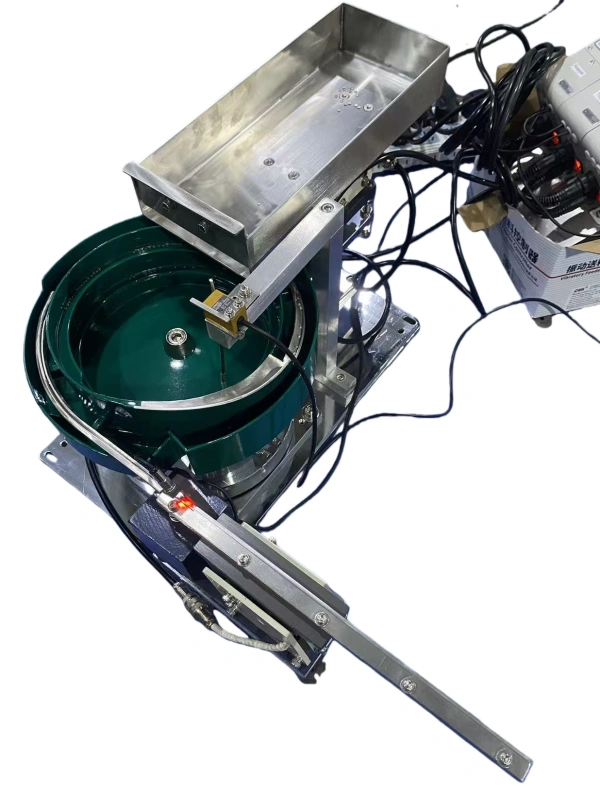
I. Rivet Types Suitable for Riveting Machines
Most blind and solid rivets can be used with automatic or semi‑automatic riveting machines, provided the rivet geometry is compatible with the feeder and riveting head. Below are the most common types:
1. Blind Rivets (Pop Rivets)
These are the most widely used with automatic riveting machines.
| Rivet Sub‑Type | Sự miêu tả | Machine Suitability |
|---|---|---|
| Standard open‑end blind rivets | Hollow body with a mandrel; available in aluminum, steel, stainless steel | Very good – easy to feed and orient |
| Closed‑end (sealed) blind rivets | Sealed body prevents leakage; used in waterproof/ air‑tight applications | Good – same geometry as standard |
| Multi‑grip blind rivets | A larger grip range covers multiple material thicknesses | Good – slightly larger head may require special tooling |
| Structural blind rivets (e.g., Huck, Monobolt) | High‑strength, locking‑stem rivets | Good – but require heavier‑duty riveting tools |
| Peel‑type blind rivets | Splits into legs for soft/ brittle materials (plastic, wood) | Moderate – requires careful feeding |
2. Solid Rivets
Less common in high‑speed automatic machines, but used in heavy‑duty or custom automated cells.
| Rivet Sub‑Type | Sự miêu tả | Machine Suitability |
|---|---|---|
| Solid round‑head rivets | Classic solid rivet; requires heating or high force for setting | Limited – usually manually or hydraulically set |
| Solid flat‑head / countersunk rivets | Used in aircraft and structural applications | Limited – special handling required |
3. Semi‑Tubular and Tubular Rivets
| Rivet Sub‑Type | Sự miêu tả | Machine Suitability |
|---|---|---|
| Semi‑tubular rivets | Hollow tip that rolls over during setting | Very good – widely used in automatic machines (e.g., for small hardware, hinges) |
| Full‑tubular rivets | Completely hollow body; used for light‑duty fastening | Good – smaller sizes feed well |
4. Self‑Piercing Rivets (SPR)
| Rivet Sub‑Type | Sự miêu tả | Machine Suitability |
|---|---|---|
| Self‑piercing rivets | Pierces and joins materials without pre‑drilled holes | Good – but requires a specialized SPR machine, not a standard rivet feeder |
5. Drive Rivets
| Rivet Sub‑Type | Sự miêu tả | Machine Suitability |
|---|---|---|
| Drive rivets | Hammer‑driven; used for light‑duty applications | Not common – usually hand‑set |
II. Rivet Characteristics That Make Them Machine‑Friendly
| Characteristic | Why It Matters |
|---|---|
| Symmetrical geometry (round head, uniform body) | Easier to orient in a vibratory bowl |
| Head diameter ≥ 2 × shank diameter | Prevents jamming in tracks and tubes |
| Straight, smooth shank (no burrs, sharp edges) | Reduces wear on feeder tooling |
| Length‑to‑diameter ratio ≤ 8:1 | Prevents tipping and mis‑feeding |
| Non‑magnetic material (aluminum, stainless) | Less likely to cling to feeders (though magnetic rivets can still be fed) |
| Consistent dimensions (no significant variation) | Reliable orientation and feed rate |
III. Rivets NOT Recommended for Machine Feeding
| Rivet Type | Reason |
|---|---|
| Very large rivets (> 10 mm shank dia.) | Too heavy for standard bowl feeders; may require magazine or manual loading |
| Irregular / asymmetric heads | Impossible to orient consistently |
| Very short or very long rivets | Short → may tip; long → may jam in tubes |
| Fragile / coated rivets | Soft coatings (e.g., paint, polymer) may scratch or chip in the bowl |
| Rivets with loose washers / pre‑assembled seals | Separate components may separate during feeding |
IV. Summary Table: Rivet Types vs. Machine Suitability
| Rivet Type | Suitable for Standard Riveting Machine? | Suitable for High‑Speed Automatic Machine? |
|---|---|---|
| Blind rivet (open‑end) | ✅ Yes | ✅ Yes |
| Blind rivet (closed‑end / sealed) | ✅ Yes | ✅ Yes (with compatible tooling) |
| Multi‑grip blind rivet | ✅ Yes | ⚠️ Yes, but larger head may need special track |
| Structural blind rivet (Huck, Monobolt) | ✅ Yes (heavy‑duty machine) | ⚠️ Sometimes – requires more force and heavier feeder |
| Semi‑tubular rivet | ✅ Yes | ✅ Yes |
| Full‑tubular rivet | ✅ Yes (small sizes) | ⚠️ Limited – often used in small‑scale machines |
| Solid rivet | ❌ No (usually manual or hydraulic) | ❌ No |
| Self‑piercing rivet (SPR) | ❌ No (needs dedicated SPR machine) | ❌ No |
| Drive rivet | ❌ No (hand‑set) | ❌ No |

 Vietnamese
  English
  Spanish (Mexico)
  Czech
Czech  Arabic
  Russian
  German
  French
  Turkish
  Italian
  Ukrainian
  Polish
  Romanian
  Bengali
  Portuguese (Portugal)
  Thai
Thai  Japanese
  Korean
  Hebrew
  Uzbek
Uzbek  Hindi
Hindi  Slovak
  Portuguese (Brazil)
  Spanish (Peru)
  Spanish (Spain)
  Spanish (Venezuela)