
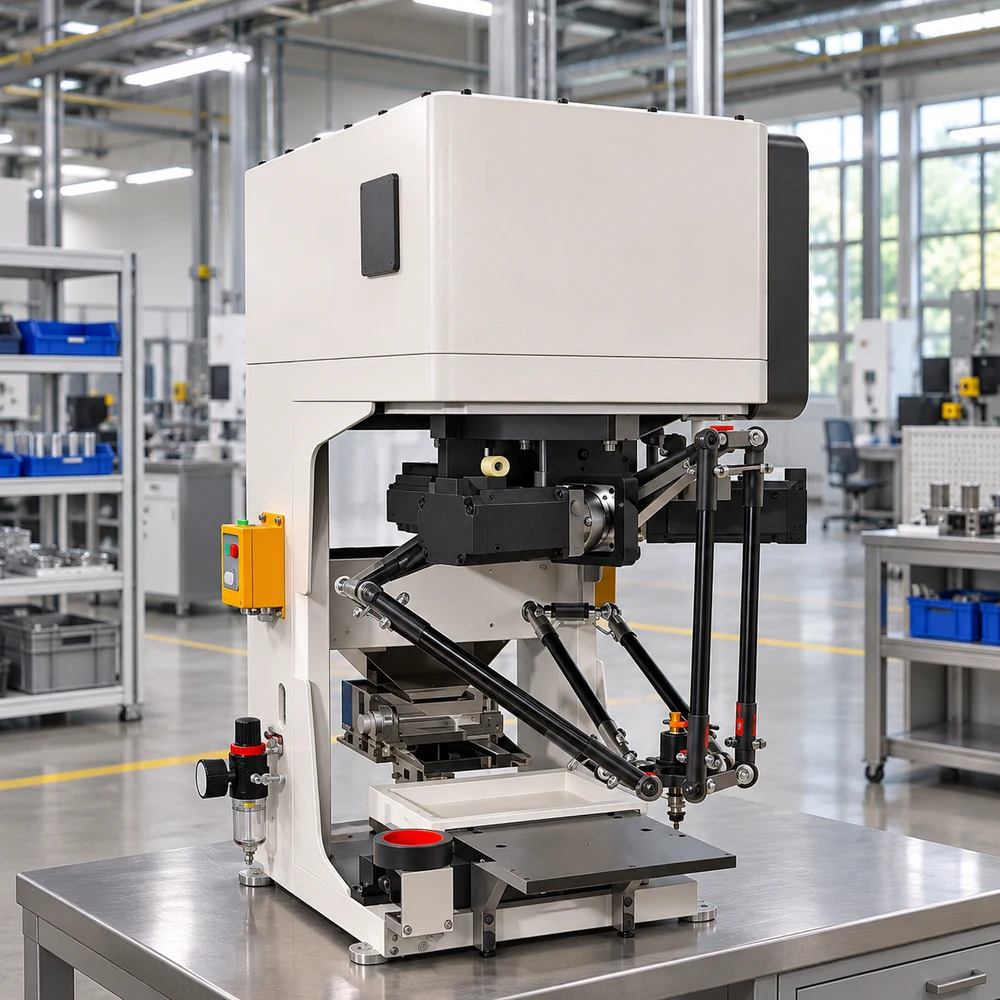
Published U.S. prices start around $5,500 for an entry-level delta robot. For a three-axis robot packaged with a controller, two public listings come in at about $20,000. If you need a machine that takes loose parts from a feeder and loads them into trays, you’ll also need a quote for the equipment and setup that make that job possible.
The first question to settle is what you already have. If your line delivers each part to the same pickup point, you may only need a robot, a gripper, and a way to connect them to your controls. If an operator currently separates, turns, and loads every part by hand, the workstation needs to do all three jobs. Here’s how to put a budget together for each case.
What Do Published Delta Robot Prices Include?
These U.S. dollar prices give you a starting point before you request a quote. Each row describes a specific listing, so check the model and included hardware before using a figure in your budget.
| Equipment | Published price | What the listing tells you |
|---|---|---|
| Entry-level delta robot | Starting at $5,483.74 | igus lists this as a starting price. Confirm the controller, cables, and accessories for your configuration. |
| Two-axis delta robot with controller | $14,594.32 | DigiKey lists the large two-axis package at this price. Check whether its movement fits your pickup and drop-off points. |
| Three-axis delta robot with controller | $19,931.84–$20,493.04 | DigiKey lists two three-axis packages at these prices. The amount depends on the model. |
| SWOER desktop pick-and-place workstation | Request a quote | The SW-HRD3T-SD-M product page lists a vibrating plate, cameras, and touch controls. SWOER quotes the equipment on request. |
What Goes Into a Delta Robot Workstation Price?
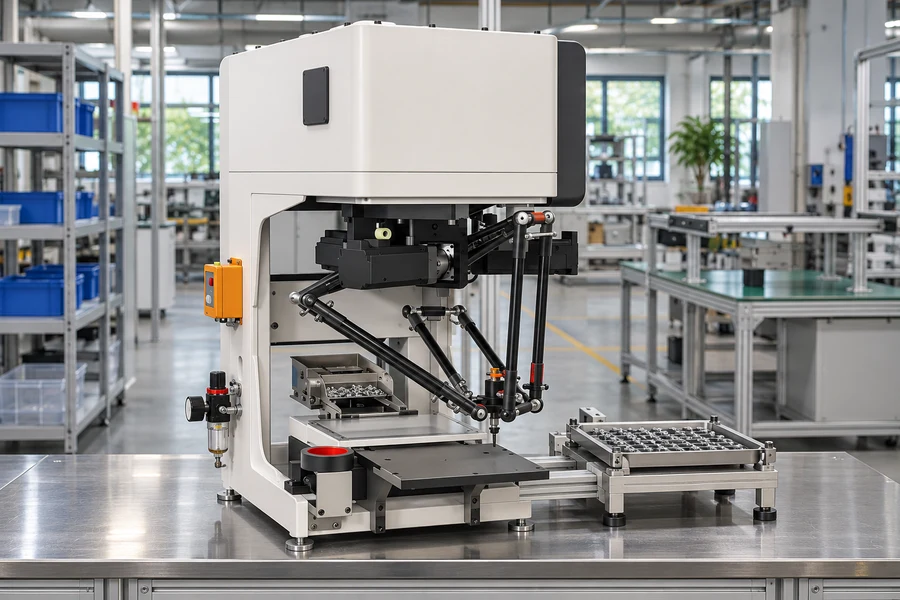
Picture a machine loading small connectors into a tray. The feeder separates the connectors. The camera finds one facing the right way. The gripper picks it up, and a fixture holds the tray steady while the robot places it. When a supplier quotes the workstation, find out who is supplying each of those pieces.
| Quote item | What to check |
|---|---|
| Robot and controls | Which model, controller, cables, and software are included? |
| Gripper or suction tool | Does the price cover a tool tested with your part? What does a second tool cost? |
| Parts feeder | Can it separate your parts and keep up when the supply runs low? |
| Camera and lighting | Can the system find the pickup point and tell which side of the part faces up? |
| Frame, guarding, and tray fixtures | Which pieces arrive assembled? Who supplies the fixtures for other tray sizes? |
| Programming and startup | Who connects the machine to your line, tests it with your parts, and trains the operator? |
For example, SWOER’s desktop delta robot for small parts lists a 220 × 200 mm working area and a vibrating plate. If your trays are wider than that working area, send a tray drawing early. The supplier can check how the machine will reach every pocket before pricing the job.
When Is a High-Speed Delta Robot Worth the Extra Cost?
Start with the number of finished parts your line needs. If you ship 2,400 correctly loaded parts per hour, the station must average 40 good placements per minute over that hour. Time spent replacing trays, clearing stuck parts, or waiting for the feeder uses up part of those 60 minutes.
SWOER lists a peak speed of 6,000 picks per hour for the SW-HRD3T-SD-M. That works out to 100 picks per minute at peak. To find out what that means for your line, give the supplier your part, tray layout, and target output. Request a timed run that includes tray changes, and count how many pockets contain a correctly seated part at the end.
That test can also show you where to spend the money. If the robot routinely waits for the next connector to reach the pickup point, ask for a price on a feeder change before paying for a faster robot.
How Much Precision Does Your Part Need?
Dropping a washer into a bin gives the robot plenty of room. Placing a connector into a close-fitting pocket takes more care. A connector can reach the right spot and still catch on the edge if it turns slightly in the gripper.
When comparing high-precision delta robot prices, send the supplier a drawing of both the part and the pocket. Mark the surfaces that must line up, how far the part must seat, and whether it can rotate during the move. Those details help the supplier price the gripper, camera setup, and tray fixture.
SWOER lists ±0.05 mm loading and placement repeatability for its SW-HRD3T-SD-M. Repeatability describes how consistently a move can be repeated. For a close fit, have the supplier run your parts in your tray and record how many seat correctly across the whole tray, including the corner pockets.
How Do You Know Whether the Workstation Will Pay for Itself?
Use the installed price for the calculation. Include freight, tooling, setup, and any work your own team must do before the first production run. Then estimate the annual savings after maintenance, replacement parts, and other running costs.
Simple payback in years = total installed cost ÷ annual net savings
Suppose a workstation costs $40,000 installed and reduces overtime and scrap by $24,000 per year. If it costs another $4,000 per year to run and maintain, the annual net savings would be $20,000. Simple payback would be two years. These figures are an example you can replace with your own costs.
One detail matters here. If the operator will still spend two hours per shift filling the feeder and changing trays, include that time in the new process. It’s easy to overstate the savings by counting a full shift of labor.
What Should You Send to Get an Accurate Quote?
You can get a more useful first quote by sending the same information to every supplier. A short phone video showing how the operator handles the part is a good place to start.
- Part details. Include a photo or drawing, dimensions, weight, material, and any surface the gripper must avoid.
- How parts arrive. Show whether they come loose in a bin, lined up on a track, or moving on a belt. Mention if they nest, overlap, or stick together.
- Where parts go. Send the tray drawing or a photo of the next machine. Mark which side of the part must face up.
- Required output. Give the number of good parts per hour, the shift length, and how often you change products or trays.
- Equipment already on site. List the feeder, conveyor, controls, and fixtures you plan to reuse. Include the available space and plant voltage.
- Delivery and startup. Give the installation location and specify who will unload, connect, and test the machine.
If you’re comparing delta pick-and-place robots from SWOER, start with the part photo, a video of the current process, and your hourly target. Request separate prices for the robot, feeding equipment, tooling, and startup. That makes it easier to see what you can reuse and what you still need to buy.
FAQS
Yes. Public listings give you reference prices for specific robots and controller packages. For example, DigiKey lists model numbers alongside its prices, so you can check exactly which package you’re comparing. For a custom workstation, get a written quote that names the feeder, tooling, programming, and installation work.
Possibly. Send a video of the feeder running at your target rate, along with its discharge height and the space around the pickup point. Have the supplier check whether the gripper can reach the part, whether the part stays still long enough to pick, and how the two machines will exchange ready signals.
Look for the first point where the two suppliers’ responsibilities differ. One quote might end with the robot wired and ready to program. Another might include a tested machine loading your parts into your trays. Request a delivered and installed total from each supplier, using the same parts-per-hour target and the same test for a successful placement.

 Vietnamese
 English
 Spanish (Mexico)
 Czech
 Arabic
 Russian
 German
 French
 Turkish
 Italian
 Ukrainian
 Polish
 Romanian
 Bengali
 Portuguese (Portugal)
 Thai
 Japanese
 Korean
 Hebrew
 Uzbek
 Hindi
 Slovak
 Portuguese (Brazil)
 Spanish (Peru)
 Spanish (Spain)
 Spanish (Venezuela)