
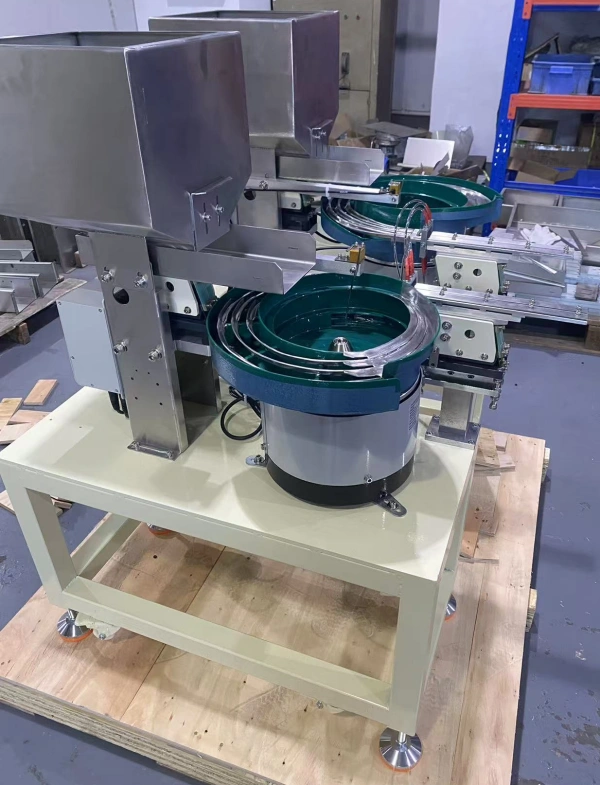
While vibrating screens are essential equipment for particle size separation, they face several challenges in practical applications. The main pain points are as follows: I. Technical & Performance Pain Points Screen Mesh Blinding / Clogging Description: Fine particles become lodged in the screen openings, reducing open area and screening efficiency. Impact: Decreased throughput, frequent cleaning […]
Lưu trữ danh mục: Customized Machine
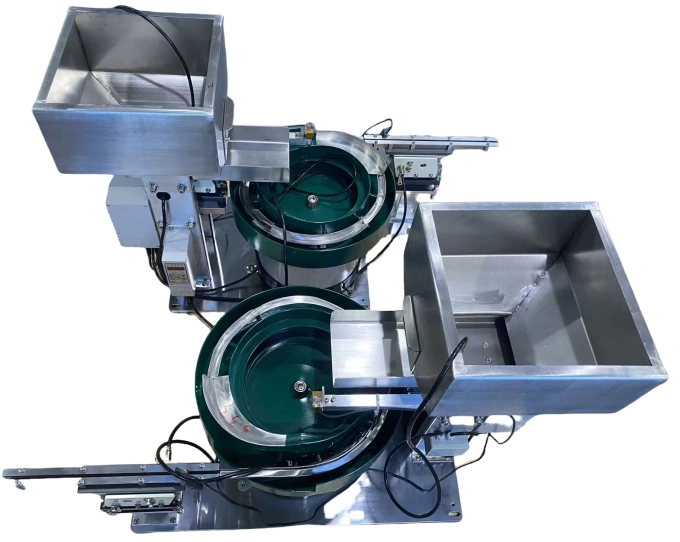
A vibrating screen is a piece of screening equipment that uses vibration to separate materials by particle size. Its main functions are as follows: I. Particle Size Classification Function: Separates materials into different particle size ranges based on mesh aperture. Application: Classifies raw materials into multiple grades (e.g., coarse, medium, fine) for downstream processes. II. […]
An optical inspection machine is a sophisticated system integrating optics, mechanics, electronics, and software. Its main components can be categorized as follows: I. Imaging & Optics Module Industrial Camera: The core sensor (typically area scan or line scan CCD/CMOS). Industrial Lens: Determines field of view, working distance, and magnification. Lighting System: Critical for highlighting features. […]
A thread coating machine is an integrated system designed for precision application of adhesives or sealants to threaded fasteners. Its main components can be categorized as follows: I. Adhesive Delivery & Dispensing System Adhesive Reservoir / Pressure Tank: Stores and supplies the coating material (e.g., anaerobic adhesives, thread sealants, PTFE pastes). Dispensing Valve: Controls the […]
A thread coating machine is specialized equipment designed to automatically apply adhesives or sealants to threaded fasteners. Its core function is to enhance the reliability of threaded connections by replacing manual application with precision automation. The main functions can be summarized as follows: I. Core Functions: Locking and Sealing Preventing Loosening Description: Precisely applies anaerobic adhesives or […]
I. Technical Challenges Stringent Environmental Demands Sensitive Lighting: Ambient light changes, reflections, and shadows interfere with results, requiring strict lighting control. Vulnerability to Vibration: Mechanical vibrations cause image blur, necessitating costly isolation measures. Inherent Detection Limitations Blind Spots & Dead Angles: Internal structures, deep recesses, and back sides are often impossible to image. Material & […]
An optical inspection machine is a sophisticated system comprising the following key components, categorized by function: I. Imaging & Optics Module Industrial Camera: The core sensor (typically area scan or line scan CCD/CMOS). Industrial Lens: Determines field of view, working distance, and magnification. Lighting System: Critical for highlighting features. Light Source: LED, halogen, or fluorescent […]
A spider robot (high-speed parallel robot) is a highly integrated system consisting of the following key components and modules: I. Mechanical Structure Components Base Platform (Static Platform): The fixed mounting frame, typically ceiling or gantry-mounted. Moving Platform (End-Effector Platform): The lightweight platform that moves in space and carries the tooling. Drive Arms (Active Arms): Usually […]
Packaging machines encompass a wide range, but their core functions typically include: 1. Metering and Filling Function: Precisely measures product quantity/weight and fills it into containers. Application: Counting pills, weighing food, volumetric filling of liquids into bags, bottles, cans. 2. Forming and Sealing Function: Forming: Shapes flat material (film, cardboard) into containers (bags, boxes). Sealing: Reliably seals packages via heat […]
I. Bucket Elevator Loading: Buckets at the bottom scoop or receive material from an inlet. Lifting: Buckets attached to a belt or chain are carried vertically upward. Discharging: At the top, buckets tip over, dumping material into the feeder hopper. Returning: Empty buckets return down to the bottom for the next cycle. Characteristics: High capacity, […]
- 1
- 2
 Vietnamese
  English
  Spanish (Mexico)
  Czech
Czech  Arabic
  Russian
  German
  French
  Turkish
  Italian
  Ukrainian
  Polish
  Romanian
  Bengali
  Portuguese (Portugal)
  Thai
Thai  Japanese
  Korean
  Hebrew
  Uzbek
Uzbek  Hindi
Hindi  Slovak
  Portuguese (Brazil)
  Spanish (Peru)
  Spanish (Spain)
  Spanish (Venezuela)