
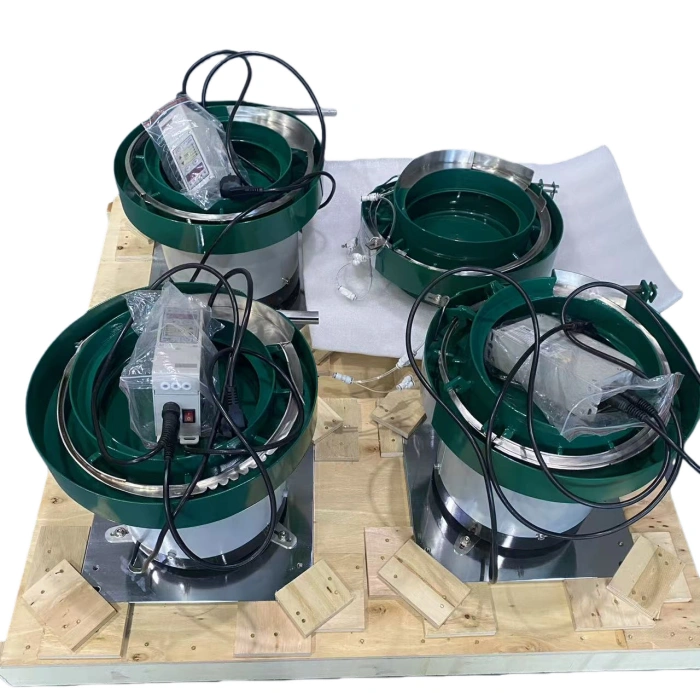
Neither is universally “better” — the choice depends on your part characteristics, transfer distance, speed, orientation requirements, and budget.
Linear vibrator is better for short-distance, high-speed, precise orientation retention.
Conveyor belt is better for long-distance transfer, heavier parts, or when orientation is not critical.
II. Detailed Comparison
| Özellik | Vibratory Bowl + Linear Vibrator | Vibratory Bowl + Conveyor Belt |
|---|---|---|
| Çalışma prensibi | Electromagnetic vibration moves parts along a straight metal track | Motor-driven belt carries parts forward |
| Orientation retention | ✅ Excellent — parts stay oriented | ❌ Poor — parts may shift, roll, or slide |
| Typical transfer distance | 200–1500 mm (short) | 1–10+ meters (long) |
| Hız | Very high — can match bowl output (up to 300+ parts/min) | Moderate — limited by belt speed and part stability |
| Suitable part types | Small, dry, rigid parts (screws, electronic components, pills) | Larger, heavier, or irregular parts (castings, fruits, bulky items) |
| Part damage risk | Moderate — parts may collide | Low — parts rest on belt |
| Noise level | Moderate (vibration noise) | Low (motor hum only) |
| Maintenance | Low — springs and coils wear slowly | Higher — belt wear, tracking, cleaning |
| Maliyet | Lower | Moderate |
| Entegrasyon | Simple — shares controller with bowl | Requires separate motor and controller |
| Footprint | Compact (short track) | Longer (belt length) |
III. When to Choose Linear Vibrator (直振)
| Condition | Reason |
|---|---|
| Parts must stay oriented (e.g., for robot pick-up or assembly) | Linear vibrator maintains orientation from bowl to pick-up point |
| High speed is required (> 150 parts/min) | Linear vibrator can match bowl output without slowing down |
| Short transfer distance (< 2 meters) | Linear vibrator is ideal for short, straight runs |
| Parts are small, dry, and rigid (screws, pills, electronic components) | These parts feed well on a vibratory track |
| Low maintenance is desired | Linear vibrator has no belts to wear out |
| Simple integration | Linear vibrator can share the bowl’s controller |
IV. When to Choose Conveyor Belt
| Condition | Reason |
|---|---|
| Long transfer distance (> 2 meters) | Conveyor can span long distances; linear vibrator cannot |
| Parts are large, heavy, or bulky | Conveyor can handle heavier loads; vibration may not move them effectively |
| Orientation is not critical | Parts can be re-oriented downstream (e.g., by vision or manual) |
| Parts are fragile or easily scratched | Conveyor provides gentler handling than vibration |
| Transfer between different levels (incline or decline) | Conveyor can incline; linear vibrator is typically horizontal |
| Noise-sensitive environment | Conveyor is quieter than a vibratory track |
V. Comparison Summary Table
| Aspect | Linear Vibrator (直振) | Conveyor Belt |
|---|---|---|
| Orientation retention | ✅ Excellent | ❌ Poor |
| Hız | ✅ Very high | ⚠️ Moderate |
| Transfer distance | ⚠️ Short (< 2 m) | ✅ Long (2–10+ m) |
| Maliyet | ✅ Lower | ⚠️ Moderate |
| Maintenance | ✅ Low | ❌ Higher |
| Noise | ⚠️ Moderate | ✅ Low |
| Part damage risk | ⚠️ Moderate | ✅ Low |
| Suitable parts | Small, dry, rigid | Large, heavy, any material |
| Entegrasyon | ✅ Simple (share controller) | ⚠️ Needs separate drive |
VI. Combined Use (Hybrid Solution)
In some systems, both are used together:
Bowl → Linear vibrator (orientation retention) → Conveyor belt (long-distance transfer)
This gives you the precision of the linear vibrator and the reach of the conveyor belt.
VII. Final Recommendation
| Your Need | Recommendation |
|---|---|
| Orient parts precisely and feed directly to a robot or assembly machine | ✅ Linear vibrator |
| Transfer parts a long distance or drop into a bin | ✅ Conveyor belt |
| Mixed — orient first, then move far | ✅ Linear vibrator + conveyor belt in series |
| Parts are small, dry, and need high speed | ✅ Linear vibrator |
| Parts are heavy, fragile, or orientation is not critical | ✅ Conveyor belt |

 Turkish
  English
  Spanish (Mexico)
  Czech
Czech  Arabic
  Russian
  German
  French
  Italian
  Ukrainian
  Polish
  Romanian
  Bengali
  Portuguese (Portugal)
  Thai
Thai  Japanese
  Korean
  Hebrew
  Uzbek
Uzbek  Hindi
Hindi  Slovak
  Vietnamese
  Portuguese (Brazil)
  Spanish (Peru)
  Spanish (Spain)
  Spanish (Venezuela)