
I. Quick Answer
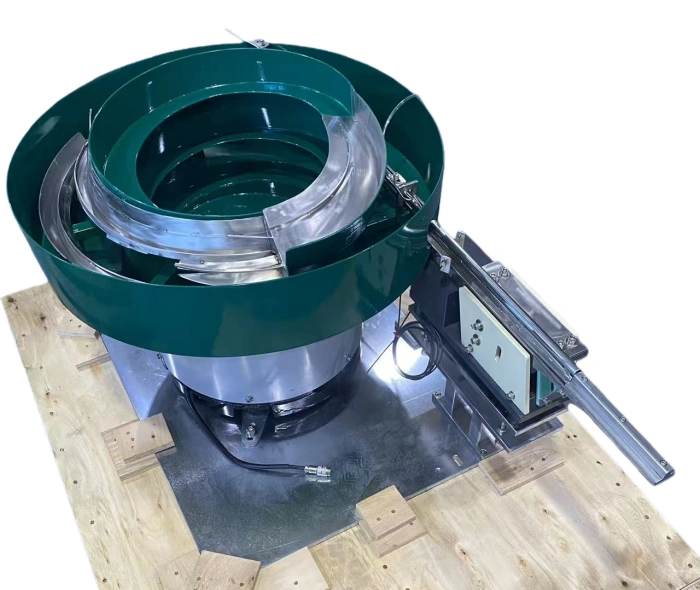
Generally, no. A vibratory bowl feeder typically cannot match the maximum speed of a centrifugal feeder, especially for small, symmetrical parts. However, in some specific applications with optimized design and suitable parts, a vibratory bowl can approach the speed of a lower-capacity centrifugal feeder.
II. Speed Comparison
| Parametre | Titreşimli Kase Besleyici | Santrifüj Besleyici |
|---|---|---|
| Typical Speed Range | 50–300 parts/min | 300–1000+ parts/min |
| Maximum Speed | Up to 500–700 parts/min (small, simple parts) | Up to 1500–2000 parts/min (small, symmetrical parts) |
| Motion Type | Reciprocating vibration (parts move in small jumps) | Continuous rotary motion (parts flow smoothly) |
| Speed Limitation | Limited by track geometry, part size, and vibration physics | Limited by disc speed and part separation mechanism |
| Speed Consistency | Good after tuning | Very stable and continuous |
III. Why a Vibratory Bowl Is Generally Slower
| Factor | Explanation |
|---|---|
| Vibration physics | Parts move in small, intermittent jumps rather than continuous flow |
| Track length | Parts must travel up a spiral track, which limits throughput |
| Orientation tooling | Complex tooling (wipers, slots) slows parts down for correct orientation |
| Part separation | Singulation is achieved by mechanical interference, which is slower than centrifugal separation |
| Jamming risk | Higher speeds increase jam risk; speed must be reduced for reliability |
IV. When a Vibratory Bowl Can Approach Centrifugal Speed
| Condition | Explanation |
|---|---|
| Very small, simple parts (e.g., 2–5 mm washers, small caps) | Lower mass allows faster vibration and higher throughput |
| Simple orientation requirements (e.g., only head-up/head-down) | Less tooling interference means faster flow |
| Optimized track design | Wide, smooth tracks with minimal obstructions |
| High-performance drive | Larger electromagnet and stiffer springs |
| Multi-track bowl | Multiple tracks can multiply output (but each track still runs at similar speed) |
| Low part weight | Lighter parts respond faster to vibration |
Even under these conditions, a vibratory bowl typically maxes out at 500–700 parts/min, while a centrifugal feeder can exceed 1000–2000 parts/min.
V. When to Choose Which
| Requirement | Recommended Feeder |
|---|---|
| Maximum speed (> 500 parts/min) | Centrifugal feeder |
| Moderate speed (100–300 parts/min) with precise orientation | Vibratory bowl feeder |
| Small, symmetrical parts with simple orientation | Either; centrifugal is faster |
| Complex orientation (polarity, specific angle) | Vibratory bowl feeder |
| Gentle handling of delicate parts | Centrifugal feeder (lower impact) |
| Low noise environment | Centrifugal feeder (quieter) |
| Lower initial cost | Vibratory bowl feeder |
| High-mix, low-volume production | Flexible feeder (not a bowl or centrifugal) |
VI. Summary Table
| Aspect | Titreşimli Kase Besleyici | Santrifüj Besleyici |
|---|---|---|
| Typical Speed | 50–300 parts/min | 300–1000+ parts/min |
| Maximum Speed | 500–700 parts/min | 1500–2000 parts/min |
| Can Match Centrifugal Speed? | ❌ Generally no | — |
| Orientation Precision | High | Moderate |
| Maliyet | Lower | Higher |
| Noise | Higher | Lower |
| Part Damage Risk | Moderate | Low |

 Turkish
  English
  Spanish (Mexico)
  Czech
Czech  Arabic
  Russian
  German
  French
  Italian
  Ukrainian
  Polish
  Romanian
  Bengali
  Portuguese (Portugal)
  Thai
Thai  Japanese
  Korean
  Hebrew
  Uzbek
Uzbek  Hindi
Hindi  Slovak
  Vietnamese
  Portuguese (Brazil)
  Spanish (Peru)
  Spanish (Spain)
  Spanish (Venezuela)