
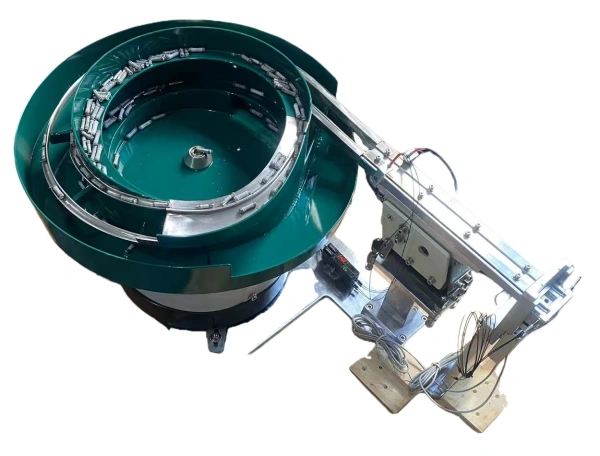
I. Quick Answer
Yes, but with some limitations. Magnetic products can be fed using a vibratory bowl feeder, but the magnetic properties of the parts create unique challenges that must be addressed during the design and tuning of the feeder.
II. Suitability Summary
| Magnetic Product Type | Suitable for Vibratory Bowl? | 重要な考慮事項 |
|---|---|---|
| Ferromagnetic metal parts (steel, iron, nickel) | ✅ Yes (with proper design) | Parts may stick together or to the track; need to overcome magnetic attraction. |
| Magnetically charged parts (permanent magnets, magnetized components) | ⚠️ Yes, but with significant design changes | Strong magnetic attraction causes parts to stick to each other and to the bowl/track; special measures required. |
| Very small magnetic parts (< 5 mm) | ⚠️ Yes, but may be difficult | Magnetic attraction increases relative to weight, making separation and orientation harder. |
| Heavy magnetic parts (> 200 g) | ⚠️ Yes, but requires high‑power drive | Heavy weight + magnetic attraction demands stronger vibration and more robust tooling. |
III. Challenges of Magnetic Parts
| Challenge | Effect on Operation |
|---|---|
| Parts sticking to each other | Clumping causes jams and misfeeds; parts may not separate properly. |
| Parts sticking to the track or bowl | Magnetic adhesion prevents parts from sliding smoothly, reducing feed rate and orientation accuracy. |
| Parts adhering to tooling | Magnetic attraction to wiper blades, steps, or other tooling causes parts to hang up and block the flow. |
| Sensor interference | Magnetic fields can affect proximity sensors (especially inductive sensors), causing false triggers or missed detections. |
| Increased wear on tooling | Strong magnetic attraction may cause parts to impact the track harder, accelerating wear. |
| Difficulty with singulation | Magnetic parts tend to group together; separating them into single‑file flow is more challenging. |
IV. Solutions for Feeding Magnetic Parts
| Problem | Recommended Solution |
|---|---|
| Parts sticking to each other | Use a demagnetizer (degausser) before the parts enter the bowl to reduce residual magnetism. |
| Parts sticking to the track | Use a non‑magnetic track material (e.g., stainless steel 316L, aluminum, or plastic) to reduce adhesion. |
| Parts sticking to the track | Apply a low‑friction coating (e.g., PTFE / Teflon) to the track surface. |
| Parts clumping in the bowl | Increase vibration amplitude to overcome magnetic attraction and separate parts. |
| Parts hanging on tooling | Use non‑magnetic tooling materials (e.g., ceramic, plastic, or stainless steel 316L) for wiper blades and steps. |
| Sensor interference | Use non‑inductive sensors (e.g., photoelectric or fiber optic sensors) instead of inductive proximity switches. |
| General feeding instability | Use side‑pushing or air‑assisted tooling to help parts break free from magnetic adhesion. |
V. Practical Recommendations
| Factor | Recommendation |
|---|---|
| Part type | If parts are magnetized (permanent magnets), consider demagnetizing them before feeding. |
| Track material | Use 316L stainless steel or aluminum for the track (these are non‑magnetic and resist corrosion). |
| Coating | Apply a PTFE/Teflon coating to the track and tooling to reduce friction and sticking. |
| Sensors | Use photoelectric or fiber optic sensors instead of inductive sensors to avoid magnetic interference. |
| Amplitude | Set the vibration amplitude higher than normal to overcome magnetic attraction. |
| 頻度 | Adjust the vibration frequency to help shake parts loose from each other and from the track. |
| Tooling | Use non‑magnetic materials (ceramic, plastic, 316L stainless) for all tooling that contacts the parts. |
| Air assist | Install air blow‑off nozzles to help push parts along the track. |
VI. Comparison Table
| Factor | Standard Parts | Magnetic Parts (Slightly Magnetized) | Strongly Magnetized Parts |
|---|---|---|---|
| Suitability | Excellent | Good | Poor (needs significant design changes) |
| Track material | Carbon steel or SUS304 | SUS316L or aluminum | SUS316L + PTFE coating |
| Coating required? | Optional (for protection) | Recommended (to reduce sticking) | Mandatory (PTFE coating) |
| Vibration amplitude | 標準 | Higher | Much higher |
| Sensor type | Any | Photoelectric preferred | Photoelectric mandatory |
| Demagnetizing before feeding | Not needed | Recommended | Highly recommended |
VII. When to Consider Alternative Feeders
| Condition | Alternative Feeder Recommendation |
|---|---|
| Strongly magnetized parts | Consider a pusher feeder or flexible feeder (non‑vibratory, no track to stick to). |
| Parts cannot be demagnetized | Use a 遠心フィーダー (rotary motion, less friction‑dependent than vibratory bowls). |
| Parts are very small and light | Use a flexible feeder + vision for gentle handling. |
| Parts are very sticky due to magnetism + oil | Use a pusher feeder (mechanical pushing overcomes sticking). |

 Japanese
  English
  Spanish (Mexico)
  Czech
Czech  Arabic
  Russian
  German
  French
  Turkish
  Italian
  Ukrainian
  Polish
  Romanian
  Bengali
  Portuguese (Portugal)
  Thai
Thai  Korean
  Hebrew
  Uzbek
Uzbek  Hindi
Hindi  Slovak
  Vietnamese
  Portuguese (Brazil)
  Spanish (Peru)
  Spanish (Spain)
  Spanish (Venezuela)