
I. はじめに
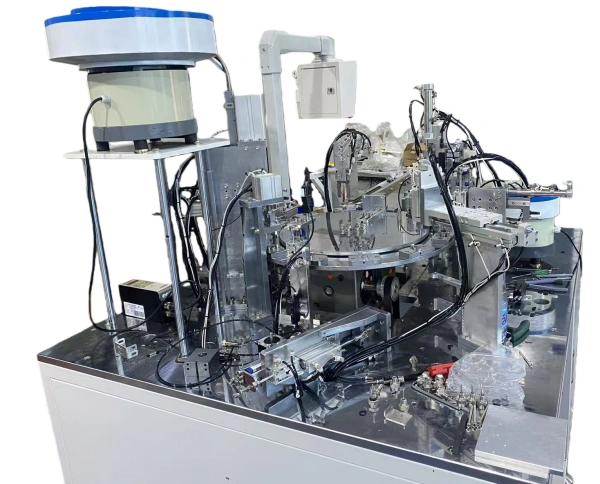
Assembly machines are complex systems that can face a variety of operational, maintenance, and quality‑related challenges. Below is a structured summary of the most frequent pain points and practical solutions.
II. Common Pain Points and Solutions
1. Frequent Jams or Misfeeds
| Aspect | Details |
|---|---|
| Pain Point | Parts get stuck in feeders, tracks, or tooling; misfeeds cause production stops and quality issues. |
| Root Causes | Part dimensional variation, worn tooling, improper feeder tuning, sticky or oily parts, foreign objects. |
| Solutions | – Use vibratory bowls with adjustable tooling or quick‑change tracks. – Install sensors (photoelectric, fiber optic) to detect jams early. – Regularly clean and inspect tracks and feeders. – Add air blow‑off or anti‑static devices to keep parts moving. – Use a flexible feeder instead of a rigid bowl for high‑mix parts. |
2. Inconsistent Assembly Quality
| Aspect | Details |
|---|---|
| Pain Point | Variations in torque, insertion depth, alignment, or final product dimensions. |
| Root Causes | Sensor drift, tooling wear, part tolerance stacking, improper machine calibration. |
| Solutions | – Calibrate torque sensors and vision systems monthly. – Use closed‑loop control (e.g., servo‑controlled press‑fit). – Inspect and replace worn tooling (grippers, bits, push rods) regularly. – Incorporate a reject station to remove out‑of‑spec parts automatically. |
3. Long Changeover Times
| Aspect | Details |
|---|---|
| Pain Point | Switching between different product types takes too long, reducing overall equipment effectiveness. |
| Root Causes | Mechanical tooling that requires manual adjustment, lack of standardized fixtures, complex programming changes. |
| Solutions | – Use quick‑change tooling and modular fixtures. – Implement a recipe‑based control system (PLC/HMI). – Standardize part interfaces where possible. – Use a flexible feeder and vision‑guided robot for mixed‑model assembly. |
4. High Maintenance Costs and Unplanned Downtime
| Aspect | Details |
|---|---|
| Pain Point | Frequent breakdowns, expensive spare parts, long repair times. |
| Root Causes | Inadequate preventive maintenance, poor lubrication, aging components, harsh environment. |
| Solutions | – Follow a scheduled maintenance plan (daily, weekly, monthly, yearly). – Keep critical spare parts in stock. – Use condition‑monitoring sensors (vibration, temperature, current). – Train operators on basic troubleshooting. |
5. Difficulty Diagnosing Problems
| Aspect | Details |
|---|---|
| Pain Point | Operators cannot quickly locate the root cause of a failure, leading to long downtime. |
| Root Causes | Lack of real‑time monitoring, unclear error messages, poor documentation. |
| Solutions | – Install a PLC‑based diagnostic system with clear alarm codes. – Use a HMI (touchscreen) to display real‑time status and error history. – Implement a camera or sensor system to monitor each station. – Provide a troubleshooting guide or flowcharts on the machine. |
6. Sensor Drift and False Readings
| Aspect | Details |
|---|---|
| Pain Point | Sensors (torque, force, vision) produce inconsistent data, causing false rejects or missed defects. |
| Root Causes | Temperature changes, dust accumulation, vibration, aging components. |
| Solutions | – Calibrate sensors at regular intervals (monthly or quarterly). – Use environmental enclosures to protect sensors from dust and temperature. – Implement auto‑calibration routines in the control software. |
7. Parts Feeding Inconsistency
| Aspect | Details |
|---|---|
| Pain Point | Feeders (vibratory bowls, centrifugal feeders) do not deliver parts consistently, causing the assembly machine to stop frequently. |
| Root Causes | Part variation (size, weight, surface), feeder wear, improper tuning, sticky or oily parts. |
| Solutions | – Use a flexible feeder + vision for variable parts. – Add sensors to detect part presence at each station. – Clean feeders regularly and replace worn tooling. – Adjust vibration parameters (amplitude, frequency) to match part characteristics. |
8. Integration Issues with Upstream/Downstream Equipment
| Aspect | Details |
|---|---|
| Pain Point | Incompatibility between the assembly machine and previous/next machines (conveyors, testers, packers). |
| Root Causes | Mismatched speed, mechanical interfaces, or communication protocols. |
| Solutions | – Use standard communication protocols (EtherNet/IP, Profinet, Modbus TCP). – Install buffer stations or accumulators to match speeds. – Design interfaces with adjustable height, width, and position. |
III. Summary Table
| Pain Point | Most Effective Solution |
|---|---|
| Jams / misfeeds | Adjustable tooling, sensors, cleaning, flexible feeder |
| Inconsistent quality | Closed‑loop control, regular calibration, tooling inspection |
| Long changeover times | Quick‑change fixtures, recipe‑based software, modular design |
| High maintenance costs | Preventive maintenance, spare parts stock, condition monitoring |
| Difficult diagnosis | PLC diagnostics, HMI error screens, troubleshooting guides |
| Sensor drift | Regular calibration, environmental protection, auto‑calibration |
| Feeding inconsistency | Flexible feeder, part presence sensors, feeder tuning |
| Integration issues | Standard communication, buffer stations, adjustable interfaces |

 Japanese
  English
  Spanish (Mexico)
  Czech
Czech  Arabic
  Russian
  German
  French
  Turkish
  Italian
  Ukrainian
  Polish
  Romanian
  Bengali
  Portuguese (Portugal)
  Thai
Thai  Korean
  Hebrew
  Uzbek
Uzbek  Hindi
Hindi  Slovak
  Vietnamese
  Portuguese (Brazil)
  Spanish (Peru)
  Spanish (Spain)
  Spanish (Venezuela)