
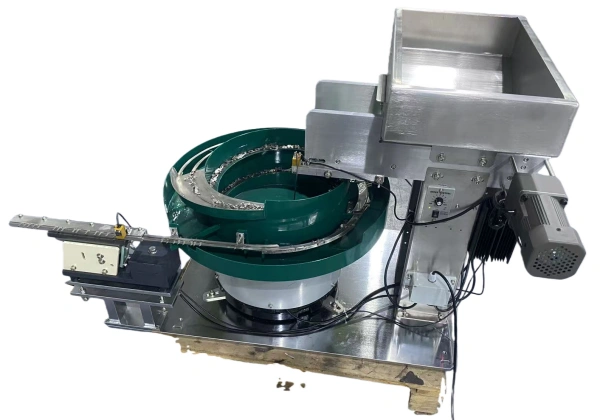
I. How to Maintain a 振動ボウルフィーダー
Proper maintenance includes cleaning, inspection, adjustment, and replacement of wear parts. Below is a clear, structured guide covering daily, weekly, monthly, quarterly, and yearly tasks.
II. Daily Maintenance (Every Shift)
| Task | Action |
|---|---|
| Clean the bowl and track | Remove dust, debris, and any stuck parts. Use a soft brush or compressed air. |
| Inspect for foreign objects | Check for broken parts, burrs, or contaminants that may cause jams. |
| Check bolts and screws | Tighten any loose mounting bolts or track fasteners. |
| Listen for abnormal noise | Unusual sounds may indicate loose springs, worn bearings, or foreign objects. |
| Check sensor alignment | Ensure sensors (fiber optic, photoelectric) are clean and correctly positioned. |
III. Weekly Maintenance
| Task | Action |
|---|---|
| Inspect leaf springs | Look for cracks, deformation, or signs of metal fatigue. |
| Check spring clamping bolts | Ensure they are tightened to the manufacturer’s specified torque. |
| Clean the controller | Use compressed air to remove dust from vents and cooling fans. |
| Inspect cables | Look for frayed insulation, loose connections, or worn wires. |
IV. Monthly Maintenance
| Task | Action |
|---|---|
| Check electromagnet air gap | The gap should typically be 0.2–0.5 mm (consult your manual). Adjust if necessary. |
| Inspect rubber mounts / isolators | Replace if cracked, hardened, or compressed. |
| Examine track coating | If the coating (Teflon, rubber, polyurethane) is worn, it may need recoating. |
| Measure feed rate | If parts/min has decreased, clean the track or re‑tune the controller. |
V. Quarterly / Every 3 Months
| Task | Action |
|---|---|
| Check spring tension | Replace springs if they have lost stiffness or show visible wear. |
| Inspect electrical connections | Tighten all terminal screws; check for corrosion or overheating. |
| Calibrate the controller | Adjust amplitude and frequency to maintain stable feeding. |
| Check the linear feeder (if used) | Align and clean the linear track to ensure smooth transfer. |
VI. Yearly / As Needed
| Task | Action |
|---|---|
| Replace leaf springs | Even if not visibly broken, springs can lose tension. Replace as a set every 3–5 years. |
| Replace rubber isolators | Replace hard or cracked isolators to maintain vibration isolation. |
| Recoat the track | If the coating is worn, have it professionally re‑applied. |
| Clean the electromagnet surface | Remove rust, dust, or debris from the electromagnet and armature faces. |
| Full system check | Test all sensors, controllers, and mechanical parts for proper function. |
VII. Summary Table: Maintenance Frequency
| 頻度 | Key Tasks |
|---|---|
| Daily | Clean bowl/track, check bolts, listen for noise, check sensors |
| Weekly | Inspect springs, clean controller, check cables |
| Monthly | Check electromagnet gap, inspect mounts/coating, measure feed rate |
| Quarterly | Spring tension, electrical tightening, controller calibration, clean linear feeder |
| Yearly | Replace springs/isolators, recoat track, clean magnet, full system check |
VIII. When to Replace Worn Parts (Quick Guide)
| Part | Typical Replacement Interval |
|---|---|
| Leaf springs | 3 – 5 years (or when cracked / losing tension) |
| Rubber mounts / isolators | 3 – 5 years (or when hardened / cracked) |
| Track coating (Teflon, rubber, polyurethane) | 1 – 3 years (depending on part abrasiveness) |
| Electromagnet coil | 5 – 10 years (if overheated or burned out, replace immediately) |
| コントローラ | 5 – 10 years (or when obsolete / failing) |
| Sensors (fiber optic, photoelectric) | Replace only when faulty |
IX. Common Warning Signs
| Symptom | Probable Cause | Action |
|---|---|---|
| Parts not moving | Broken spring, burned coil, no power | Inspect spring, check coil, verify power |
| Feed rate dropped | Worn coating, dirty track, low amplitude | Clean track, re‑tune controller, recoat track |
| Loud / unusual noise | Loose spring, worn bearing, foreign object | Tighten bolts, inspect springs, remove object |
| Jamming | Worn track, misaligned sensors, wrong frequency | Adjust track, align sensors, re‑tune controller |
| Controller overheating | Poor ventilation, voltage issue | Clean vents, check power supply |
X. Best Practices
| Rule | Reason |
|---|---|
| Always turn off power before cleaning | Prevents injury and damage to the controller |
| Use original manufacturer springs | Ensures correct stiffness and performance |
| Do not overtighten bolts | Can cause spring breakage or misalignment |
| Keep a maintenance log | Track replacement dates and performance trends |
| Train operators on daily checks | Early detection of issues prevents major breakdowns |

 Japanese
  English
  Spanish (Mexico)
  Czech
Czech  Arabic
  Russian
  German
  French
  Turkish
  Italian
  Ukrainian
  Polish
  Romanian
  Bengali
  Portuguese (Portugal)
  Thai
Thai  Korean
  Hebrew
  Uzbek
Uzbek  Hindi
Hindi  Slovak
  Vietnamese
  Portuguese (Brazil)
  Spanish (Peru)
  Spanish (Spain)
  Spanish (Venezuela)