
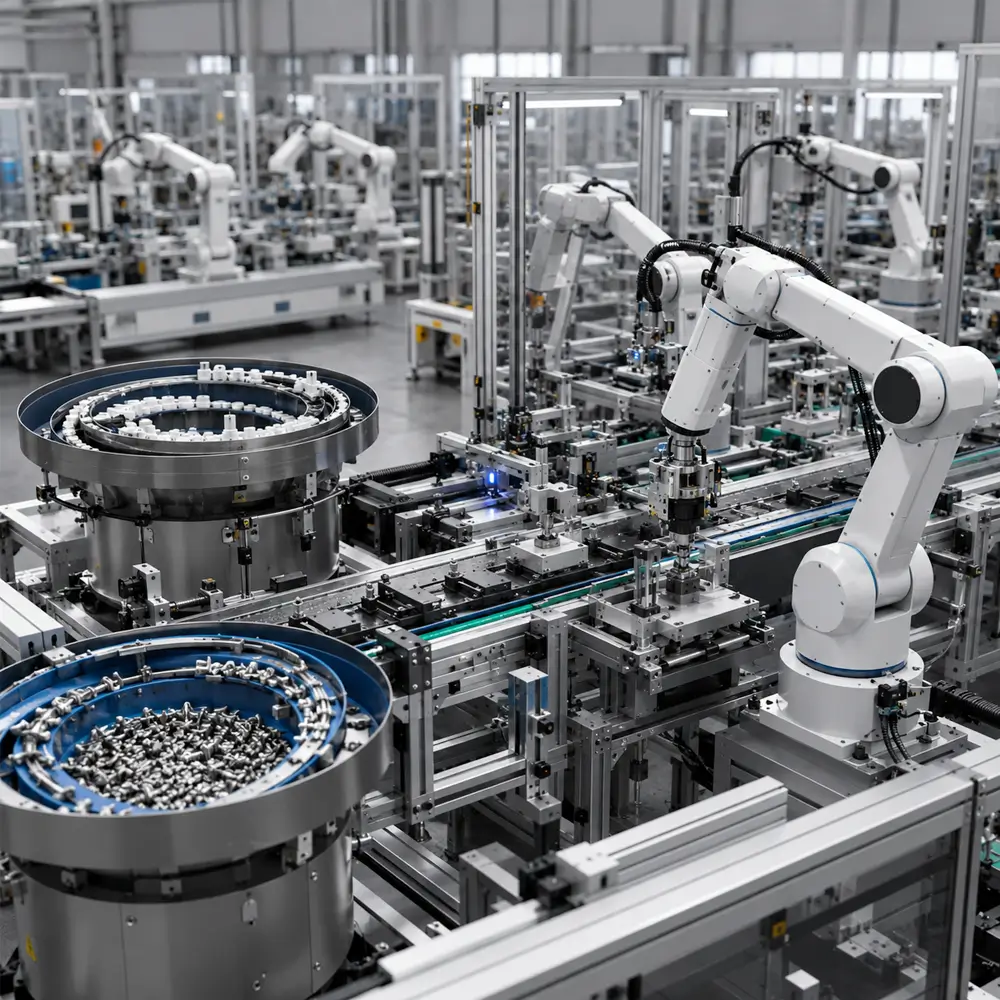
Automated assembly lines help manufacturers handle repetitive assembly tasks with less manual work. Good line design also helps control cycle time, product quality, and production costs.
However, every product requires a different automation setup. Part size, assembly steps, production volume, feeding method, and inspection requirements all affect the final system.
The following practices can help manufacturers plan an automated assembly line that fits their production needs.
Start With the Assembly Process
Start by breaking the product into individual assembly steps. List every operation from part feeding to final inspection.
Typical operations may include:
- Part feeding
- Part orientation
- Pick and place
- Screw fastening
- Press fitting
- Rivettatura
- Welding
- Gluing
- Inspection
- Labeling
- Confezione
Clear process mapping helps engineers identify which tasks need automation and which tasks still require manual work.
Tip: Define the complete assembly sequence before selecting machines or robots.
Set Production Targets Before Choosing Equipment
Production targets directly affect machine design. Define the required output per hour, cycle time, working hours, and expected production volume.
For example, manufacturers can use the following basic calculation:
Required cycle time = Available production time ÷ Required production quantity
| Production factor | Example target |
| Daily production | 8,000 pcs |
| Working time | 16 hours |
| Required hourly output | 500 pcs/hour |
| Target cycle time | 7.2 seconds/pc |
| Working days | 22 days/month |
These figures help engineers select suitable assembly machines, feeding systems, robots, and inspection equipment.
Choose the Right Part Feeding System
Part feeding plays an important role in automated assembly. The feeding system must deliver parts in the correct position and at the required speed.
Common feeding options include:
| Feeding system | Suitable parts | Typical use |
| Vibratory bowl feeder | Small rigid parts | Screws, caps, springs, plastic parts |
| Centrifugal feeder | Small and delicate parts | High-speed part feeding |
| Flex feeder | Mixed or fragile parts | Vision-guided picking |
| Step feeder | Larger or sensitive parts | Metal and plastic components |
| Conveyor system | Larger components | Transfer between stations |
GIURARE can combine feeding systems with robots, vision systems, and assembly machines to match different product requirements.
Plan Machine Layout and Material Flow
Good layout design keeps parts moving in one direction and reduces unnecessary transfers.
Consider these factors during layout planning:
- Machine footprint
- Operator access
- Part loading position
- Material flow
- Maintenance space
- Safety area
- Inspection position
- Finished-product collection
- Electrical and pneumatic connections
Place frequently serviced components where technicians can reach them easily. Keep feeding systems close to the assembly stations whenever possible.
A practical layout can reduce material handling time and make machine maintenance easier.
Add Inspection and Quality Control
Quality inspection should form part of the assembly process rather than remain completely separate.
Depending on the product, manufacturers can use:
- Vision inspection
- Presence detection
- Dimensional inspection
- Torque testing
- Pressure testing
- Leak testing
- Functional testing
- Barcode or QR code checking
Vision systems can check part position, assembly condition, missing components, and product appearance.
Combining assembly and inspection within one production line also helps identify problems earlier.
Design for Easy Maintenance
Machine maintenance affects long-term production performance. Engineers should consider maintenance access during the initial design stage.
Useful design practices include:
- Keep key components easy to reach.
- Provide clear access to feeders and conveyors.
- Use standard electrical components where practical.
- Add sensors at important inspection points.
- Provide clear machine status information.
- Keep spare parts for critical components.
Regular maintenance can help prevent unexpected downtime and keep production stable.
Allow Room for Future Production Changes
Production requirements can change after the assembly line starts running. New product versions, higher output targets, or additional inspection steps may require changes to the system.
Plan enough space for future equipment and consider modular machine designs where practical.
For example, manufacturers may later add:
- Additional feeding systems
- Vision inspection
- Robotic pick-and-place
- Screw fastening
- Labeling
- Confezione
- Additional assembly stations
Flexible planning can reduce the cost and difficulty of future upgrades.
Work With an Experienced Assembly Machine Manufacturer
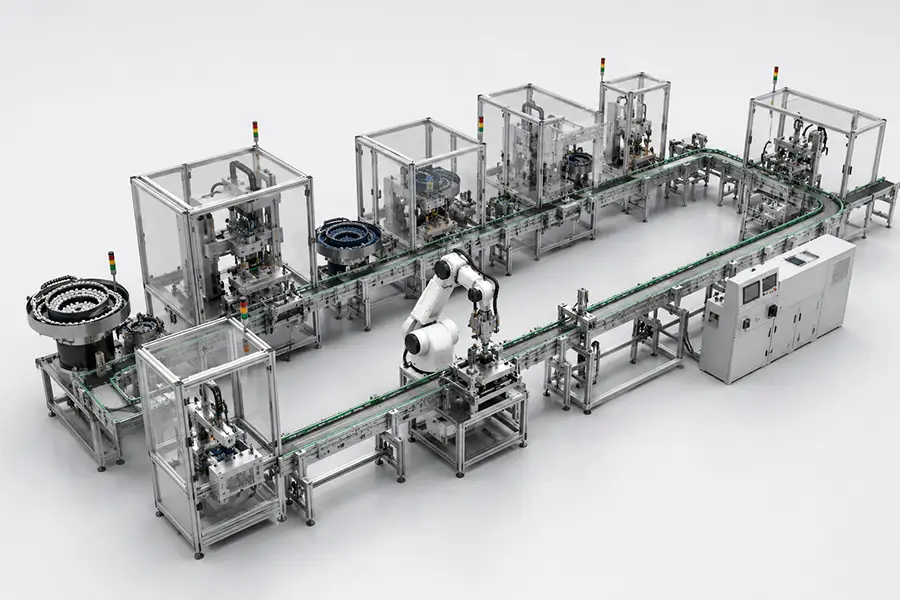
Automated assembly line design involves more than selecting individual machines. Feeding, assembly, inspection, robotics, controls, and material flow need to work together.
GIURARE provides customized assembly automation based on product drawings, assembly processes, production targets, and customer requirements.
The typical project process includes:
Product information → Process review → 3D machine design → Customer confirmation → Machine production → Testing → Delivery → Installation guidance
Manufacturers can provide product drawings, samples, production targets, and assembly requirements at the beginning of the project. Engineers can then develop a suitable automation solution around the actual production process.
Final Checklist for Automated Assembly Line Design
Before starting machine production, check the following items:
| Articolo | Key question |
| Prodotto | What parts does the product contain? |
| Assembly process | Which operations require automation? |
| Production target | How many pieces must the line produce per hour? |
| Feeding | Which feeding system suits each component? |
| Inspection | Which quality checks must the line perform? |
| Layout | Does the line provide enough working and maintenance space? |
| Safety | Does the design provide suitable safety measures? |
| Maintenance | Can technicians easily access key components? |
| Future upgrades | Can the line support higher output or new processes? |
| Supplier | Can the manufacturer provide complete automation support? |
Conclusione
Successful automated assembly line design starts with a clear understanding of the product and production process. Manufacturers should define output targets, select suitable feeding systems, plan material flow, add quality inspection, and leave room for future changes.
For customized projects, GIURARE can design assembly machines and complete automation systems around specific products, processes, and production targets.

 Italian
  English
  Spanish (Mexico)
  Czech
Czech  Arabic
  Russian
  German
  French
  Turkish
  Ukrainian
  Polish
  Romanian
  Bengali
  Portuguese (Portugal)
  Thai
Thai  Japanese
  Korean
  Hebrew
  Uzbek
Uzbek  Hindi
Hindi  Slovak
  Vietnamese
  Portuguese (Brazil)
  Spanish (Peru)
  Spanish (Spain)
  Spanish (Venezuela)