
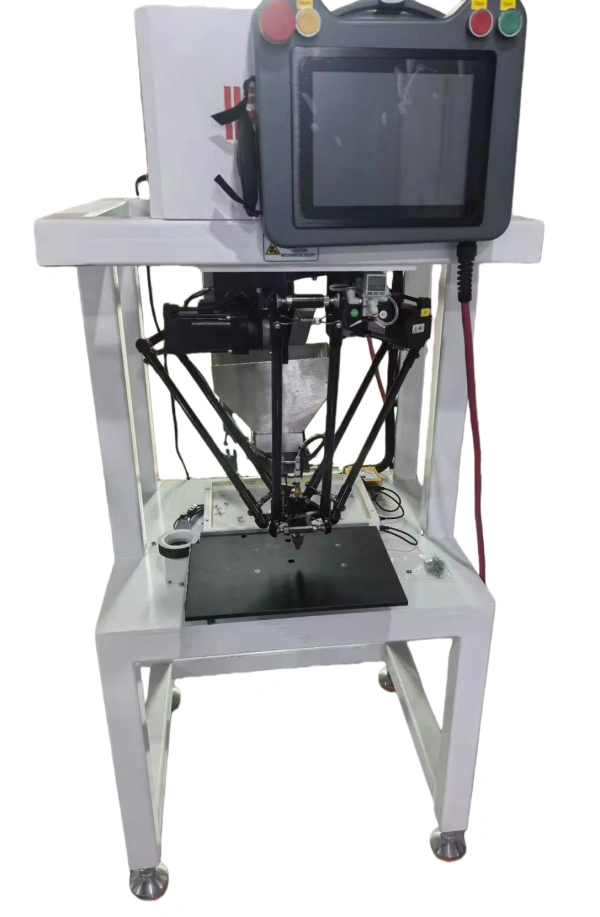
I. How Often Should a Parallel Robot Be Maintained?
Maintenance frequency depends on the robot’s duty cycle, working environment, and the manufacturer’s recommendations. Below is a typical schedule based on a 2‑shift (16‑hour) daily operation:
| תדירות | Recommended Actions |
|---|---|
| Daily / per shift | Visual inspection, clean end‑effector, check for loose screws, listen for abnormal noise. |
| Weekly | Check spherical joints for play, inspect belts for tension and wear, clean controller cooling fans. |
| Monthly | Check gearbox backlash, verify repeatability, lubricate joints (if applicable). |
| Quarterly (every 3 months) | Inspect cables for wear, tighten electrical connections, run a full system diagnostic. |
| Yearly | Replace worn spherical joints, replace controller backup battery, perform full system calibration. |
| Every 2–3 years | Replace synchronous belts, replace gearboxes if backlash exceeds spec. |
| Every 3–5 years | Replace servo motors (or their bearings) if noisy or losing torque. |
II. Under What Circumstances Is Maintenance Required?
Maintenance should be performed not only on a fixed schedule but also when certain conditions or warning signs appear:
A. Performance‑Related Signs
| Sign | What It Indicates | Action |
|---|---|---|
| Reduced positioning accuracy | Worn joints, belt stretch, gearbox backlash | Inspect and replace worn parts; re‑calibrate |
| Increased cycle time | Mechanical resistance, worn bearings, low motor torque | Check lubrication, motor health, and alignment |
| Parts frequently missed or dropped | Gripper wear, vacuum leak, or poor calibration | Replace vacuum cups; check gripper alignment; re‑calibrate |
B. Mechanical Warning Signs
| Sign | What It Indicates | Action |
|---|---|---|
| Unusual noise during operation | Worn spherical joint, loose belt, bad bearing | Inspect joints, belts, and bearings; replace as needed |
| Vibration or shaking during motion | Loose mounting, worn gearbox, unbalanced load | Tighten bolts; inspect gearbox; reduce unbalanced payload |
| Binding or sticking at certain positions | Damaged joint, foreign object, or lack of lubrication | Clean and lubricate joints; inspect for physical damage |
C. Electrical / Control Signs
| Sign | What It Indicates | Action |
|---|---|---|
| Motor overheating | Overload, poor cooling, or failing bearing | Reduce load, clean cooling fans, replace bearing |
| Intermittent signal loss | Damaged cable, loose connector | Replace flex cable; tighten connections |
| Controller alarm / error code | Various (e.g., overcurrent, encoder failure) | Refer to manual; run diagnostics; call support if needed |
D. Environmental Factors
| Condition | Why Maintenance Is Needed | Action |
|---|---|---|
| Dusty environment | Accelerated wear on joints and bearings | More frequent cleaning and inspection |
| High humidity or corrosive atmosphere | Corrosion of metal parts and electrical contacts | Apply anti‑corrosion coatings; inspect more often |
| High temperature (> 40°C) | Reduces motor and drive life | Improve cooling; check temperature ratings |
| Continuous 24/7 operation | Faster wear on all moving parts | Shorten maintenance intervals (e.g., monthly → weekly inspections) |
E. After Specific Events
| Event | Why Maintenance Is Needed | Action |
|---|---|---|
| Impact or collision (robot hit something) | Possible structural damage or misalignment | Inspect arms, joints, and belts; re‑calibrate |
| Power surge or outage | Controller settings may be lost; electronics may be damaged | Check parameters; replace backup battery; run diagnostics |
| Heavy overload (picked up a part > rated capacity) | Motor strain; possible gearbox damage | Inspect gearbox; check motor current; reduce load |
| Lubricant leakage | Joints may run dry; risk of seizure | Clean and re‑lubricate; check seals |
| After 10,000 operating hours | Significant wear on moving parts | Perform a complete mechanical inspection and replace worn parts |
III. Maintenance Intervals Based on Operating Hours
| Operating Hours (Approx.) | Typical Time (2 shifts, 16h/day) | Recommended Action |
|---|---|---|
| 1,000 hours | ~2 months | First scheduled check; replace if needed |
| 5,000 hours | ~10 months | Lubricate joints; check belts |
| 10,000 hours | ~1.5 years | Replace spherical joints; check gearboxes |
| 15,000 hours | ~2.5 years | Replace belts; check cables |
| 20,000 hours | ~3.5 years | Replace gearboxes if backlash exceeds spec |
| 30,000–50,000 hours | ~5–8 years | Replace servo motors or bearings (as needed) |
IV. Maintenance Summary Table
| תדירות | Key Tasks |
|---|---|
| Daily | Visual check, clean end‑effector, listen for noise |
| Weekly | Check spherical joints, inspect belts, clean fans |
| Monthly | Check backlash, verify accuracy, lubricate (if applicable) |
| Quarterly | Inspect cables, tighten electrical connections, run diagnostics |
| Yearly | Replace worn joints, replace controller battery, full calibration |
| Event‑based | After impact, overload, surge, or 10,000‑hour mark |
V. Best Practices for Maintenance
| Rule | Reason |
|---|---|
| Keep a maintenance log | Tracks component life and helps predict replacements |
| Use manufacturer‑recommended spare parts | Ensures correct fit and performance |
| Train operators on daily checks | Early detection prevents major failures |
| Always power off before mechanical inspection | Prevents injury and damage |
| Calibrate after any major repair | Restores original accuracy |
 Hebrew
  English
  Spanish (Mexico)
  Czech
Czech  Arabic
  Russian
  German
  French
  Turkish
  Italian
  Ukrainian
  Polish
  Romanian
  Bengali
  Portuguese (Portugal)
  Thai
Thai  Japanese
  Korean
  Uzbek
Uzbek  Hindi
Hindi  Slovak
  Vietnamese
  Portuguese (Brazil)
  Spanish (Peru)
  Spanish (Spain)
  Spanish (Venezuela)
חוות דעת
אין עדיין חוות דעת.