Which performance is more stable, vibrating feeder or centrifugal feeder? Which speed is higher?
In terms of performance stability and speed, each has its own emphasis, but alimentador centrífugo usually have a significant advantage in speed, while the stability evaluation of vibrating feeder needs to be evaluated on a case by case basis: traditional vibrating feeder are relatively stable in terms of structural simplicity and adaptability to complex parts, but patent literature also points out their inherent defect of “unstable feeding”; The centrifugal disc is fed by rotating centrifugal force, avoiding product scratches and slippage caused by vibration, and running more smoothly.
Speed comparison: Centrifugal feeder are usually faster
From actual product data and industry comparisons, centrifugal feeder are generally leading in high-speed feeding scenarios: the upper limit of centrifugal feeder speed is higher: industry comparison data shows that the production capacity of vibrating feeder is usually between 200-1000+pieces/minute, while centrifugal discs can reach 600-3000 pieces/minute, with obvious advantages in high-speed simple parts such as bottle caps and pins. In specific product cases, a centrifugal feeder system has achieved a feeding rate of 1300 pieces/minute for pharmaceutical parts, as well as a high-speed feeding machine for 1000 pieces/minute for specific screws.
The vibration feeder speed range is wide but the upper limit is low: the vibration feeder speed of conventional small hardware/electronic components is mostly between 80-600 pieces/minute, and even in experimental studies of specific thin sheet parts, the highest record is about 610 pieces/minute.
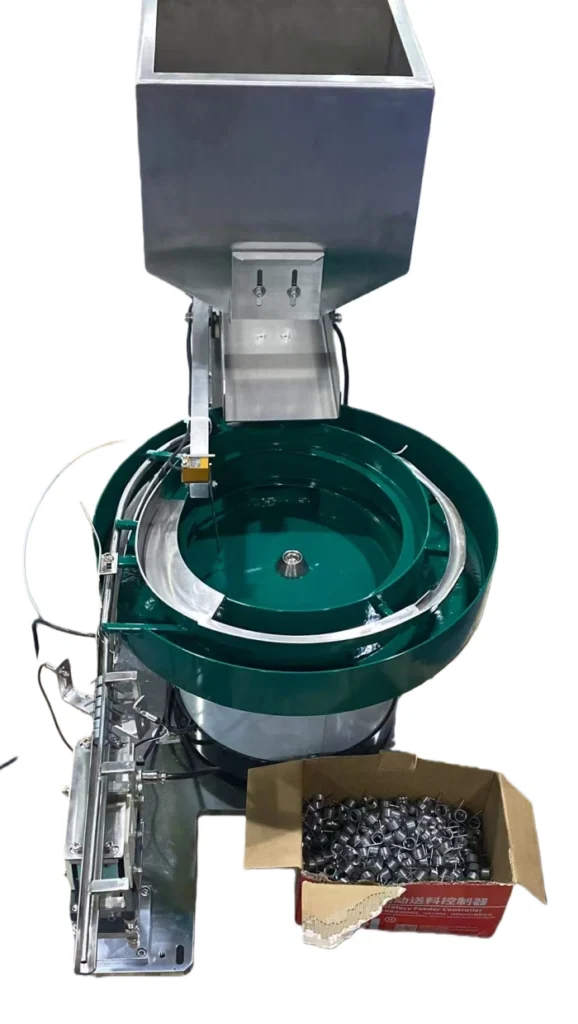
Vibration feeder: The advantage lies in its ability to handle parts with complex shapes and complex orientations, and its mature technology and wide application. But its vibration principle may cause oily products to slip or scratch precision/coated surfaces, resulting in shortcomings in feeding stability.
Centrifugal feeder: Its advantages lie in high speed, low noise, and no need for vibration, making it more friendly to products that are afraid of scratches. The feeding process is relatively smooth. But it is usually more suitable for parts with simple and symmetrical shapes (such as cylinders, spheres, bottle caps), and for parts that require multi axis complex orientation or flexibility, its ability is not as good as vibration discs.
Summary: If you pursue ultimate speed and the shape of the parts is simple and symmetrical, the centrifugal feeder is the better solution; If you need to handle complex shaped parts and do not have extremely high speed requirements, the adaptability of the vibration feeder is wider, but you need to pay attention to its stability risk to oily/vulnerable parts.


 Spanish (Mexico)
 English
 Czech
 Arabic
 Russian
 German
 French
 Turkish
 Italian
 Ukrainian
 Polish
 Romanian
 Bengali
 Portuguese (Portugal)
 Thai
 Japanese
 Korean
 Hebrew
 Uzbek
 Hindi
 Slovak
 Vietnamese
 Portuguese (Brazil)
 Spanish (Peru)
 Spanish (Spain)
 Spanish (Venezuela)