
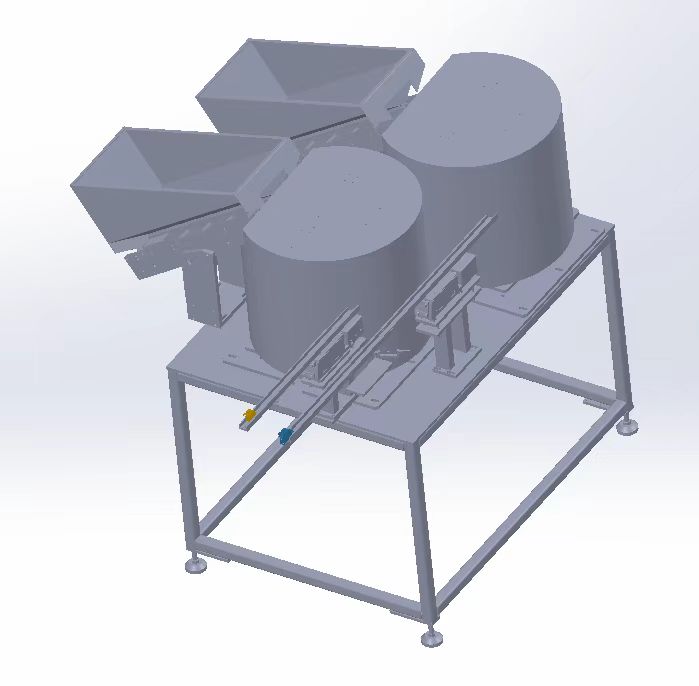
The short answer is: It depends. While a vibratory bowl feeder is typically designed and tooled for a specific part, there are scenarios where one bowl can handle multiple products — but with important limitations.
I. General Rule
| Situation | Possibility | Difficulty |
|---|---|---|
| Multiple products with very similar geometry (e.g., screws of same head style but different lengths) | ✅ Possible | Low to Moderate |
| Multiple products with different shapes (e.g., screws vs. nuts vs. washers) | ❌ Generally not possible | High |
| Different sizes of the same family (e.g., M3, M4, M5 screws of same type) | ✅ Possible with adjustable tooling | Moderate |
| Different materials but identical geometry (e.g., steel vs. plastic screw) | ⚠️ Maybe; may need different coating or amplitude | Moderate |
II. Conditions for Using One Bowl for Multiple Products
A single vibratory bowl can serve multiple products if:
Similar physical dimensions – Length, diameter, and overall shape are close enough that parts do not jam or fall through gaps.
Same orientation requirement – All products need the same final orientation (e.g., all head‑up, all flange‑down).
Adjustable tooling – The bowl’s tooling (wiper blades, gaps, tracks) can be easily adjusted without major rework.
Same feeding rate requirement – All products can be fed at roughly the same speed (or the controller can adjust).
Material compatibility – Heavier or stickier parts may require different amplitude or track coating.
III. Methods to Make One Bowl Work for Multiple Products
| Method | وصف | المرونة |
|---|---|---|
| Adjustable tooling | Use adjustable wiper blades, movable side guides, or interchangeable track inserts. | Moderate |
| Multi‑profile track | Design the track with multiple “steps” or profiles, each suited for a different part. | Low (limited to 2‑3 parts) |
| Universal design for family | For a family of similar parts (e.g., screws of same head but varying length), the bowl can feed all by adjusting part‑present sensors and speed. | Good for family |
| Quick‑change bowl insert | Keep a base bowl and swap out the inner track assembly (tooling insert) for each product. | High (but requires storage of inserts) |
| Software + vision feedback | Add a vision system to check part orientation and reject incompatible parts; the bowl does not need mechanical change. | High (but cost increases) |
IV. Limitations and Pain Points
| Issue | Explanation |
|---|---|
| Jamming | A part slightly larger than the intended one may get stuck in a track designed for smaller parts. |
| Orientation failure | A different part may not engage with the same tooling (e.g., a wiper blade designed for a washer may knock over a taller screw). |
| Feed rate drop | A heavier or more slippery part may require different amplitude, causing the bowl to feed slower. |
| Tooling changeover time | If manual adjustment is needed, changeover may take 15–60 minutes, reducing the benefit of “one bowl.” |
| Increased cost | Adjustable tooling, quick‑change inserts, or vision systems add initial cost. |
V. Recommended Approach
| Production Profile | Recommendation |
|---|---|
| High‑mix, low‑volume with different part families | Use a flexible feeder (vision‑guided) instead of a vibratory bowl. |
| High‑mix, within the same part family (e.g., different screw lengths of same type) | One vibratory bowl with adjustable tooling and sensors may work well. |
| Two or three very similar parts | One bowl with minor adjustment between runs can work. |
| Completely different parts (screw vs. spring vs. clip) | Not recommended – use separate bowls or a flexible feeder. |
VI. Summary Table
| Question | Answer |
|---|---|
| Can one bowl handle multiple products? | ✅ Yes, but only if they are very similar (family parts). |
| Can it handle completely different shapes? | ❌ Generally no. |
| Is it more expensive than a dedicated bowl? | ✅ Yes, due to adjustable tooling or quick‑change inserts. |
| Is it faster than changing bowls? | ✅ Yes, if changeover takes minutes instead of hours. |
| Is a flexible feeder a better choice for high‑mix? | ✅ Yes, for completely different shapes. |

 Arabic
  English
  Spanish (Mexico)
  Czech
Czech  Russian
  German
  French
  Turkish
  Italian
  Ukrainian
  Polish
  Romanian
  Bengali
  Portuguese (Portugal)
  Thai
Thai  Japanese
  Korean
  Hebrew
  Uzbek
Uzbek  Hindi
Hindi  Slovak
  Vietnamese
  Portuguese (Brazil)
  Spanish (Peru)
  Spanish (Spain)
  Spanish (Venezuela)