
Choosing between vibratory bowl feeder manufacturers starts with your parts and production requirements. The feeder must deliver components in the correct orientation, at the required rate, and in a position the next machine can use.
Price matters, but so do tooling quality, part handling, testing, and access for maintenance. Problems in any of these areas can lead to frequent stoppages or extra work during installation.
Before requesting a quote, compare manufacturers against seven practical checks: experience with similar parts, sample testing, sustained output, tooling design, machine integration, quotation scope, and after-sales support.
What Do Vibratory Bowl Feeder Manufacturers Provide?
Vibratory bowl feeder manufacturers build equipment that separates, orients, and supplies loose components to production machinery. Vibration moves parts along a bowl track, while custom tooling guides correctly positioned parts toward the outlet.
Depending on the application, the supply scope may include:
Bowl top and vibratory drive.
Custom orientation tooling.
Linear feeder or outfeed track.
Bulk storage hopper and replenishment equipment.
Sensors and feeder controller.
Part separator or escapement.
Support frame and sound enclosure.
These components need to work together. The bowl may orient parts correctly, but the production line can still stop if the outfeed track does not maintain a suitable supply or the separator presents parts inconsistently.
When comparing vibratory bowl feeder systems, confirm whether the quotation covers a standalone bowl or the complete feeding arrangement required by your machine.
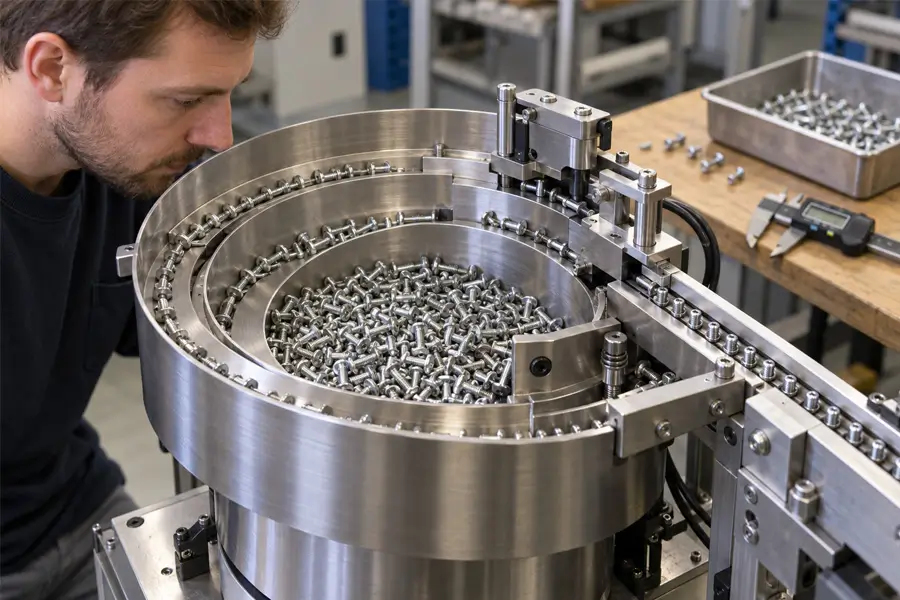
Checks 1–2: Similar Part Experience and Sample Testing
Check 1: Experience With Similar Components
Ask manufacturers about projects involving components with similar geometry, material, and surface finish.
Small differences can affect feeding behavior. Thin washers may overlap, threaded fasteners may interlock, and lightweight plastic components may behave differently from metal parts. Delicate surfaces may also require specific contact materials or coatings.
Useful project examples should show how the manufacturer handles orientation, recirculation, discharge, and access for clearing a blockage.
Experience with your industry helps, but experience with the way your part behaves is especially useful.
Check 2: Testing With Representative Samples
Send production samples before the design is finalized. Drawings help define dimensions, but physical samples reveal how parts slide, nest, tangle, and interact with the track.
Include samples that represent normal production variation. If your line receives parts from several molds or suppliers, explain those differences early.
For custom vibratory bowl feeders, ask the manufacturer to confirm:
Required outlet orientation.
Critical dimensions and tolerances.
Acceptable surface marking.
Expected variation between batches.
Any tendency for parts to stick together or interlock.
Sample testing should help identify feeding difficulties before they become installation problems.
Checks 3–4: Sustained Feed Rate and Tooling Quality
Check 3: Output Under Agreed Operating Conditions
A short video showing fast movement does not establish whether the feeder can support your production line throughout a normal run.
Specify the required output at the handoff point. For example, a machine requiring 60 correctly oriented parts per minute needs that supply at its pickup or loading position. Parts moving inside the bowl do not count as usable output.
Agree on test conditions, including the part batch, bowl fill level, test duration, and downstream demand. Where relevant, include start-stop operation and hopper replenishment.
Ask for evidence of sustained feeding and record interruptions, incorrect orientations, and manual interventions during the test.
Check 4: Tooling That Operators Can Maintain
Tooling determines how parts are selected and oriented. It also affects cleaning, wear, and the time needed to remove trapped components.
Review whether operators can reach the track, inspect likely blockage points, and replace wear items. If a coating is proposed, ask why it suits the component and how it can be repaired or renewed.
Manufacturers should also explain the limits of changeover. Similar-looking parts may still need different tooling, track settings, or a separate bowl.
If your production involves frequent product changes, discuss whether a flex feeder or step feeder would better suit the application.
Check 5: Integration With Your Production Machine
The bowl outlet is only one part of the feeding process. Components must reach the next operation at the correct height, spacing, orientation, and timing.
Share the machine layout before approving the feeder design. Include available floor space, loading height, maintenance access, and the location of the pickup or assembly station.
Confirm the following interfaces:
Outlet height and feeding direction.
Required part spacing and presentation.
Track-full and low-level detection.
Start-stop signals and fault handling.
Electrical and compressed-air requirements.
Mounting arrangement and access for servicing.
Some applications need a linear feeder to transfer oriented parts. Others need a part separator to release one component per machine cycle.
If the project includes vision inspection, define the inspection task separately. Orientation checking, defect detection, and rejection each require suitable part presentation and clear acceptance criteria.
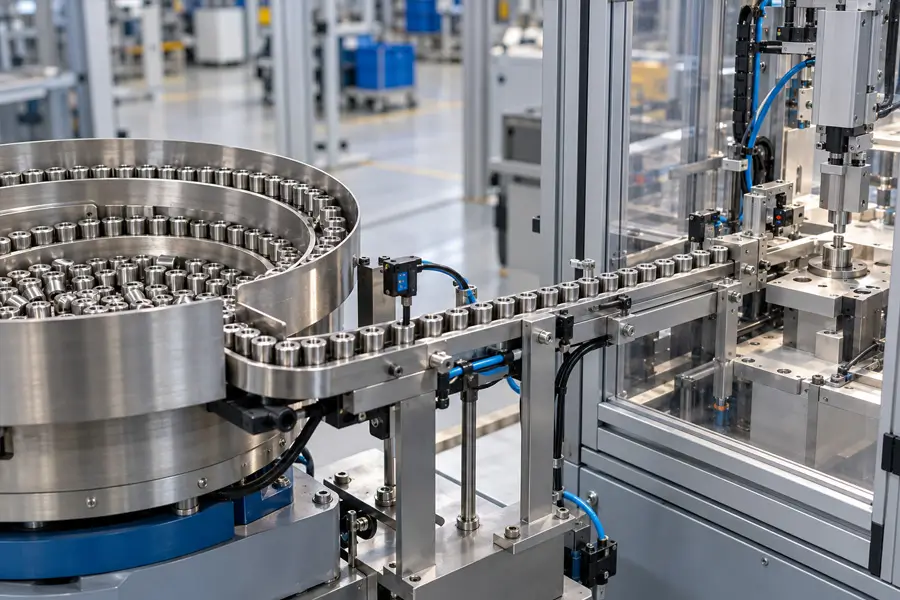
Checks 6–7: Quotation Scope and After-Sales Support
Check 6: Compare the Same Equipment Scope
Quotations are difficult to compare when one includes a complete system and another includes only the bowl and drive.
Use a shared specification so every manufacturer prices the same requirements.
| Item to confirm | Details to request |
|---|---|
| Feeding equipment | Bowl, drive, tooling, outfeed track, and controller |
| Bulk replenishment | Hopper type, capacity, and level control |
| Machine interface | Sensors, separator, signals, and mounting |
| Noise control | Enclosure scope and agreed measurement conditions |
| Testing | Samples, duration, output, and acceptance criteria |
| Documentation | Drawings, operating instructions, and spare-parts list |
| Delivery | Packing, freight responsibility, and installation scope |
Review the cost of installation and maintenance alongside the purchase price. Missing controls or interface components can create additional work after delivery.
Check 7: Support After Delivery
Ask how the manufacturer handles commissioning questions, replacement parts, and later adjustments.
Confirm which components are standard and which are custom-made. Request a recommended spare-parts list, including wear items and sensors where appropriate.
Support questions should include:
Who assists with installation and tuning?
What information is needed to diagnose a feeding problem?
How are replacement tooling and wear parts supplied?
What happens if the component design changes?
Which service terms are included in the quotation?
Clear answers make it easier to plan maintenance and resolve problems once the feeder is in production.

Discuss Your Feeding Requirements With SWOER
The right manufacturer should be able to explain how the proposed feeder will handle your component, connect to your machine, and meet the agreed acceptance test.
SWOER is a Chinese manufacturer specializing in custom feeding equipment. Its product range includes vibratory bowl feeders, flex feeders, step feeders, and related feeding components.
For projects requiring more than a standalone bowl, SWOER can discuss custom feeding solutions based on the customer’s parts and production layout. Depending on the application, the system may include hopper replenishment, linear tracks, separators, controllers, support structures, or a sound enclosure.
This range allows the feeding method and supporting equipment to be considered together when planning the line.
Send SWOER your part drawings, representative samples, required output, outlet orientation, and machine layout to discuss a suitable configuration and request a quotation.

 English
 Spanish (Mexico)
 Czech
 Arabic
 Russian
 German
 French
 Turkish
 Italian
 Ukrainian
 Polish
 Romanian
 Bengali
 Portuguese (Portugal)
 Thai
 Japanese
 Korean
 Hebrew
 Uzbek
 Hindi
 Slovak
 Vietnamese
 Portuguese (Brazil)
 Spanish (Peru)
 Spanish (Spain)
 Spanish (Venezuela)