
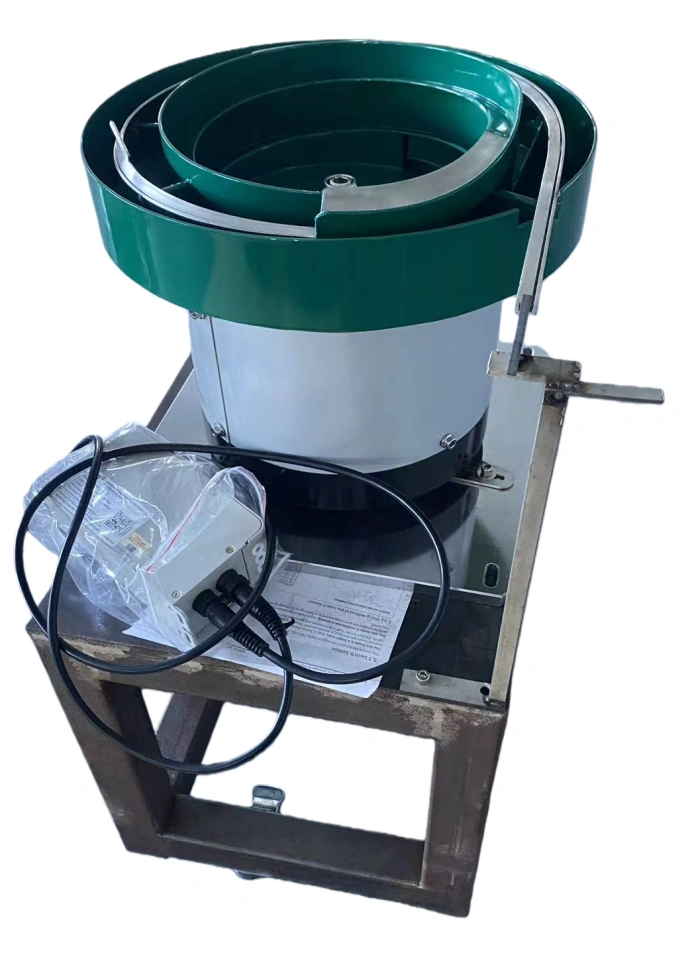
I. Quick Answer
Price difference: Yes, centrifugal feeders are significantly more expensive than standard vibratory bowl feeders — typically 2–5 times the price for comparable part sizes and feed rates.
Which has more advantages: Neither is universally better. Centrifugal feeders win on speed, gentle handling, and low noise. Vibratory bowls win on cost, orientation precision, and flexibility for complex shapes.
II. Price Comparison
| Cost Factor | Standard Vibratory Bowl Feeder | Centrifugal Feeder |
|---|---|---|
| Typical price range | $1,000 – $8,000 USD | $3,000 – $20,000+ USD |
| Price ratio | 1× (baseline) | 2–5× more expensive |
| Tooling cost | Moderate (track tooling) | Higher (precision disc and guide tooling) |
| Drive system | Electromagnetic drive (simple, low cost) | Motor + gearbox + belt (more complex) |
| Controller | Simple amplitude controller | More complex motor controller (VFD or servo) |
| Maintenance cost | Moderate (springs, coils) | Lower (fewer wear parts, but higher part cost) |
| Customization cost | Moderate | High (custom discs and guides are expensive) |
III. Advantage Comparison
| Factor | Standard Vibratory Bowl Feeder | Centrifugal Feeder |
|---|---|---|
| Speed | 50–300 parts/min (up to 700 for small parts) | 300–1000+ parts/min (up to 2000 for small parts) |
| Orientation precision | High — can orient complex features (polarity, specific angle) | Moderate — best for simple orientation |
| Part damage risk | Moderate (parts collide) | Low (gentle sliding motion) |
| Noise level | High (70–95 dBA) | Low (60–75 dBA) |
| Suitable part types | Most rigid, dry parts | Small, symmetrical, non-tangling parts |
| Tangle-prone parts | ❌ Poor | ✅ Good (better at handling springs, rings) |
| Initial cost | Low | High (2–5× more) |
| Footprint | Compact | Larger (disc + drive) |
| Maintenance | Moderate | Lower |
| Changeover | Slow (mechanical tooling) | Moderate (tooling change) |
| Energy consumption | Moderate | Lower |
IV. Which One Has More Advantages?
| Your Priority | Recommended Choice | Reason |
|---|---|---|
| Lowest initial cost | ✅ Vibratory bowl feeder | 2–5× cheaper |
| Maximum speed (> 500 parts/min) | ✅ Centrifugal feeder | Can reach 1000–2000 parts/min |
| Precise, complex orientation | ✅ Vibratory bowl feeder | Better tooling for polarity/angle |
| Gentle handling of fragile parts | ✅ Centrifugal feeder | Low-impact sliding motion |
| Low noise environment | ✅ Centrifugal feeder | 20–30 dBA quieter |
| Tangle-prone parts (springs, O-rings) | ✅ Centrifugal feeder | Better at separating tangled parts |
| Standard screws, washers, pills | ✅ Vibratory bowl feeder | Cost-effective and reliable |
| Limited floor space | ✅ Vibratory bowl feeder | Smaller footprint |
| Long-term low maintenance | ✅ Centrifugal feeder | Fewer wear parts |
V. Summary Table
| Aspect | Standard Vibratory Bowl Feeder | Centrifugal Feeder |
|---|---|---|
| Price | $1k–$8k (baseline) | $3k–$20k+ (2–5× more) |
| Speed | 50–300 parts/min | 300–1000+ parts/min |
| Orientation precision | ✅ High | ⚠️ Moderate |
| Part damage risk | ⚠️ Moderate | ✅ Low |
| Noise | ⚠️ High | ✅ Low |
| Tangle-prone parts | ❌ Poor | ✅ Good |
| Footprint | ✅ Compact | ⚠️ Larger |
| Maintenance | ⚠️ Moderate | ✅ Lower |
| Best for | Precise orientation, low cost | High speed, gentle handling, low noise |

 English
 Spanish (Mexico)
 Czech
 Arabic
 Russian
 German
 French
 Turkish
 Italian
 Ukrainian
 Polish
 Romanian
 Bengali
 Portuguese (Portugal)
 Thai
 Japanese
 Korean
 Hebrew
 Uzbek
 Hindi
 Slovak
 Vietnamese
 Portuguese (Brazil)
 Spanish (Peru)
 Spanish (Spain)
 Spanish (Venezuela)