
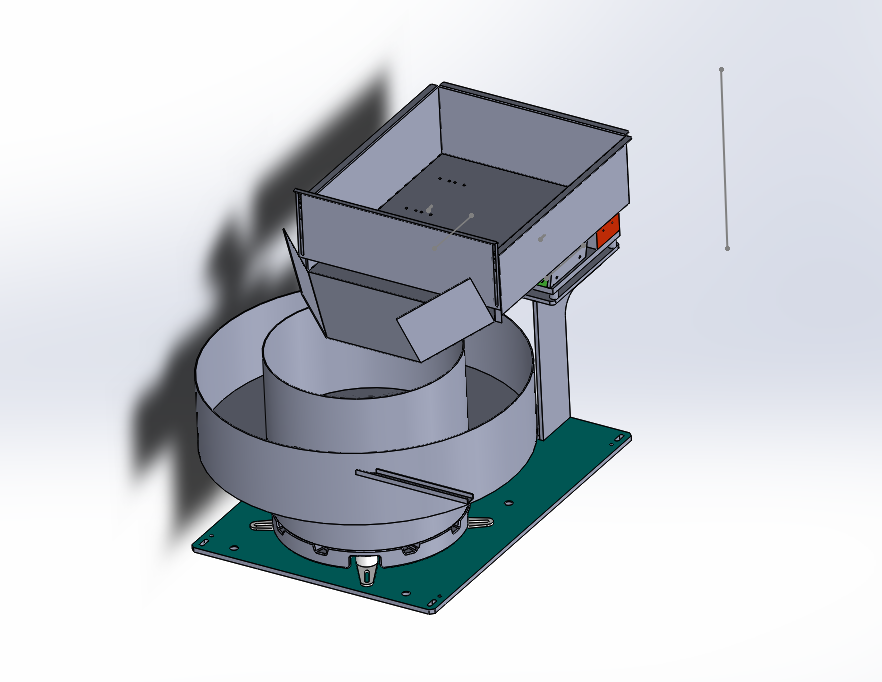
The main difference between an elevator (also called a vertical conveyor or bucket elevator) and a standard hopper lies in their function and operating principle. Below is a detailed comparison.
I. Core Functional Difference
| Tính năng | Elevator | Standard Hopper |
|---|---|---|
| Primary function | Actively lifts material from a lower level to a higher level | Passively stores material and relies on gravity for discharge |
| Material movement | Forced upward movement (mechanical or pneumatic) | Downward flow by gravity only |
| Power requirement | Requires motor or pneumatic power | No power required |
II. Detailed Comparison
| Aspect | Elevator | Standard Hopper |
|---|---|---|
| Operating principle | Uses buckets, belts, chains, or screws to lift material | Material flows out through an opening at the bottom due to gravity |
| Inlet / outlet position | Inlet at bottom, outlet at top | Inlet at top, outlet at bottom |
| Vertical lift capability | Can lift material to significant heights (1–5+ meters) | Cannot lift; material stays at same level or only flows down |
| Flow control | Active, metered, on‑demand feeding | Passive; depends on gravity and outlet design |
| Storage capacity | Smaller internal storage; often fed from an upstream hopper | Can be large (e.g., several cubic meters) |
| Moving parts | Yes (buckets, belts, chains, or screws) | None (static) |
| Noise level | Moderate to high (depending on type) | Very low or none |
| Maintenance | Higher (bearings, motors, wear parts) | Very low (only cleaning) |
| Initial cost | Higher | Lower |
| Footprint | Small footprint for tall height | Larger horizontal footprint for same capacity |
III. When to Use Which?
| Scenario | Recommended Solution | Reason |
|---|---|---|
| Material is at floor level, but machine inlet is high (e.g., workbench height) | Elevator | Actively lifts material to the required height |
| Machine inlet is at the same level as material supply | Standard hopper | Gravity flow is sufficient |
| Need high‑capacity, long‑running automation with minimal refill frequency | Elevator + hopper combination | Hopper stores bulk; elevator feeds on demand |
| Limited floor space, but tall space available | Elevator | Small footprint, uses vertical space |
| Simple, low‑cost, low‑volume application | Standard hopper | Lower investment; no power needed |
| Free‑flowing material (no bridging, no sticking) | Either; hopper is simpler | Hopper works well with free‑flowing materials |
| Material is sticky, bridging, or requires agitation | Elevator | Active movement prevents bridging |
| Material is fragile or easily damaged | Gentle elevator (belt or vibrating) | Standard hopper may cause impact damage if dropped from height |
IV. Common Combinations
In many automated feeding systems, elevators and standard hoppers are used together, not as alternatives:
Operator pours parts into a large hopper → Hopper gravity‑feeds into elevator → Elevator lifts parts to vibratory bowl or packaging machine.
Elevator lifts from floor‑level bulk container → Discharges into a small surge hopper → Hopper gravity‑feeds a vibratory bowl.
This combination maximizes storage capacity while providing controlled, on‑demand vertical lifting.
V. Summary Table: Key Differences at a Glance
| Comparison Aspect | Elevator | Standard Hopper |
|---|---|---|
| Main function | Actively lifts material vertically | Passively stores and gravity‑feeds material |
| Power required | Yes (electric motor or pneumatic) | No |
| Moving parts | Yes | No |
| Vertical lift | Yes (can be >5 m) | No |
| Installation height | Tall | Low profile |
| Horizontal footprint | Small for given capacity | Larger for equivalent capacity |
| Trị giá | Higher | Lower |
| Maintenance | More frequent | Minimal |
| Best for | Vertical transfer, high capacity, automation integration | Simple storage, gravity feeding, low cost |

 Vietnamese
  English
  Spanish (Mexico)
  Czech
Czech  Arabic
  Russian
  German
  French
  Turkish
  Italian
  Ukrainian
  Polish
  Romanian
  Bengali
  Portuguese (Portugal)
  Thai
Thai  Japanese
  Korean
  Hebrew
  Uzbek
Uzbek  Hindi
Hindi  Slovak
  Portuguese (Brazil)
  Spanish (Peru)
  Spanish (Spain)
  Spanish (Venezuela)