
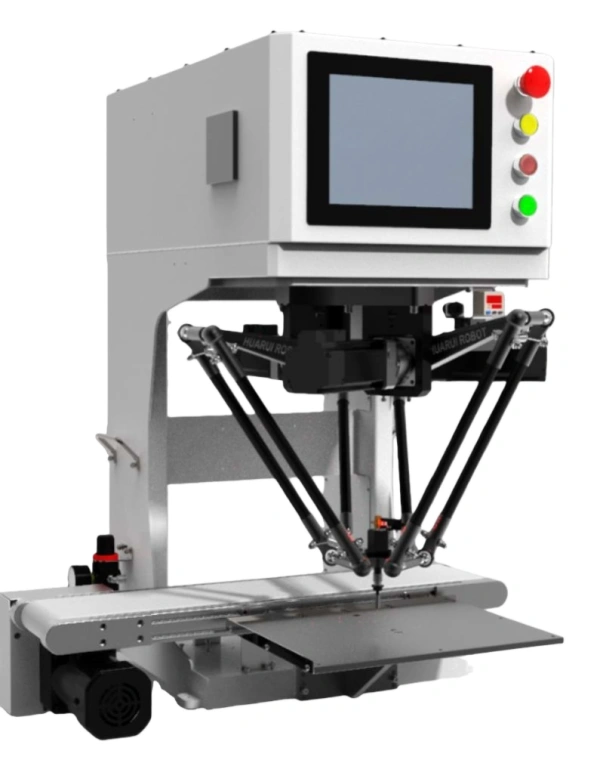
Parallel robots (also known as delta robots or spider robots) differ from conventional serial robots (such as articulated 6‑axis or SCARA robots) in several fundamental ways. The table below summarizes the key differences.
I. Structural Differences
| Özellik | Parallel Robot | Conventional Serial Robot |
|---|---|---|
| Basic structure | Multiple closed‑loop kinematic chains; all actuators work simultaneously to move a single platform | Open kinematic chain; actuators work in sequence from base to end‑effector |
| Arm arrangement | Several arms (typically 3 or 4) connect the base platform directly to the moving platform | One main arm with links connected end‑to‑end (like a human arm) |
| Motor position | All motors are fixed on the base frame | Motors are distributed along the arm (joints) and move with the arm |
| Moving mass | Very low (only lightweight arms and end‑effector move) | High (motors and links move together) |
II. Performance Differences
| Performance Aspect | Parallel Robot | Conventional Serial Robot |
|---|---|---|
| Hız | Very high (up to 10 m/s, 10–15 G acceleration) | Lower (2–4 m/s for 6‑axis, 5–7 m/s for SCARA) |
| Cycle time | 0.3 – 0.5 seconds (300mm pick‑place) | 0.5 – 0.8 s (SCARA), 0.8 – 1.5 s (6‑axis) |
| Accuracy / repeatability | Very high (±0.05 – 0.1 mm) | High (±0.02 – 0.05 mm for SCARA; ±0.03 – 0.1 mm for 6‑axis) |
| Rigidity | Excellent (closed‑loop structure), especially in vertical direction | Lower (errors accumulate at each joint) |
| Payload capacity | Low to medium (1 – 10 kg typical) | Medium to very high (5 – 500+ kg) |
| Workspace shape | Small, dome‑shaped (500 – 1500 mm diameter) | Large, spherical or cylindrical (extensive reach) |
III. Flexibility & Application Differences
| Capability | Parallel Robot | Conventional Serial Robot |
|---|---|---|
| Path complexity | Limited to fast pick‑and‑place motions; not good at curved or complex 3D paths | Excellent for complex paths (welding, painting, grinding, assembly) |
| Number of axes | Usually 3 or 4 axes (some 5–6 exist but are rare and expensive) | Typically 6 axes (6‑axis articulated), or 4 axes (SCARA) |
| Reach | Short (distance from base to end‑effector is limited by arm length) | Long (can reach far from base) |
| Orientation flexibility | Limited (end‑effector orientation changes only via 4th theta axis) | Full orientation freedom (6 degrees of freedom) |
| Typical application | High‑speed picking, sorting, packaging of lightweight items | Welding, assembly, machine tending, painting, palletizing, general manufacturing |
IV. Practical Summary Table
| Aspect | Parallel Robot | Conventional Serial Robot |
|---|---|---|
| Best for | Fast pick‑and‑place, sorting, packaging | General purpose, complex tasks, heavy loads |
| Hız | ⭐⭐⭐⭐⭐ (extremely fast) | ⭐⭐⭐ (SCARA) / ⭐⭐ (6‑axis) |
| Payload | ⭐⭐ (light only) | ⭐⭐⭐⭐ (medium to heavy) |
| Workspace | ⭐⭐ (small dome) | ⭐⭐⭐⭐⭐ (large) |
| Path flexibility | ⭐⭐ (limited) | ⭐⭐⭐⭐⭐ (excellent) |
| Cost per kg payload | Lower for high‑speed light tasks | Higher for general use |
V. When to Choose Which
| Choose a parallel robot if… | Choose a conventional serial robot if… |
|---|---|
| You need extremely high speed (200–300 picks/min) | You need heavy payload (e.g., 20 kg, 100 kg) |
| Parts are lightweight (≤ 1–3 kg) | Parts are heavy or bulky |
| Motion is simple pick‑and‑place (vertical + small X‑Y) | Motion requires complex paths (welding, painting, grinding) |
| Workspace is small (500–1200 mm diameter) | Workspace is large (1‑3+ meters reach) |
| You need 3 or 4 axes (X, Y, Z + theta) | You need 6 axes (full orientation freedom) |
| You are packaging food, pharmaceuticals, small electronics | You are doing arc welding, machine tending, palletizing, or assembly of larger parts |

 Turkish
  English
  Spanish (Mexico)
  Czech
Czech  Arabic
  Russian
  German
  French
  Italian
  Ukrainian
  Polish
  Romanian
  Bengali
  Portuguese (Portugal)
  Thai
Thai  Japanese
  Korean
  Hebrew
  Uzbek
Uzbek  Hindi
Hindi  Slovak
  Vietnamese
  Portuguese (Brazil)
  Spanish (Peru)
  Spanish (Spain)
  Spanish (Venezuela)