
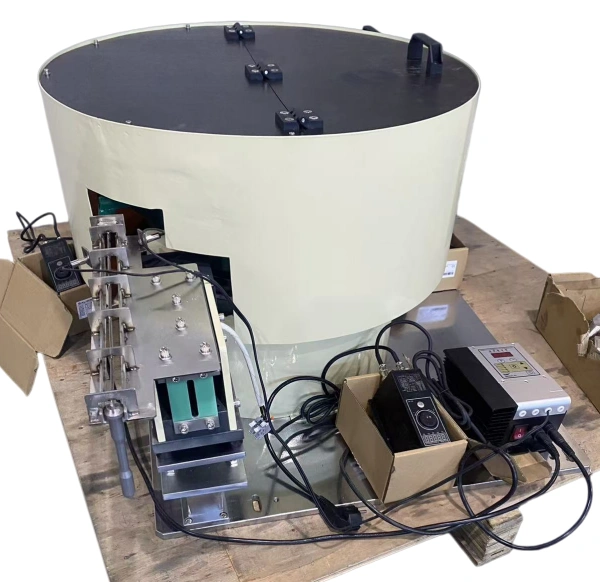
I. Products That Typically Require a Soundproof Enclosure Product Type / Characteristic Reason for High Noise Hard, heavy metal parts (e.g., steel screws, bolts, nuts, rivets, pins) Metal‑to‑metal contact generates loud impact noise. Small, rigid parts (e.g., bearings, small gears, machine components) High‑frequency impacts produce sharp, irritating sounds. High‑speed feeding applications (e.g., feeding at 300+ parts/min) Faster bowl […]
Arhive categorie: Flex Feeder
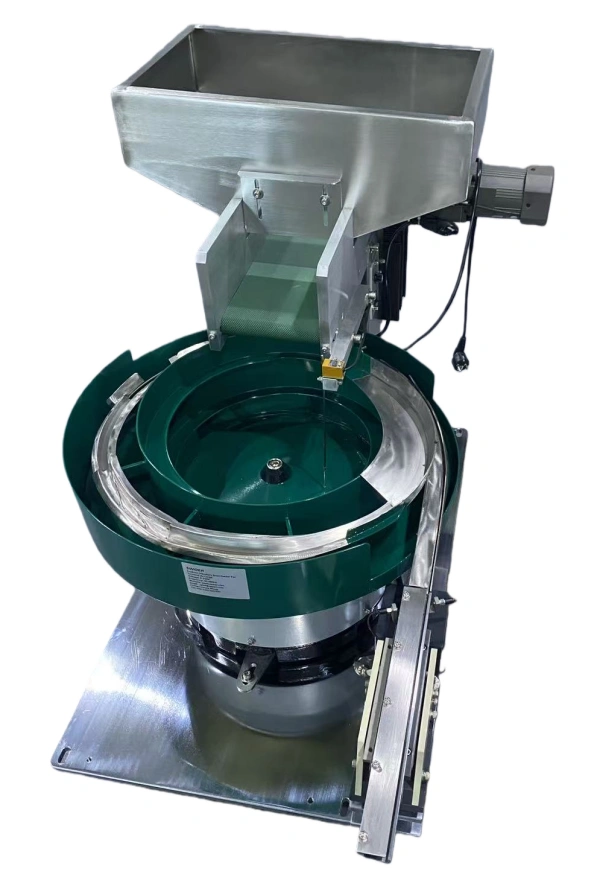
How Should a Vibratory Bowl Be Made for Oily Products? If you must use a vibratory bowl for oily parts, the following design modifications are recommended: 1. Surface Treatment & Materials Measure Purpose PTFE (Teflon) coating Reduces friction and prevents oil from sticking to the track. Stainless steel bowl (SUS304 or SUS316) Resists oil‑related corrosion […]
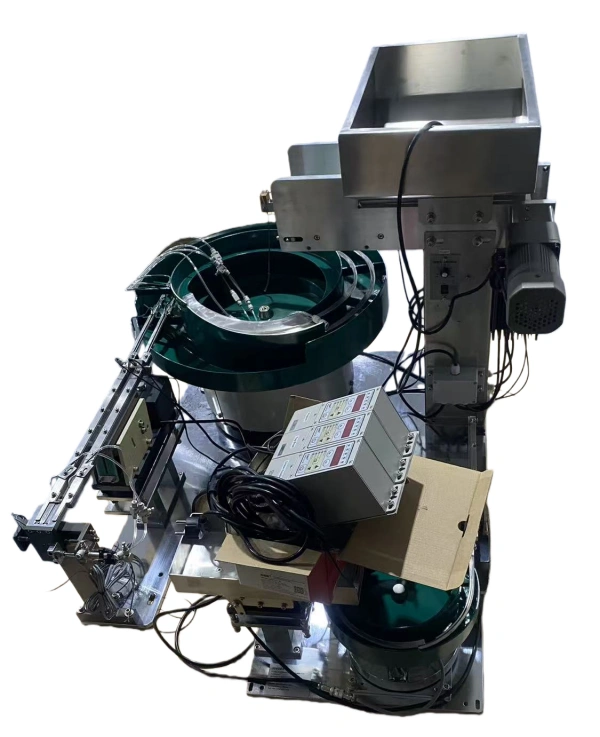
Sensors play a critical role in automating and stabilizing the operation of a vibratory bowl feeder. Their main functions are as follows: I. Part Presence Detection (Feedback Control) Start/Stop Control Sensor detects when parts are present at the discharge point or linear track. Sends a signal to the controller to stop the bowl (prevents overfeeding). When parts are absent for a […]
Answer: It depends on the specific type of spider robot being referred to. I. Industrial Spider Robots (High-Speed Parallel Robots) Typically do NOT contain built-in lithium batteries. Power Source: They are powered directly from the industrial electrical grid (e.g., 220V or 380V AC) via cables, with internal power supplies converting AC to DC for the […]
Thread coating machines, while essential for reliable automated application, face several challenges in practical use: I. Technical & Process-Related Pain Points Adhesive Consistency Issues Description: Adhesive viscosity can change with temperature, humidity, or age, leading to inconsistent flow, stringing, or clogging. Impact: Results in uneven coating, waste, and frequent downtime for cleaning. Nozzle Clogging and […]
1. High-Precision, High-Speed Pin Insertion Function: Replaces manual labor to insert various metal or plastic terminals into predetermined positions with extreme speed and repeatable accuracy. Value: This is its core function, ensuring consistency and reliability in mass production. 2. Automated Assembly of Multiple Connector Types Function: Handles pin insertion for various complex connectors, such as: […]
The working principle of an industrial camera can be summarized in four core stages: 1. Light Acquisition Process: Light reflected from or emitted by the target passes through the industrial lens into the camera. Key: The lens collects and focuses the light to form a sharp optical image on the internal sensor. 2. Photoelectric Conversion Process: This is the core step. […]
A complete flexible feeder system is a sophisticated assembly typically comprised of the following core modules and components: Core Vibration & Dispersion Module Vibratory Platform / Feeder Base: Generates multi-axis micro-vibration to scatter parts uniformly. Flexible Feeding Tray / Plate: The removable work surface on the platform. Pin Tray: Features an array of pins to […]
Superior Flexibility for Rapid Changeover Description: Its core advantage. Switching from Part A to Part B requires no mechanical retooling. Advantage: Simply load a new vision program. Changeover time is reduced from hours to minutes, ideal for high-mix, low-volume production. Extremely Gentle on Parts Description: Operates on a “scatter, identify, pick” principle. Advantage: Parts experience no forced […]
A complete flexible feeder system is an integrated mechatronic device consisting of the following key functional modules and components: I. Core Vibration and Handling Module Vibratory Platform/Feeder Base: Generates micro-amplitude, multi-axis vibration to scatter parts. Flexible Feeding Tray/Plate: The removable surface placed on the vibratory platform. Pin Tray: With an array of pins to stabilize […]
 Romanian
  English
  Spanish (Mexico)
  Czech
Czech  Arabic
  Russian
  German
  French
  Turkish
  Italian
  Ukrainian
  Polish
  Bengali
  Portuguese (Portugal)
  Thai
Thai  Japanese
  Korean
  Hebrew
  Uzbek
Uzbek  Hindi
Hindi  Slovak
  Vietnamese
  Portuguese (Brazil)
  Spanish (Peru)
  Spanish (Spain)
  Spanish (Venezuela)