
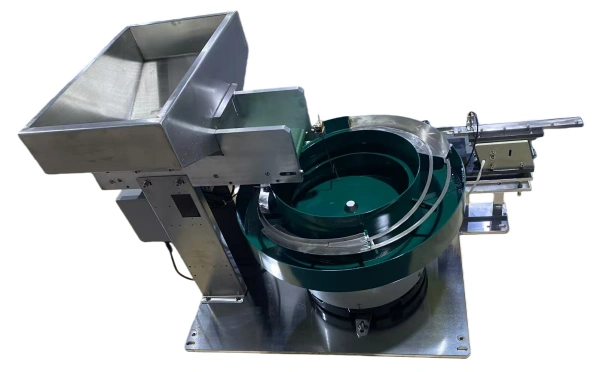
Can a vibratory bowl feeder reject deformed parts? What methods are used for rejection?
Answer: Yes, a vibratory bowl feeder can be designed to reject deformed or out‑of‑spec parts. This is typically achieved by using mechanical tooling, sensors, ou sistemas de visão that detect deformation and then remove the defective part from the stream.
I. Mechanical Rejection Methods (Tooling‑Based)
These methods use physical features of the track to allow only correctly shaped parts to pass.
| Method | How It Works | Best For |
|---|---|---|
| Gap / slot tooling | A precision‑cut gap or slot in the track: correct parts fall into or pass over it; deformed parts (longer, bent, oversize) get caught or are tipped off. | Bent pins, oversize length, warped parts. |
| Wiper blade / step tooling | Adjustable blades or steps that knock off parts which are too tall, too short, or incorrectly oriented. | Height variations, missing features. |
| Selective track width | The track narrows so that only parts with the correct width or diameter can proceed; wider or deformed parts jam or fall back into the bowl. | Parts with bulges, burrs, or swelling. |
| Air jet blow‑off | An air nozzle blows parts that protrude too high or are obviously deformed back into the bowl. | Lightweight parts with obvious shape faults. |
| Weight‑based gravity separation | A ramp with a drop‑off where lighter (or heavier) deformed parts fall away due to wrong center of gravity. | Parts with missing material, voids, or extra material. |
II. Sensor‑Based Rejection Methods (Non‑Contact)
Sensors detect deformation after the part leaves the bowl or on the linear track.
| Method | How It Works | Best For |
|---|---|---|
| Photoelectric / laser sensor | Measures length, height, or presence of features using a through‑beam or reflective sensor. If a part is too long, too short, or missing a feature, the sensor triggers a reject signal. | Length, height, missing hole/tab. |
| Inductive / capacitive proximity sensor | Detects metal or non‑metal presence; a deformed part may cause a different signal amplitude. | Metal parts with size/volume variation. |
| Load cell / weight sensor | Weighs each part as it passes; deformed parts with excess or missing material will have wrong weight. | Parts with critical weight tolerance. |
| Vision system (camera + software) | Takes an image and compares it to a stored “good” template. It detects bending, scratches, incomplete features, or dimensional deviations. | Complex shapes, fine details, surface defects. |
III. Actuation / Rejection Mechanism
Once a defect is detected, the part must be physically removed.
| Mechanism | How It Works |
|---|---|
| Air blast nozzle | A short, high‑pressure air burst blows the defective part off the track or into a reject bin. |
| Solenoid pusher / gate | A retractable pin or gate pushes the part sideways, diverting it into a reject chute. |
| Drop‑out / trapdoor | The track opens (or the part is guided into a hole) so the defective part falls out. |
| Rotary reject wheel | A wheel with pockets that can selectively dump a part at a reject station. |
IV. Typical Rejection Workflow (with Sensor)
Part leaves bowl → Passes sensor/vision (inspection) →
If PASS: continues to assembly →
If FAIL: air blast / pusher activates → defective part removed to reject bin
V. Summary Table
| Method | Detects | Removes | Velocidade | Custo |
|---|---|---|---|---|
| Mechanical gap / slot | Length, width, bends | Passive (falls out) | Very fast | Low |
| Wiper / step tooling | Height, orientation | Passive (knocked off) | Very fast | Low |
| Air jet blow‑off | Obvious shape defects | Active (blown off) | Fast | Medium |
| Photoelectric / laser sensor | Length, height, features | Active (air/pusher) | Fast | Medium |
| Vision system (camera) | Complex defects, fine details | Active (air/pusher) | Fast (with processing) | High |
| Weight sensor / load cell | Weight variation | Active (air/pusher) | Medium | High |
VI. Important Considerations
| Factor | Note |
|---|---|
| Deformation type | Slight bends (e.g., 0.1 mm) may need a vision system; large deformation can be removed by simple mechanical tooling. |
| Velocidade | Mechanical methods are fastest (passive, no processing time). Vision is slower but more capable. |
| Custo | Mechanical tooling is cheap but limited. Vision systems are expensive but flexible and precise. |
| False rejects | Ensure that the rejection method does not reject good parts (tune sensors and tooling carefully). |
| Reject bin | Provide a clearly marked bin to collect rejects for analysis. |
 Portuguese (Brazil)
  English
  Spanish (Mexico)
  Czech
Czech  Arabic
  Russian
  German
  French
  Turkish
  Italian
  Ukrainian
  Polish
  Romanian
  Bengali
  Portuguese (Portugal)
  Thai
Thai  Japanese
  Korean
  Hebrew
  Uzbek
Uzbek  Hindi
Hindi  Slovak
  Vietnamese
  Spanish (Peru)
  Spanish (Spain)
  Spanish (Venezuela)
Avaliações
Ainda não há avaliações.