
Adjusting a pusher feeder focuses on optimizing mechanical stroke, timing, and sensor feedback. Mechanical Adjustment Inspection & Cleaning Safety: Disconnect air and power. Action: Clean and check for wear on the pusher, guides, and hopper. Adjust Pusher Stroke Goal: Ensure the pusher fully ejects the part without over-travel. Method: For Pneumatic Cylinders: Adjust sensor positions or flow control valves. […]
Arquivos de Categoria: Step Feeder
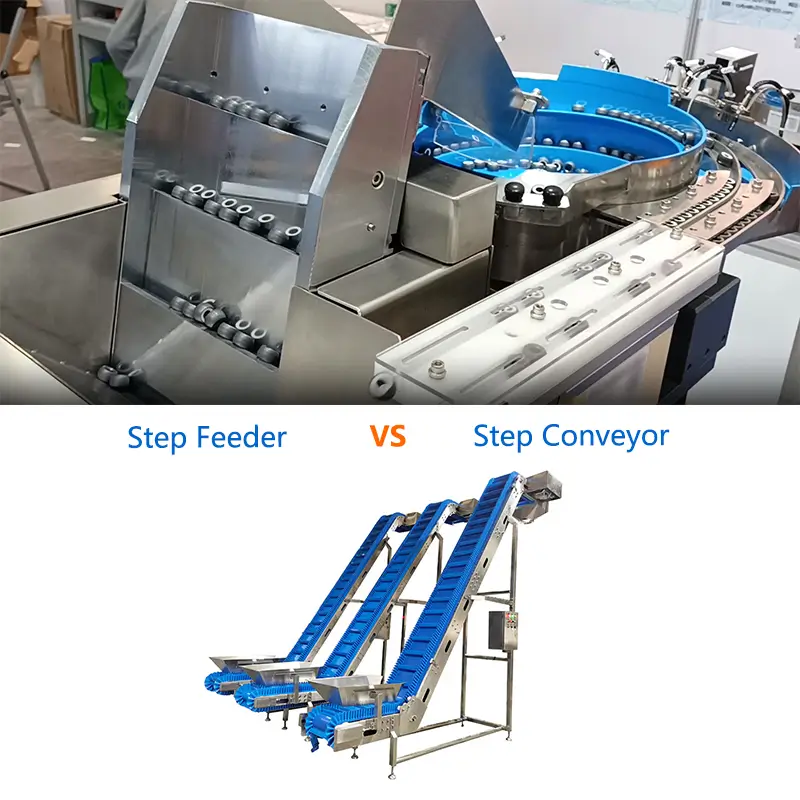
The working principle of a step feeder can be summarized in three core steps, forming a typical “push-return-wait” cycle: Reset and Loading Process: The pusher is in its retracted home position. Parts in the hopper fall by gravity to fill the space in front of the pusher. Purpose: Prepares parts for the next feeding cycle. Advancing and […]
The manufacturing of a step feeder focuses on creating a precise, reliable, and linear feeding mechanism tailored to specific parts. Part Analysis and Hopper Design Analysis: Precisely measure the part and analyze its behavior when stacked to design a hopper that prevents jamming and misorientation. Hopper Design: The hopper is custom-designed to match the part’s […]
 Portuguese (Brazil)
  English
  Spanish (Mexico)
  Czech
Czech  Arabic
  Russian
  German
  French
  Turkish
  Italian
  Ukrainian
  Polish
  Romanian
  Bengali
  Portuguese (Portugal)
  Thai
Thai  Japanese
  Korean
  Hebrew
  Uzbek
Uzbek  Hindi
Hindi  Slovak
  Vietnamese
  Spanish (Peru)
  Spanish (Spain)
  Spanish (Venezuela)