
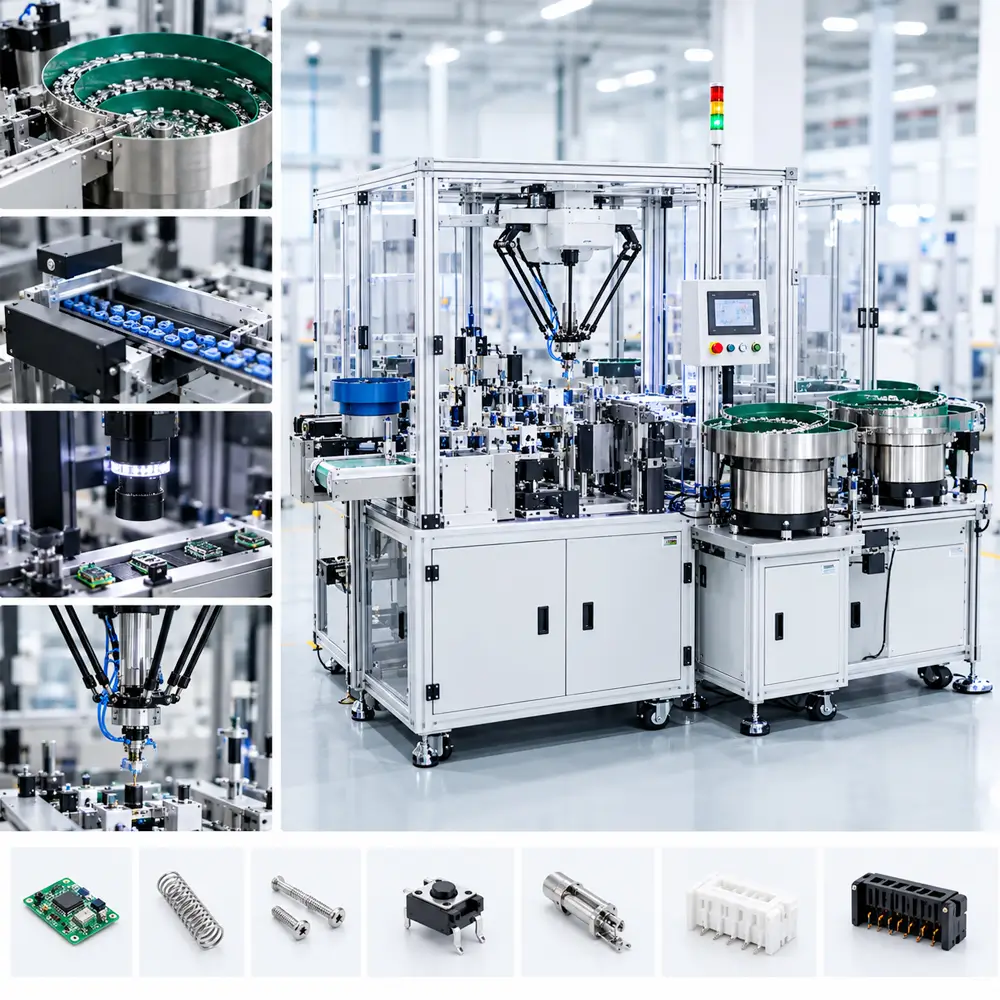
What Is Electronics Assembly Equipment?
Electronics assembly equipment helps manufacturers build electronic products with better speed, accuracy, and consistency.
Modern production lines use different machines for feeding, assembly, inspection, testing, and packaging.
Equipment selection depends on the product structure, production volume, part size, and assembly process.
Common applications include connectors, switches, circuit breakers, sensors, small electronic components, and other precision parts.
Vibratory Bowl Feeders for Electronic Parts
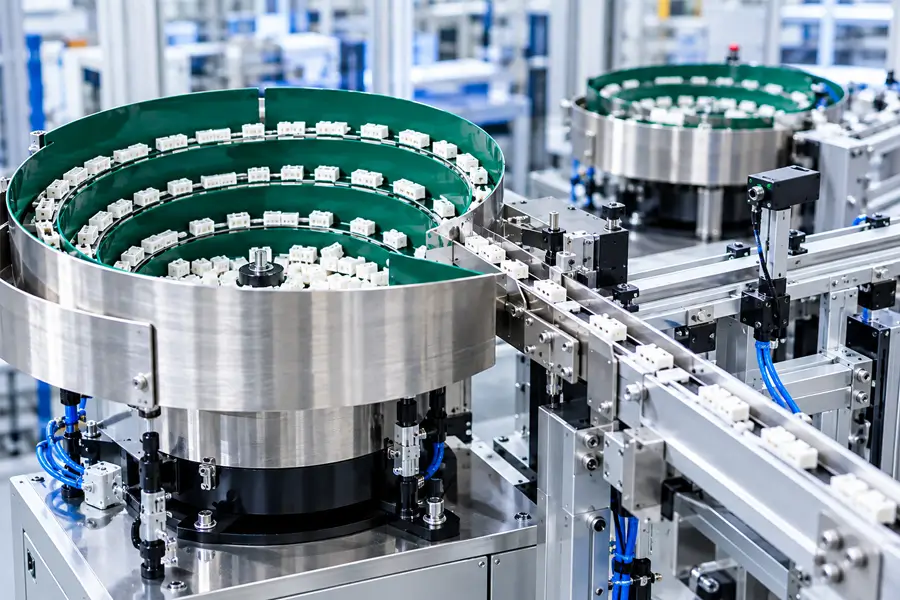
Alimentadores de tigela vibratória organize and supply small parts to automatic assembly machines.
They work well with parts that have consistent shapes and sizes.
Common electronic parts include:
- Connectors
- Screws
- Pins
- Molas
- Terminals
- Small plastic parts
- Metal components
The feeder separates parts from a bulk supply and sends them to the correct position.
Custom tooling can match the shape of the customer’s parts.
SWOER provides customized vibratory bowl feeders for automatic assembly lines and production equipment.
Flex Feeders for Small Electronic Components
Flex feeders offer another solution for feeding small and delicate electronic parts.
They use a flexible feeding surface to move parts into the working area.
A vision system can identify part position and guide a robot to pick each component.
Flex feeders work well for mixed parts, irregular shapes, and products that need gentle handling.
Typical applications include:
| Aplicativo | Suitable Equipment |
| Small connectors | Vibratory bowl feeder |
| Irregular plastic parts | Flex feeder |
| Metal terminals | Bowl feeder |
| Small components | Flex feeder + vision |
| Molas | Vibratory bowl feeder |
Automatic Electronics Assembly Machines
Automatic assembly machines combine several processes into one production system.
Typical processes include feeding, positioning, inserting, fastening, pressing, riveting, welding, and testing.
Manufacturers can design equipment around the product structure and production requirements.
Custom assembly machines work well when standard equipment cannot meet the required process.
Common examples include:
- Automatic connector assembly machines
- Circuit breaker assembly machines
- Switch assembly machines
- Electronic component assembly machines
- Small parts assembly machines
SWOER can connect vibratory feeders, flex feeders, robots, inspection systems, and assembly units into one automated system.
Vision Inspection Systems
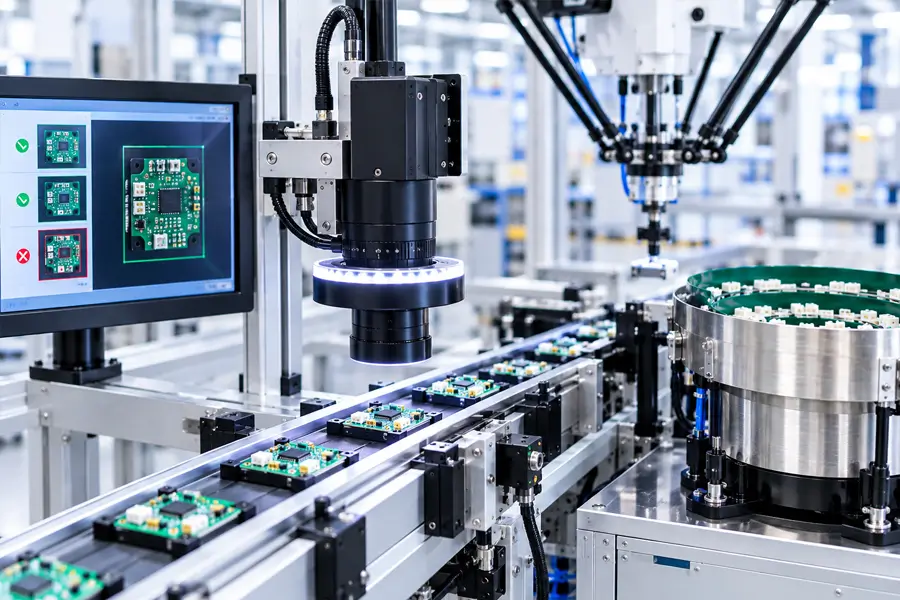
Vision inspection equipment checks parts during the assembly process.
Cameras can identify missing, damaged, incorrectly positioned, or defective components.
Vision inspection can also check dimensions, orientation, color, and surface conditions.
For example, a vibratory feeder can supply parts to a camera inspection station.
The system can then separate qualified and defective parts through different outlets.
This setup helps reduce manual inspection work and improves production consistency.
Robotic Pick and Place Equipment
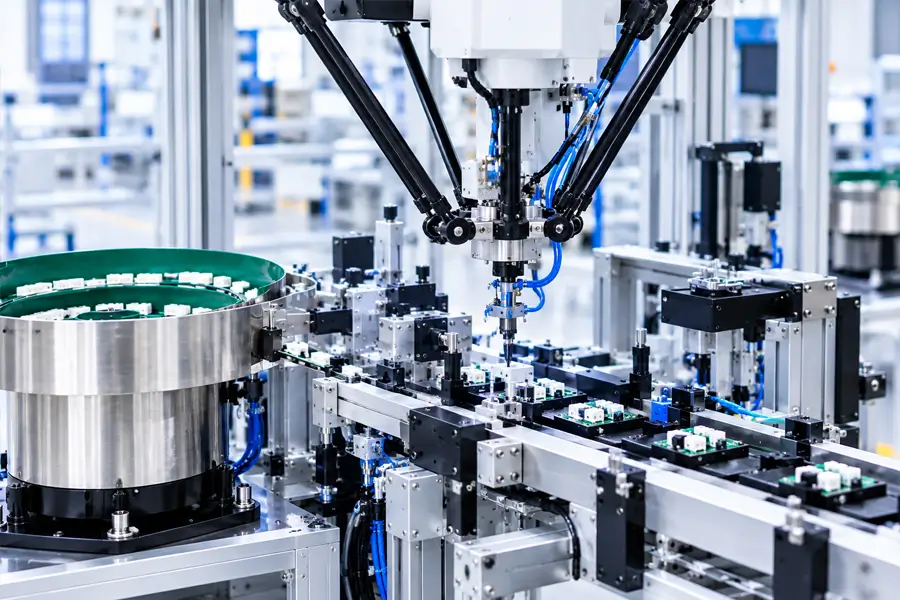
Robots move electronic components between different production stations.
Delta robots work well for high-speed pick-and-place applications.
They can pick parts from feeders, trays, or conveyors and place them into assembly fixtures.
Robot systems can also connect with vision inspection equipment.
This combination supports fast and flexible electronics production.
Packaging Equipment for Electronics Manufacturing
Packaging equipment completes the production process after assembly and inspection.
Common packaging processes include:
- Counting
- Bagging
- Sealing
- Labeling
- Sorting
- Boxing
Automatic packaging machines can connect with conveyors and inspection systems.
This setup creates a continuous production flow from assembly to final packaging.
How to Choose Electronics Assembly Equipment
Choosing the right equipment starts with the product and production requirements.
Consider these key factors:
1. Part shape and size
Check whether parts need orientation, separation, or special handling.
2. Production volume
High-volume production often needs faster automatic systems.
3. Assembly process
List each operation, such as insertion, pressing, welding, or testing.
4. Inspection requirements
Determine whether cameras or sensors need to check product quality.
5. Available production space
Equipment layout should match the available factory area.
6. Future production needs
Leave room for additional stations or process upgrades.
Custom equipment can combine several functions when standard machines cannot meet these requirements.
Custom Electronics Assembly Solutions from SWOER
SWOER provides custom automation solutions for electronics manufacturing.
The system can combine vibratory bowl feeders, flex feeders, conveyors, vision inspection, robots, and automatic assembly machines.
Each system can match the customer’s parts and production process.
The typical process starts with customer drawings and production requirements.
SWOER then designs a 3D model for customer confirmation.
After contract signing, the team starts machine production and testing.
After delivery, SWOER provides technical support and guides customers through machine installation, operation, and adjustment.
Conclusão
Different electronic products require different assembly equipment.
Vibratory bowl feeders and flex feeders handle part feeding.
Automatic assembly machines complete production operations.
Vision systems inspect parts, while robots provide fast pick-and-place movement.
Packaging equipment completes the final production steps.
The best solution depends on your parts, assembly process, production volume, and automation goals.
For complex electronics production, custom assembly equipment can combine these functions into one complete system.
Need a custom electronics assembly system? Contact SWOER with your product drawings and production requirements.

 Portuguese (Portugal)
  English
  Spanish (Mexico)
  Czech
Czech  Arabic
  Russian
  German
  French
  Turkish
  Italian
  Ukrainian
  Polish
  Romanian
  Bengali
  Thai
Thai  Japanese
  Korean
  Hebrew
  Uzbek
Uzbek  Hindi
Hindi  Slovak
  Vietnamese
  Portuguese (Brazil)
  Spanish (Peru)
  Spanish (Spain)
  Spanish (Venezuela)