
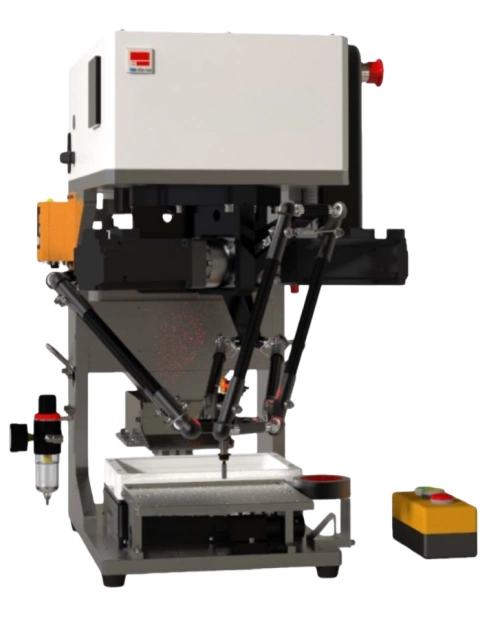
Advantages of Parallel Robots
Parallel robots (also known as delta robots or spider robots) offer several distinct advantages over traditional serial robots (such as articulated or SCARA robots). These advantages make them the preferred choice for specific high-speed, high-precision applications.
I. Speed and Dynamic Performance
Extremely High Speed and Acceleration
Opis: Parallel robots achieve very high speeds (often >10 m/s) and accelerations (up to 10-15 G or more) due to their lightweight moving platform and fixed, heavy motors.
Benefit: Ideal for high-throughput applications like pick-and-place, sorting, and packaging.
Short Pick-and-Place Cycle Times
Opis: Typical cycle times for a 300mm pick-and-place operation range from 0.3 to 0.5 seconds.
Benefit: Significantly faster than articulated robots (0.8-1.5 seconds) or SCARA robots (0.5-0.8 seconds).
Excellent Dynamic Stability
Opis: The parallel structure distributes inertial forces, minimizing vibration and settling time at the end of motion.
Benefit: Allows for precise high-speed positioning without oscillation or overshoot.
II. Precision and Rigidity
High Positioning Accuracy
Opis: Errors are not accumulated across multiple joints as in serial robots; all actuators work together to position the end-effector.
Benefit: Superior repeatability (typically ±0.05 to ±0.1 mm) for high-precision tasks.
Excellent Structural Rigidity
Opis: The closed-loop kinematic chain provides high stiffness-to-weight ratio, especially in the vertical direction.
Benefit: Can handle higher vertical loads relative to its weight; resists deflection under load.
No Accumulated Joint Error
Opis: In serial robots, error from each joint adds up. In parallel robots, the end-effector position is the result of simultaneous, coordinated motion.
Benefit: Higher absolute accuracy without complex calibration.
III. Workspace and Configuration Benefits
Large Workspace Relative to Footprint
Opis: Parallel robots are typically ceiling-mounted, with a workspace that extends downward in a dome or cylinder shape.
Benefit: The robot occupies minimal floor space while covering a large working area underneath.
No Cabling from the Base to the End-Effector
Opis: Motors and drives are fixed on the base frame, not moving with the arms.
Benefit: Cables and hoses for the end-effector can be routed directly from above, simplifying cable management and reducing wear.
Ideal for Conveyor Tracking
Opis: The high speed and rigid structure make parallel robots excellent for tracking moving conveyors in real-time.
Benefit: Seamless integration into high-speed packaging and assembly lines.
IV. Operational and Maintenance Advantages
No Heavy Moving Mass
Opis: All motors and drives are stationary on the base; only lightweight arms and the end-effector move.
Benefit: Lower energy consumption, less wear on moving parts, and higher dynamic performance.
Simplified Calibration
Opis: The parallel structure has fewer calibration parameters compared to serial robots with multiple articulated joints.
Benefit: Faster commissioning and easier maintenance.
High Reliability for Repetitive Tasks
Opis: With fewer moving joints subject to complex articulation, parallel robots excel at millions of repetitive cycles.
Benefit: Long-term reliability in high-duty-cycle applications.
V. Application-Specific Advantages
| Aplikacja | Korzyść |
|---|---|
| High-Speed Pick-and-Place | Unmatched cycle times for lightweight items |
| Packaging (Food, Pharma, Consumer Goods) | Clean operation, high throughput, easy sanitation |
| Sorting (Conveyor-based) | Excellent conveyor tracking and high-speed sorting |
| Assembly of Small Components | High precision at speed |
| Produkcja urządzeń medycznych | Clean, precise, repeatable motion |
Summary Table: Key Advantages
| Category | Korzyść |
|---|---|
| Prędkość | >10 m/s, up to 15G acceleration |
| Cycle Time | 0.3 – 0.5 seconds (300mm pick-place) |
| Dokładność | ±0.05 – 0.1 mm repeatability |
| Rigidity | High stiffness-to-weight ratio |
| Footprint | Small floor space, ceiling-mounted |
| Cable Management | No moving motors; easy routing |
| Efektywność energetyczna | Low inertia, fixed heavy components |
| Niezawodność | Excellent for high-duty-cycle repetitive tasks |
Streszczenie: The advantages of parallel robots center on extreme speed, high precision, excellent rigidity, compact footprint, and suitability for high-throughput pick-and-place applications. They are the preferred choice for industries such as food packaging, pharmaceuticals, electronics assembly, and consumer goods where lightweight items must be moved quickly, accurately, and reliably. However, their limitations (small workspace, low payload, poor complex path flexibility) mean they are best used as specialized high-speed workhorses rather than general-purpose robots.

 Polish
  English
  Spanish (Mexico)
  Czech
Czech  Arabic
  Russian
  German
  French
  Turkish
  Italian
  Ukrainian
  Romanian
  Bengali
  Portuguese (Portugal)
  Thai
Thai  Japanese
  Korean
  Hebrew
  Uzbek
Uzbek  Hindi
Hindi  Slovak
  Vietnamese
  Portuguese (Brazil)
  Spanish (Peru)
  Spanish (Spain)
  Spanish (Venezuela)