
I. Quick Answer
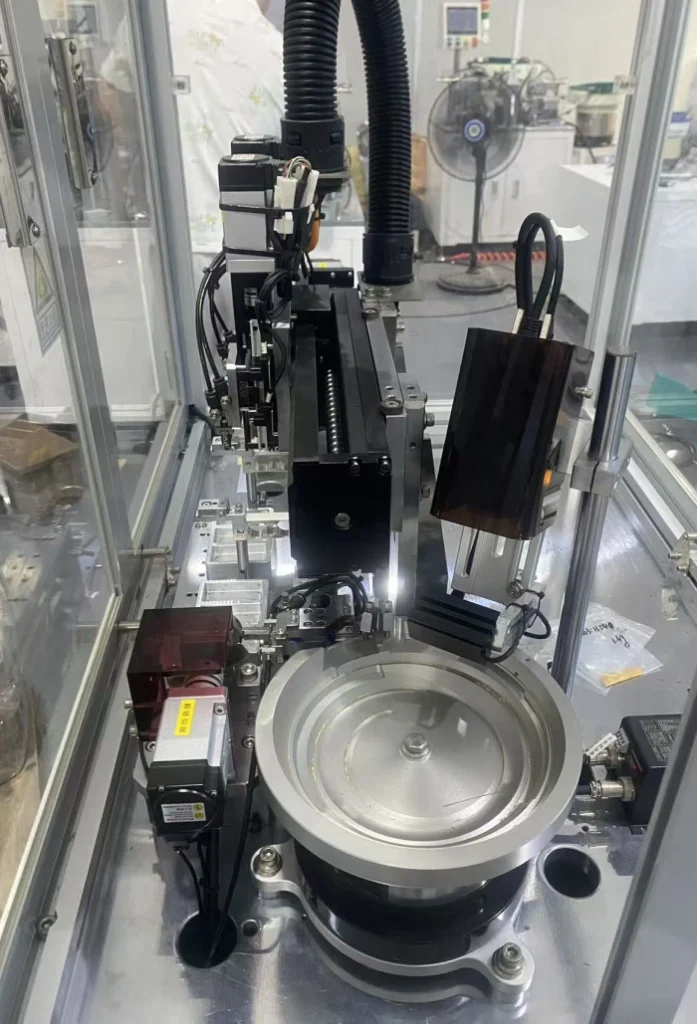
Yes, a vibratory bowl feeder can work together with a riveting machine. This is a common automation configuration where the bowl feeder sorts, orients, and supplies rivets one by one to the riveting machine, enabling continuous, high-speed riveting without manual loading.
II. Principle of Operation
| Step | Action |
|---|---|
| 1 | Bulk rivets are loaded into the vibratory bowl feeder |
| 2 | The bowl vibrates, moving rivets up a spiral track |
| 3 | Track tooling (wipers, slots, gaps) orients each rivet correctly (e.g., head-up or head-down) |
| 4 | Oriented rivets exit the bowl and enter a linear feeder or feed tube |
| 5 | Rivets are delivered one by one to the riveting machine’s nosepiece or die |
| 6 | ए sensor detects that a rivet is in position |
| 7 | The riveting machine picks or receives the rivet and performs the riveting operation |
| 8 | The cycle repeats automatically |
Core principle: The vibratory bowl feeder acts as the automated rivet supply source, replacing manual rivet handling with a continuous, oriented, single-file feed. The riveting machine then performs the forming operation (pressing, spinning, or pulling) on each rivet.
III. Key Components for Integration
| Component | Purpose |
|---|---|
| Vibratory bowl feeder | Sorts and orients rivets |
| Linear feeder (straight track) | Transfers rivets from bowl exit to riveting machine |
| Feed tube / escapement | Delivers one rivet at a time to the riveting head |
| Part-present sensor | Detects rivet is ready for pick-up |
| Riveting machine | Performs the riveting operation (press, spin, or pull) |
| PLC / control interface | Synchronizes bowl feeder and riveting machine cycles |
IV. Rivet Types Suitable for Bowl Feeding
| Rivet Type | Suitable for Bowl Feeding? | नोट्स |
|---|---|---|
| Blind rivets (pop rivets) | ✅ Yes | Most common; symmetrical, easy to orient |
| Semi-tubular rivets | ✅ Yes | Good for automatic feeding |
| Solid rivets | ⚠️ Limited | Heavier; may require special bowl design |
| Large rivets (> 10 mm) | ⚠️ Limited | May need a larger bowl or alternative feeder |
| Custom or asymmetric rivets | ⚠️ Requires special tooling | Orientation may be challenging |
V. Advantages of Bowl Feeder + Riveting Machine
| फ़ायदा | Explanation |
|---|---|
| Continuous operation | Bowl feeder supplies rivets automatically; no manual loading |
| High speed | Up to 60–120 rivets per minute (depending on rivet size and machine) |
| Consistent orientation | Every rivet is correctly oriented before entering the riveting head |
| Reduced labor cost | One operator can monitor multiple riveting stations |
| Quality improvement | Fewer mis-feeds and jams compared to manual loading |
| Integration flexibility | Can be combined with sensors and PLC for automatic start/stop |
VI. Issues to Consider
| Issue | Solution |
|---|---|
| Rivet jams in the feed tube | Use a slightly oversized tube; add air assist; inspect rivets for burrs |
| Rivet orientation errors | Improve track tooling; add vision verification if needed |
| Bowl speed mismatch | Adjust bowl amplitude or add a buffer track between bowl and riveting machine |
| Rivet wear on tooling | Use wear-resistant track materials (stainless steel, hardened inserts) |
| Noise | Add a soundproof enclosure if noise exceeds 80 dBA |
| Rivet size changeover | Use quick-change tooling and adjustable tracks |
VII. Summary Table
| Aspect | Details |
|---|---|
| Can they work together? | ✅ Yes |
| Principle | Bowl sorts/orients → linear feeder → riveting machine picks and forms |
| Suitable rivet types | Blind rivets, semi-tubular rivets, small solid rivets |
| Typical speed | 60–120 rivets/min |
| Key integration components | Linear feeder, feed tube, sensor, PLC |
| Main advantages | Continuous operation, high speed, consistent orientation, reduced labor |
| Main challenges | Jams, orientation errors, speed matching, noise |

 Hindi
 English
 Spanish (Mexico)
 Czech
 Arabic
 Russian
 German
 French
 Turkish
 Italian
 Ukrainian
 Polish
 Romanian
 Bengali
 Portuguese (Portugal)
 Thai
 Japanese
 Korean
 Hebrew
 Uzbek
 Slovak
 Vietnamese
 Portuguese (Brazil)
 Spanish (Peru)
 Spanish (Spain)
 Spanish (Venezuela)