
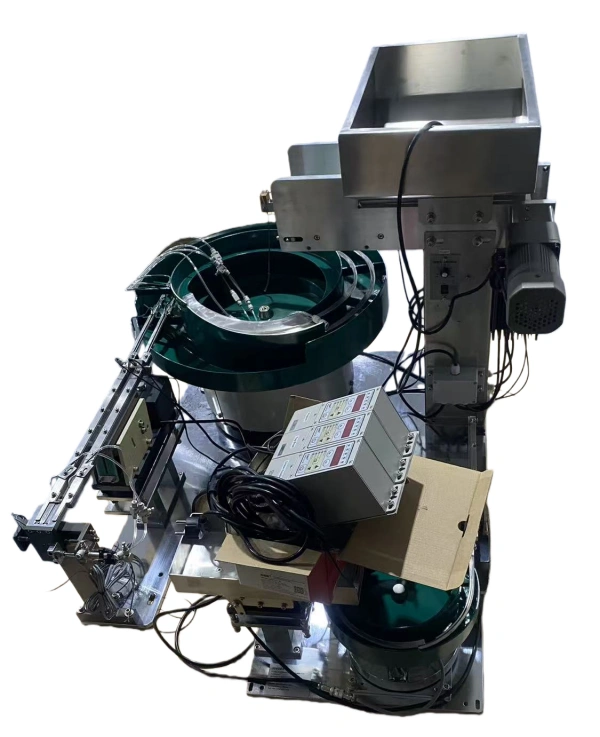
I. Products That Typically Require a Soundproof Enclosure
| Product Type / Characteristic | Reason for High Noise |
|---|---|
| Hard, heavy metal parts (e.g., steel screws, bolts, nuts, rivets, pins) | Metal‑to‑metal contact generates loud impact noise. |
| Small, rigid parts (e.g., bearings, small gears, machine components) | High‑frequency impacts produce sharp, irritating sounds. |
| High‑speed feeding applications (e.g., feeding at 300+ parts/min) | Faster bowl operation increases both vibration noise and part‑to‑part collision noise. |
| Large bowl with high amplitude (e.g., feeding parts > 50 mm) | Larger bowls and higher vibration energy produce louder mechanical noise. |
| Parts with sharp edges or rough surfaces (e.g., stamped metal parts, formed components) | Rough surfaces increase friction noise and part‑to‑part scraping. |
| Parts that tumble or bounce (e.g., disc‑shaped or irregular parts) | Parts that roll or fall over during feeding create additional impact noise. |
| Long or heavy parts (e.g., long pins, thick washers) | Heavier parts create more kinetic energy and louder impact when they strike the track or each other. |
II. When an Enclosure Is Almost Always Required
| Condition | Why |
|---|---|
| Operator station nearby | Exposure > 85 dBA for 8 hours is a health risk; enclosure protects workers. |
| Open workshop with multiple machines | Factory‑wide noise level must be controlled to avoid cumulative noise exposure. |
| Medical / pharmaceutical / cleanroom environment | Noise can be a disturbance and may affect operator concentration; enclosure also contains dust. |
| Office or laboratory attached to the production area | Noise must be kept below typical office noise limits (e.g., < 55–60 dBA). |
| Local noise regulations require ≤ 75–80 dBA at operator position | Enclosure is a simple and effective way to meet legal noise limits. |
| Night‑shift operation | Noise restrictions are often stricter at night. |
III. When an Enclosure May NOT Be Needed
| Condition | Why |
|---|---|
| Plastic or soft rubber parts | Lower impact noise due to softer material. |
| Very low speed (< 30 parts/min) | Low‑energy impact produces little noise. |
| Remote installation (bowl is far from operator, e.g., behind a wall or in a separate room) | Operator exposure is already low. |
| Small, lightweight parts (e.g., plastic clips, foam pieces) | Minimal collision noise. |
| Short production runs (e.g., 1–2 hours per day) | Exposure time is short; risk is lower. |
| Factory has no noise limit requirement | If no regulation exists, an enclosure is an optional extra. |
IV. Typical Noise Levels by Part Type
| Part Type | Typical Noise Level (Without Enclosure) | Enclosure Recommended? |
|---|---|---|
| Plastic caps (soft) | 70 – 80 dBA | Optional (usually not needed) |
| Aluminum screws / nuts | 75 – 85 dBA | Yes, if operator nearby |
| Steel screws / rivets | 85 – 95 dBA | Strongly recommended |
| Steel bearings / heavy pins | 90 – 100+ dBA | Required for most factory conditions |
| Glass / ceramic parts | 85 – 95 dBA | Required (also protects parts) |
| Rubber O‑rings / seals | 65 – 75 dBA | Usually not needed |
V. Summary Table
| Consideration | Action |
|---|---|
| Hard metal parts (steel, brass, stainless) | ✅ Highly recommended |
| High speed (> 200 parts/min) | ✅ Recommended |
| Operator works within 2 meters | ✅ Strongly recommended |
| Noise level measured > 85 dBA | ✅ Required (to meet safety standards) |
| Soft / plastic / rubber parts | ❌ Usually not needed |
| Low speed & remote location | ❌ Not needed |

 Hebrew
  English
  Spanish (Mexico)
  Czech
Czech  Arabic
  Russian
  German
  French
  Turkish
  Italian
  Ukrainian
  Polish
  Romanian
  Bengali
  Portuguese (Portugal)
  Thai
Thai  Japanese
  Korean
  Uzbek
Uzbek  Hindi
Hindi  Slovak
  Vietnamese
  Portuguese (Brazil)
  Spanish (Peru)
  Spanish (Spain)
  Spanish (Venezuela)