
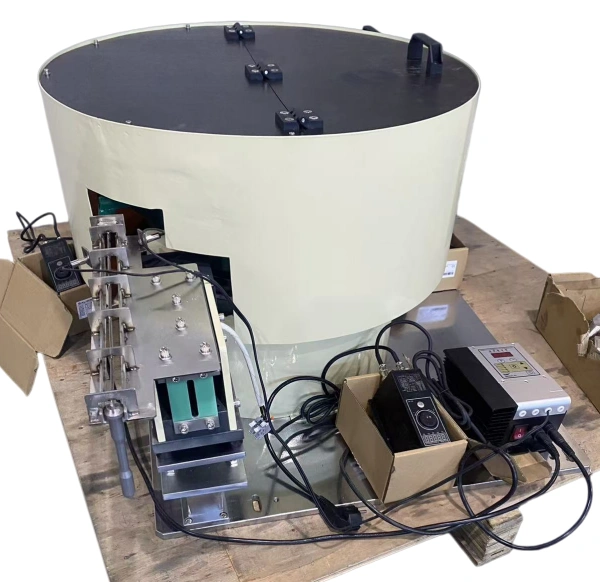
Sensors play a critical role in automating and stabilizing the operation of a vibratory bowl feeder. Their main functions are as follows:
I. Part Presence Detection (Feedback Control)
Start/Stop Control
Sensor detects when parts are present at the discharge point or linear track.
Sends a signal to the controller to stop the bowl (prevents overfeeding).
When parts are absent for a set time, the sensor signals the bowl to start again.
Downstream Machine Request
Sensor at the pickup station detects that a part has been taken (e.g., by a robot or assembly machine).
Triggers the bowl to advance the next part into position.
II. Part Quality and Orientation Verification
Correct Orientation Check
Sensor (often a fiber optic or photoelectric sensor) verifies that a part is in the correct orientation (e.g., a screw head‑up or head‑down).
If orientation is wrong, a reject signal can be sent to an air blast or pusher.
Presence / Absence of Features
Checks for missing features (e.g., a washer on a screw, a hole in a stamped part).
Can be combined with vision for more complex checks.
III. Jamming Detection
Jam / Back-up Detection
Sensor placed at a critical point on the track detects when parts stop moving or pile up.
Signals the controller to stop the bowl or activate a reverse‑pulse (if available) to clear the jam.
Overflow Prevention
Sensor at the bowl discharge or linear track exit detects when parts have backed up into the sensing zone.
Stops the bowl until the downstream machine clears the backlog.
IV. Level Control (Hopper / Bowl)
Low Level Detection
Sensor in the bowl or in a supply hopper detects when the part level drops below a set point.
Activates an automatic refill mechanism (e.g., a hopper gate or elevator) to add more parts.
High Level / Full Bowl Detection
Sensor detects when the part level reaches a maximum safe level.
Stops the refill mechanism to prevent overfilling and part damage.
V. Speed and Process Monitoring
Feed Rate Monitoring
Sensor counts parts passing a point over time.
Compares actual feed rate to a setpoint and adjusts bowl amplitude or frequency to maintain target rate.
Machine Cycle Synchronization
Sensor signals the PLC when a part is in position for pick‑up.
Ensures the robot or assembly machine picks at the correct moment.
VI. Safety Functions
Access Detection (with guard door)
Sensor detects if a safety guard or door is opened during operation.
Immediately stops the bowl to protect the operator.
Vibration / Overload Sensing (advanced systems)
Accelerometer or strain sensor monitors vibration intensity.
Shuts down the bowl if abnormal vibration (e.g., from jamming or broken springs) is detected.
Summary Table: Sensor Functions
| Function Category | Specific Role |
|---|---|
| Feed control | Start/stop bowl based on part demand |
| Orientation check | Verify part direction before discharge |
| Jam detection | Stop bowl when parts pile up or stop moving |
| Level control | Maintain correct part volume in bowl |
| Feed rate monitoring | Adjust amplitude to maintain target speed |
| Synchronization | Signal downstream machine when part is ready |
| Safety | Stop bowl when guard is opened or abnormal vibration occurs |
In short:
Sensors on a vibratory bowl feeder provide real‑time feedback for automatic start/stop control, part verification, jam detection, level management, and safety interlocking. They are essential for turning a simple vibrating bowl into a reliable, efficient, and fully automated feeding station.

 Spanish (Peru)
  English
  Spanish (Mexico)
  Czech
Czech  Arabic
  Russian
  German
  French
  Turkish
  Italian
  Ukrainian
  Polish
  Romanian
  Bengali
  Portuguese (Portugal)
  Thai
Thai  Japanese
  Korean
  Hebrew
  Uzbek
Uzbek  Hindi
Hindi  Slovak
  Vietnamese
  Portuguese (Brazil)
  Spanish (Spain)
  Spanish (Venezuela)