
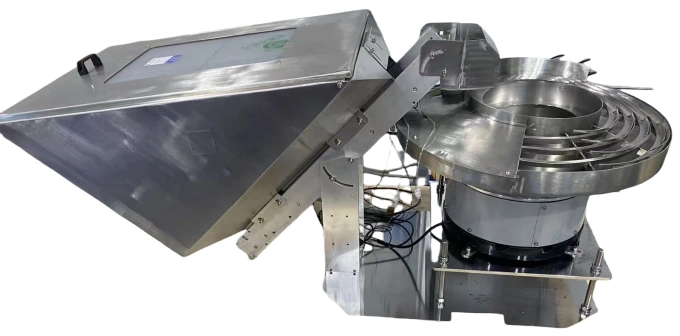
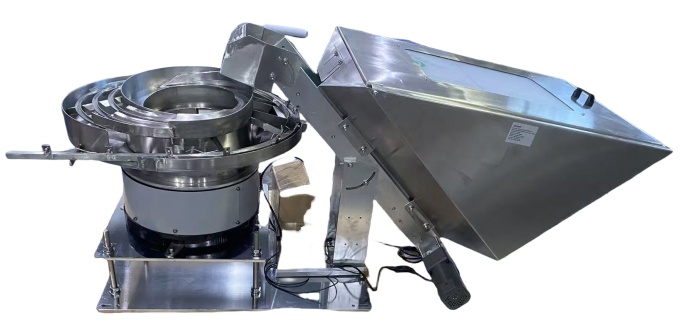
Why Does a Vibratory Bowl Jam or Have Parts Flow Backwards? How to Solve It?
- Main Causes
- Incorrect Vibration Settings
- Amplitude:
- Too Low: Parts can’t overcome friction, causing jams.
- Too High: Parts bounce chaotically, leading to backflow or jamming.
- Frecuencia: Mismatched rhythm disrupts flow.
- Track and Part Mismatch
- Worn/Damaged Track: Burrs or deformities obstruct flow.
- Incorrect Track Clearance: Too wide or too narrow.
- Poor Track Tooling: Ineffective orienting or sorting features.
- Part Issues
- Poor Part Quality: Excessive burrs, flashing, or dimensional variation.
- Part Characteristics: Oily, very lightweight, or tangle-prone.
- Environmental & Physical Factors
- Overfilled Bowl: Excessive pressure on parts.
- Static Electricity: Light parts cling to surfaces.
- External Vibration: Improper mounting or interference.
- Systematic Solutions
- Fine-Tune Vibration Parameters
- Adjust Controller: Start low, increase amplitude until flow is stable.
- Adjust Leaf Springs: Ensure they are tight and adjust the attack angle.
- Inspect and Optimize the Track
- Clean and Polish: Remove all debris and smooth out burrs.
- Repair Track: Fix any deformed or damaged sections.
- Optimize Tooling: Ensure orienting devices work correctly.
- Control Input and Conditions
- Ensure Part Quality: Use parts within specification.
- Control Material Level: Keep the bowl 1/3 to 1/2 full.
- Eliminate Static: Use an ionizing blower.
- Secure Mounting: Mount the bowl solidly and isolate from other vibrations.
- Use Auxiliary Methods
- Apply Lubrication/Coating: Use dry lubricant or a non-stick coating.
- Add Air Assist: Install air jets to dislodge parts at trouble spots.
Summary: Jamming and backflow signal an imbalance between vibration energy and track resistance. The solution is a systematic process of tuning, inspection, and input control.
 Spanish (Peru)
  English
  Spanish (Mexico)
  Czech
Czech  Arabic
  Russian
  German
  French
  Turkish
  Italian
  Ukrainian
  Polish
  Romanian
  Bengali
  Portuguese (Portugal)
  Thai
Thai  Japanese
  Korean
  Hebrew
  Uzbek
Uzbek  Hindi
Hindi  Slovak
  Vietnamese
  Portuguese (Brazil)
  Spanish (Spain)
  Spanish (Venezuela)
Reseñas
No hay ninguna reseña todavía.