
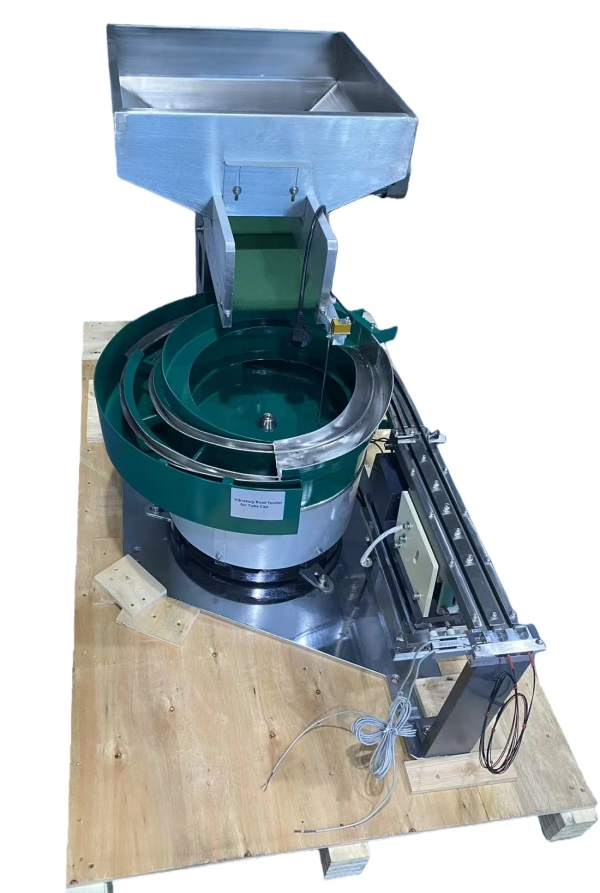
I. Quick Answer
| Aspect | Alimentador de tazón vibratorio | Alimentador flexible |
|---|---|---|
| Speed (parts/min) | Much faster – typically 100–500+ parts/min, up to 1000+ for small, simple parts | Slower – typically 10–60 parts/min (limited by robot cycle time) |
| Stability | Very stable – once tuned for a specific part, the feed rate is highly consistent | Moderate – depends on vision processing speed and robot repeatability; can be affected by lighting, part appearance, and tray condition |
II. Speed Comparison
| Speed Factor | Alimentador de tazón vibratorio | Alimentador flexible |
|---|---|---|
| Typical range | 100 – 500 parts/min | 10 – 60 parts/min |
| Maximum (small, simple parts) | Up to 1000+ parts/min | Up to 120 parts/min (with high‑speed robot + fast vision) |
| Speed limitation | Limited by track geometry and part size | Limited by robot pick‑and‑place cycle time and vision processing time |
| Continuous vs. intermittent | Continuous – parts flow steadily | Intermittent – robot picks, then waits for vision to locate the next part |
Winner for speed: Vibratory bowl feeder – significantly faster for suitable parts.
III. Stability Comparison
| Stability Factor | Alimentador de tazón vibratorio | Alimentador flexible |
|---|---|---|
| Feed rate consistency | Very consistent – once tuned, the rate remains stable | Variable – depends on how well parts are scattered, lighting conditions, and part recognition quality |
| Sensitivity to part variation | High – small changes in part dimensions or surface condition can cause jamming | Moderate – vision can adapt to minor variations, but may mis‑identify parts if appearance changes |
| Sensitivity to environmental factors | Low – unaffected by dust, lighting, or vibration (if properly mounted) | High – affected by changes in lighting, dust on the tray, or camera calibration drift |
| Long‑term stability | Maintains performance with periodic cleaning and spring replacement | Requires regular calibration, software updates, and gripper maintenance |
| Jamming / downtime | Prone to jams if parts are sticky, oily, or tangled | Less prone to jams – parts are scattered, not forced through a track |
Winner for stability (low‑variation output): Vibratory bowl feeder – when feeding a single, well‑behaved part type.
Winner for stability (reliability against jams): Alimentador flexible – less likely to jam, but speed is less predictable.
IV. Which One to Choose – Speed vs. Stability Decision Matrix
| Your Priority | Recommended Feeder |
|---|---|
| Maximum speed (500+ parts/min) | Vibratory bowl feeder – essential for high‑volume production |
| Consistent feed rate (no fluctuations) | Vibratory bowl feeder – after proper tuning |
| Handling delicate or complex parts | Alimentador flexible – speed is lower, but parts are gently handled |
| Frequent product changeover | Alimentador flexible – quick software‑based changeover, even if speed is lower |
| High‑mix, low‑volume production | Alimentador flexible – speed is acceptable, flexibility is key |
| Tangle‑prone or sticky parts | Alimentador flexible – avoids jamming, despite lower speed |

 Spanish (Mexico)
  English
  Czech
Czech  Arabic
  Russian
  German
  French
  Turkish
  Italian
  Ukrainian
  Polish
  Romanian
  Bengali
  Portuguese (Portugal)
  Thai
Thai  Japanese
  Korean
  Hebrew
  Uzbek
Uzbek  Hindi
Hindi  Slovak
  Vietnamese
  Portuguese (Brazil)
  Spanish (Peru)
  Spanish (Spain)
  Spanish (Venezuela)