
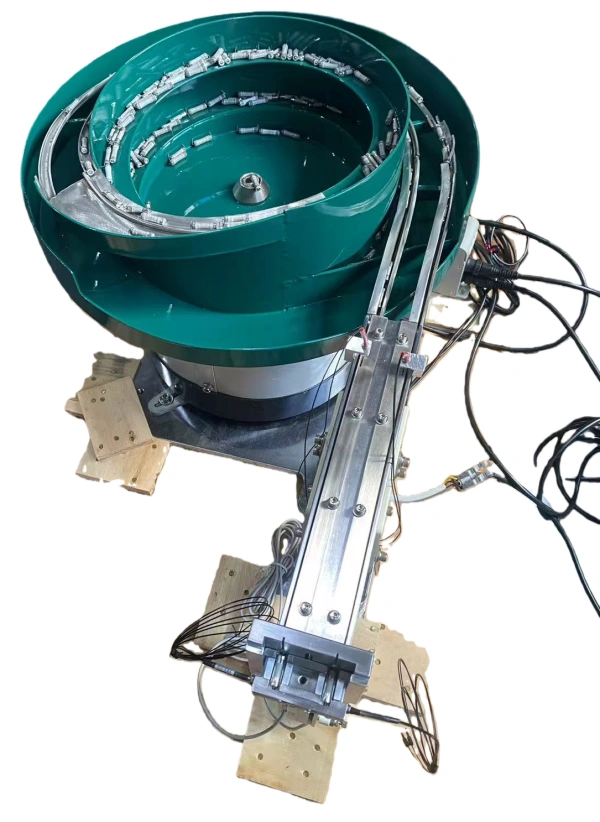
A vibratory bowl feeder with an integrated camera (vision-guided feeding system) is suitable for products that require high-precision orientation, quality inspection, oder real-time defect detection. Below is a detailed breakdown:
I. Product Types Best Suited for a Vibratory Bowl Feeder with a Camera
| Product Category | Specific Examples | Why Camera Integration Helps |
|---|---|---|
| Parts with polarity or orientation marks | ICs, connectors, diodes, capacitors, LEDs, sensors | The camera detects polarity marks, notches, or orientation features to ensure correct feeding direction before assembly. |
| Parts with fine details or subtle defects | Precision gears, medical components, optical parts, micro‑switches | The camera identifies scratches, burrs, cracks, missing features, or dimensional deviations that are difficult to detect mechanically. |
| Parts that change appearance frequently | Products with different colors, markings, or printed text | The camera can be re‑programmed to recognize new patterns or colors, offering flexibility for variant parts. |
| Mixed‑part feeding (different types in one batch) | Mixed screws, mixed connectors, multi‑variant electronic components | The camera identifies the part type and guides the feeder or robot to handle each variant correctly. |
| Parts requiring 100% inspection before assembly | Automotive sensors, medical devices, aerospace components, safety‑critical parts | The camera ensures every part meets quality standards before entering the assembly process. |
| Delicate or easily scratched parts | Optical lenses, plated parts, mirror‑finished components | The camera enables non‑contact inspection, reducing handling damage. |
| Parts with complex geometry | Irregularly shaped plastic parts, complex castings, non‑symmetric parts | The camera can identify the correct orientation for parts that are difficult to orient using mechanical tooling alone. |
| Parts that need sorting by grade or class | Electronic components (e.g., resistors with different values), colored parts, parts with different surface finishes | The camera classifies parts based on color, marking, or size and triggers a reject or divert mechanism. |
II. Key Benefits of Adding a Camera to a Vibratory Bowl
| Benefit | Explanation |
|---|---|
| Higher orientation accuracy | The camera can identify subtle orientation features that mechanical tooling cannot handle, achieving near‑100% orientation accuracy. |
| Defect detection | The camera detects scratches, chips, missing features, or contamination before parts enter assembly. |
| Flexibilität | Software‑based recipes allow quick changeover between different part types without mechanical retooling. |
| Quality data | The system records defect rates and part counts, providing traceability and process control data. |
| Reduced downtime | Early rejection of defective parts prevents jams and reduces downtime downstream. |
III. When Is a Camera Necessary?
| Condition | Mechanical Feeder Only | Feeder + Camera |
|---|---|---|
| Simple orientation (e.g., head‑up / head‑down) | ✅ Usually sufficient | ❌ Not needed |
| Complex orientation (e.g., polarity mark, specific angle) | ❌ May fail | ✅ Required |
| 100% defect inspection | ❌ Not possible | ✅ Required |
| Mixed‑part feeding | ❌ Not possible | ✅ Required |
| Delicate parts | ⚠️ May scratch | ✅ Preferred (non‑contact inspection) |
IV. Summary Table
| Product Feature | Suitable for Bowl + Camera? | Reason |
|---|---|---|
| Polarity or orientation marks | ✅ Yes | Camera ensures correct direction |
| Subtle surface defects | ✅ Yes | Camera detects scratches, cracks, missing features |
| Mixed part types | ✅ Yes | Camera identifies and sorts variants |
| Printed text or color | ✅ Yes | Camera reads codes or colors |
| Complex geometry | ✅ Yes | Camera identifies orientation without mechanical tooling |
| Safety‑critical parts | ✅ Yes | 100% inspection ensures quality |
| Simple, symmetrical parts | ❌ Not needed | Mechanical tooling is faster and cheaper |

 German
  English
  Spanish (Mexico)
  Czech
Czech  Arabic
  Russian
  French
  Turkish
  Italian
  Ukrainian
  Polish
  Romanian
  Bengali
  Portuguese (Portugal)
  Thai
Thai  Japanese
  Korean
  Hebrew
  Uzbek
Uzbek  Hindi
Hindi  Slovak
  Vietnamese
  Portuguese (Brazil)
  Spanish (Peru)
  Spanish (Spain)
  Spanish (Venezuela)