
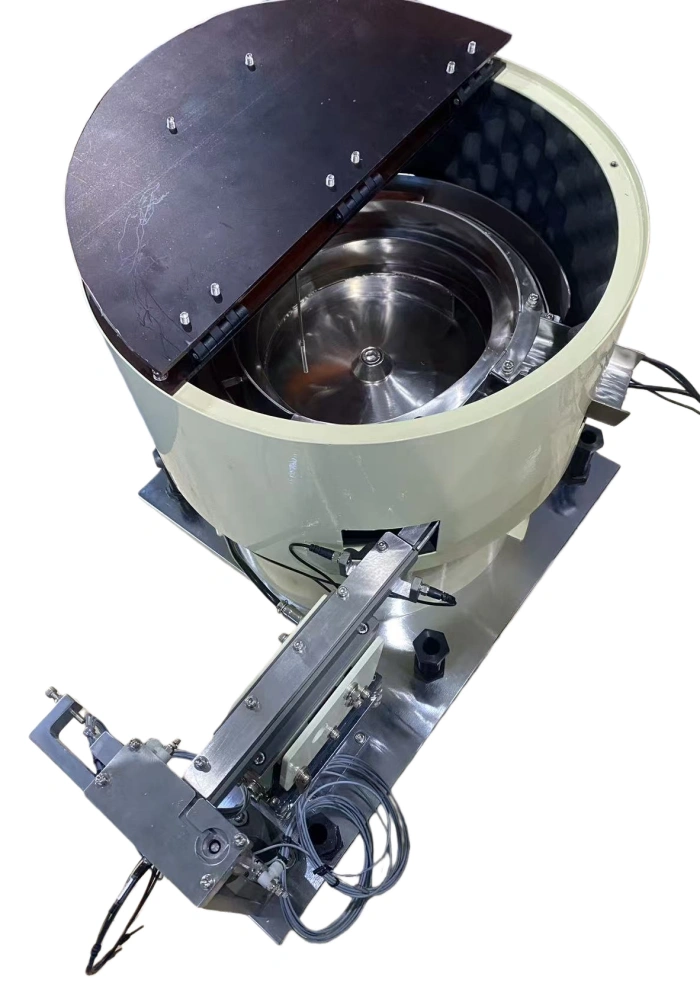
I. How a Vibratory Годівниця з чашею Works with an Electric Screwdriver?
The vibratory bowl feeder acts as the automated screw supply source, delivering screws one by one to the screwdriver in the correct orientation.
| Step | Action |
|---|---|
| 1 | Bulk screws are loaded into the vibratory bowl feeder |
| 2 | The bowl vibrates, moving screws up a spiral track |
| 3 | Track tooling (wipers, slots, gaps) orients each screw correctly (e.g., head-up, thread-down) |
| 4 | Oriented screws exit the bowl and enter a linear feeder or feed tube |
| 5 | Screws are delivered one by one to the screwdriver’s pick-up point |
| 6 | А sensor detects that a screw is in position |
| 7 | The screwdriver vacuum nozzle or magnetic bit picks the screw |
| 8 | The screwdriver moves to the target location and drives the screw |
| 9 | The cycle repeats automatically |
Core principle: The bowl feeder replaces manual screw handling with a continuous, oriented, single-file feed, allowing the screwdriver to operate without interruption.
II. Common Integration Methods
| Method | опис | Best For |
|---|---|---|
| Direct pick-up from bowl track | Screwdriver bit picks screw directly from the bowl’s linear track | Simple, low-speed applications |
| Pick-up from a nest / escapement | Screw is separated into a precision nest; screwdriver picks from the nest | High-precision, high-speed applications |
| Feed tube (blow-feed) | Screw travels through a flexible tube to the screwdriver head; often air-assisted | Robotic screwdriving, hard-to-reach locations |
| Handheld screwdriver with bowl feeder | Operator holds the screwdriver; bowl feeder supplies screws to a fixed pick-up point | Manual assembly with automated screw supply |
III. Efficiency of Bowl Feeder + Screwdriver
| Параметр | Typical Value | Best-in-Class |
|---|---|---|
| Screwdriving cycle time | 1–3 seconds per screw | 0.5–1 second per screw (small screws, optimized system) |
| Screws per minute | 20–60 screws/min | 60–120 screws/min (high-speed automated system) |
| Screws per hour | 1,200–3,600 screws/hour | 3,600–7,200 screws/hour |
| Bowl feed rate | 50–300 screws/min (bowl output) | Up to 500+ screws/min (small screws) |
| System efficiency (OEE) | 85–95% | 95–98% (well-maintained, optimized system) |
| Downtime (jams, refills) | 5–15% of operating time | < 5% (with proper maintenance and jam prevention) |
Примітка: Actual efficiency depends on screw size, screwdriver type, part complexity, and operator skill (for semi-automatic systems).
IV. Factors Affecting Efficiency
| Factor | Impact on Efficiency | Solution |
|---|---|---|
| Screw size | Smaller screws = faster cycle (0.5–1 s); larger screws = slower (2–3 s) | Match screwdriver torque and speed to screw size |
| Screw type | Screws with washers or unusual heads may jam more frequently | Use special track tooling; inspect screws for burrs |
| Bowl feed rate | If bowl cannot supply screws fast enough, screwdriver waits | Use a larger bowl or higher amplitude; add buffer track |
| Screwdriver type | Electric screwdrivers are faster and more repeatable than pneumatic | Use servo-controlled electric screwdrivers for high speed |
| Pick-up method | Vacuum pick-up is faster than magnetic; blow-feed is fastest for robotic systems | Choose pick-up method based on screw size and application |
| Jam frequency | Jams cause downtime and reduce efficiency | Regular cleaning; proper track gap; air assist |
| Maintenance | Worn springs, dirty track, or misaligned sensors reduce speed | Follow preventive maintenance schedule |
V. Efficiency by Automation Level
| Automation Level | Screws per Minute | Screws per Hour | Typical Application |
|---|---|---|---|
| Manual (handheld screwdriver + bowl feeder) | 15–30 | 900–1,800 | Low-volume assembly, repair |
| Semi-automatic (fixed screwdriver + bowl feeder) | 30–60 | 1,800–3,600 | Medium-volume assembly |
| Fully automatic (robot + bowl feeder + screwdriver) | 60–120 | 3,600–7,200 | High-volume production |
| High-speed automated system (multi-head) | 120–200+ | 7,200–12,000+ | Very high-volume production (small screws) |
VI. Summary Table
| Aspect | Details |
|---|---|
| Can they work together? | ✅ Yes |
| Principle | Bowl sorts/orients → linear feeder → screwdriver picks and drives |
| Typical cycle time | 1–3 seconds per screw |
| Typical speed | 20–60 screws/min (semi-auto); 60–120 screws/min (fully auto) |
| Максимальна швидкість | Up to 120–200 screws/min (high-speed system, small screws) |
| System efficiency (OEE) | 85–95% (typical); 95–98% (optimized) |
| Key factors affecting efficiency | Screw size, bowl feed rate, screwdriver type, jam frequency |
| Main advantages | Continuous operation, consistent orientation, reduced labor, high speed |

 Ukrainian
 English
 Spanish (Mexico)
 Czech
 Arabic
 Russian
 German
 French
 Turkish
 Italian
 Polish
 Romanian
 Bengali
 Portuguese (Portugal)
 Thai
 Japanese
 Korean
 Hebrew
 Uzbek
 Hindi
 Slovak
 Vietnamese
 Portuguese (Brazil)
 Spanish (Peru)
 Spanish (Spain)
 Spanish (Venezuela)