
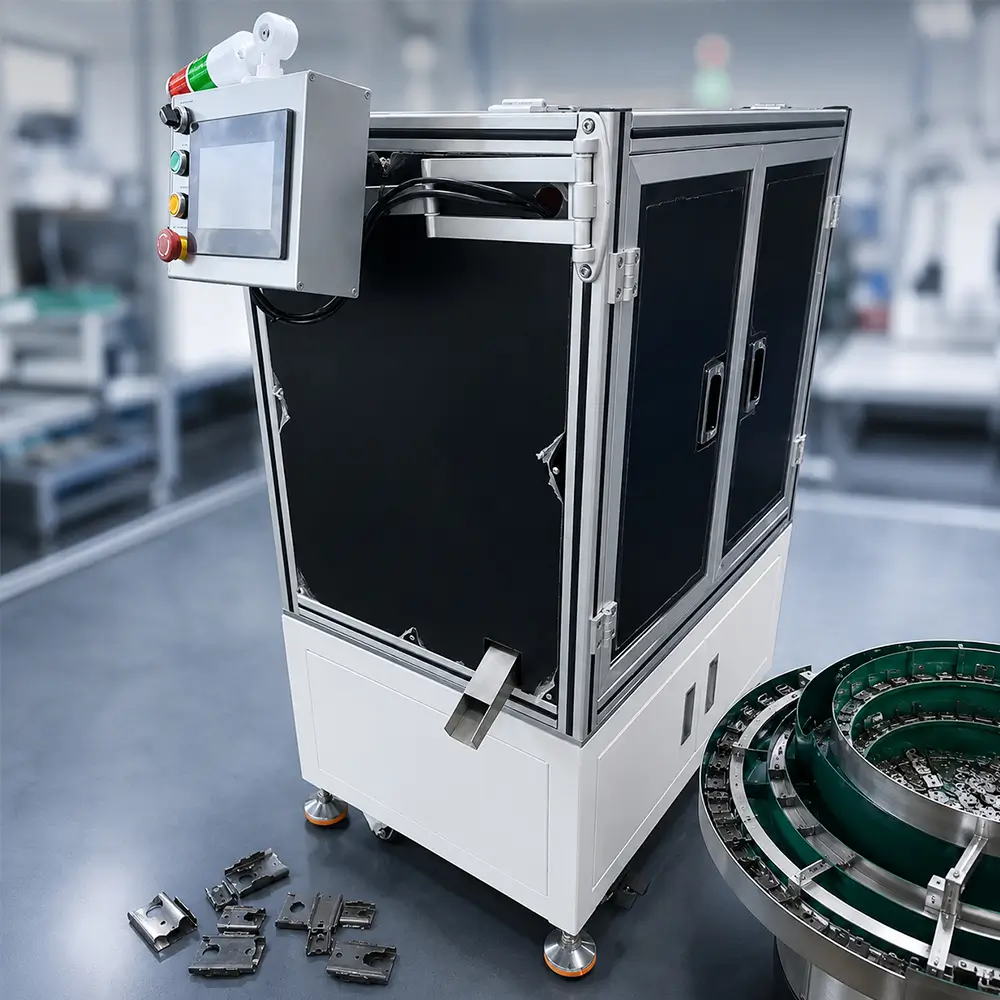
Small metal parts often arrive in bulk, but automated assembly machines need them one by one and in the correct position.
Manual feeding can slow production and increase counting errors. An automatic counting vibratory bowl feeder solves these problems by combining part feeding, orientation, counting and fault detection in one system.
The machine uses vibration to move small parts from a bulk supply into a controlled feeding track. Sensors then monitor the parts as they leave the feeder and help the system count each piece.
For production lines that need a fixed number of parts or continuous automatic feeding, this type of feeder can provide a practical way to reduce manual handling.
What Is an Automatic Counting Vibratory Bowl Feeder?
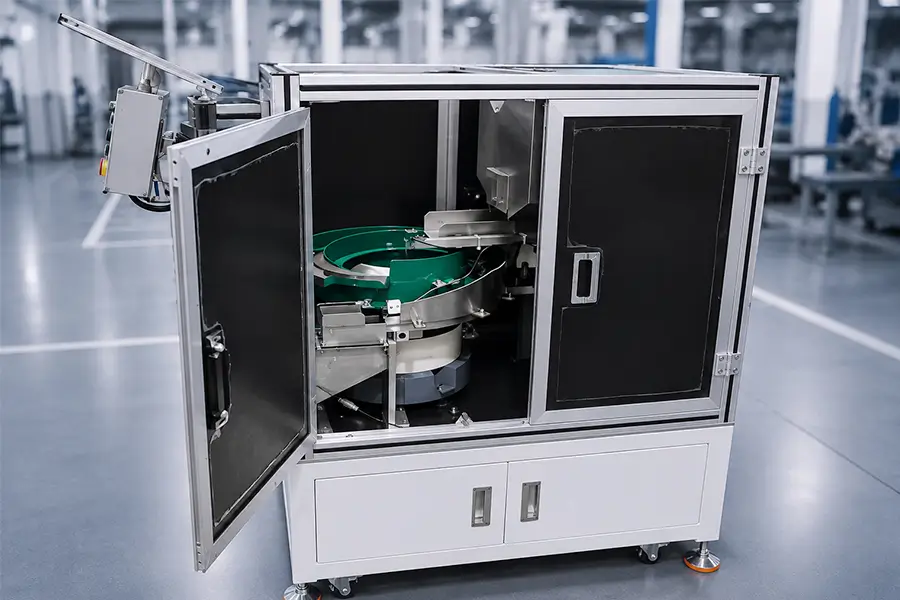
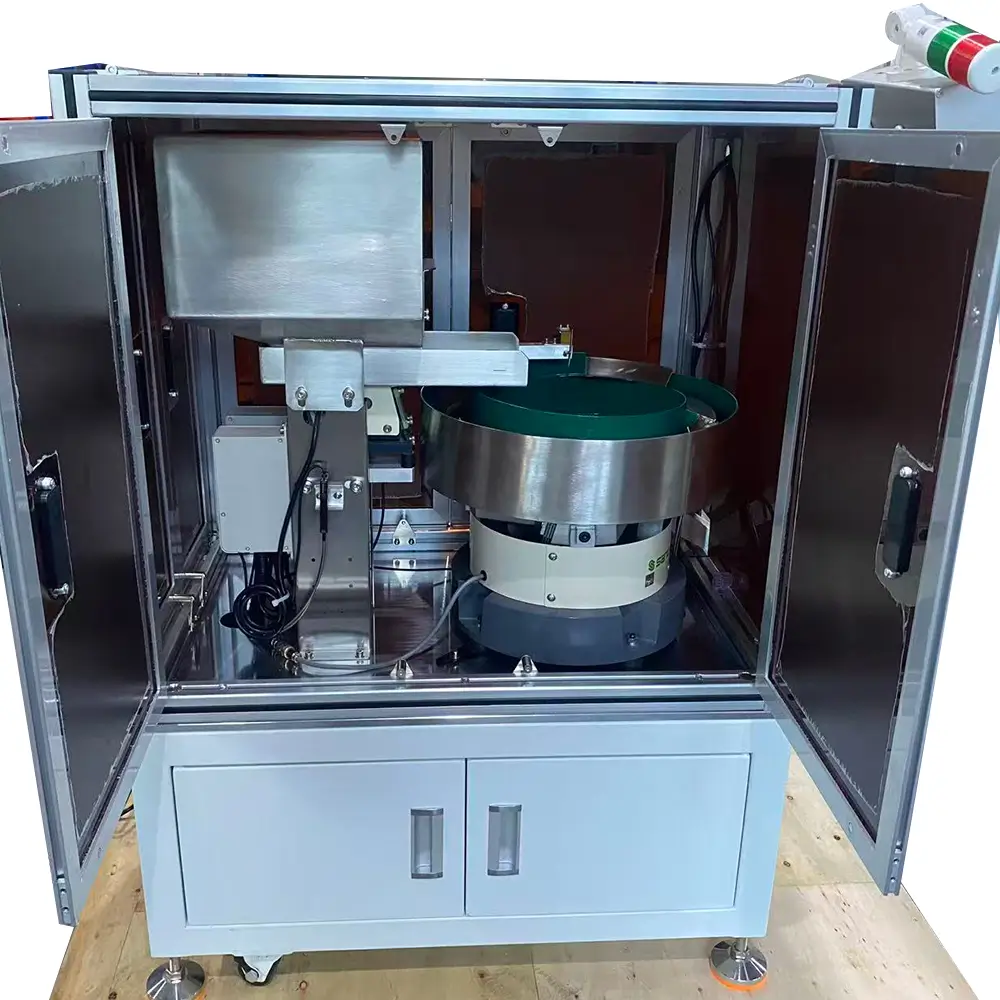
An automatic counting vibratory bowl feeder is a feeding system that uses controlled vibration to sort, orient, and transport small components.
Unlike a standard vibratory bowl feeder, the counting version adds sensors and control functions to monitor the number of parts that pass through the feeding track.
Typical components include:
- Vibratory bowl
- Customized feeding track
- Vibration controller
- Part detection sensor
- Counting system
- Jam detection system
- No-material detection
- Control panel
- Protective or soundproof enclosure
The exact bowl and track design depends on the part’s shape, size, weight, material and required feeding direction.
For small stamped metal parts, customized tooling helps separate overlapping components and guide each part toward the outlet.
How Does the Feeder Count Small Parts?
The counting process starts when bulk parts enter the vibratory bowl.
Vibration moves the parts around the bowl and gradually guides them toward the feeding track. Customized tooling removes incorrectly positioned parts and keeps properly oriented parts moving toward the outlet.
A sensor monitors the parts as they pass a specific detection point.
The control system records each detected part as one count.
Basic working process
Bulk parts → Vibratory feeding → Part orientation → Sensor detection → Automatic counting → Part output
For example, if the production process requires 100 metal parts, the operator can set the target quantity in the control system.
Once the feeder reaches the preset quantity, the system can stop feeding or send a signal to the next machine, depending on the production setup.
This approach works well for batch feeding, automatic assembly and parts dispensing applications.
How Does Jam Detection Work?
Part jams can interrupt an automated production line.
A component may become stuck because of an incorrect orientation, overlapping parts, foreign material or an unsuitable feeding condition.
The counting vibratory bowl feeder can monitor the feeding track to identify abnormal feeding conditions.
When the system detects that parts are not moving as expected, it can trigger a jam alarm.
Operators can then check the feeding track and remove the blockage before restarting production.
Common jam detection functions include:
| Функция | Purpose |
| Part detection | Monitors parts passing through the track |
| Jam detection | Detects abnormal or stopped part movement |
| No-material detection | Alerts operators when the bowl runs out of parts |
| Counting | Records the number of parts fed |
| Quantity setting | Sets the required number of parts |
| Alarm output | Alerts operators to check the feeder |
This type of monitoring helps reduce the time operators spend checking the feeder manually.
What Happens When the Feeder Runs Out of Parts?
No-material detection provides another useful function for automated production.
Without detection, an empty bowl may continue running even though no parts reach the next process. This can cause production interruptions, missed assembly cycles or unnecessary machine operation.
A sensor can monitor whether parts continue to reach the feeding position.
When the system detects that no material remains, it can trigger an alarm.
Operators can then refill the bowl and restart the feeding process.
This function becomes especially useful when the vibratory feeder works together with automatic assembly machines, packaging machines or other production equipment.
Why Use a Counting Vibratory Bowl Feeder?
A standard feeder mainly focuses on moving parts. Adding counting and fault detection makes the system more suitable for production processes that require controlled quantities and continuous monitoring.
Main advantages
1. Reduce manual counting
Operators do not need to count every small component manually.
2. Improve feeding consistency
The vibratory bowl continuously moves parts toward the required output position.
3. Detect feeding problems
Jam and no-material alarms help operators respond to problems quickly.
4. Support batch production
Preset quantities allow the machine to feed a specific number of parts for each production cycle.
5. Connect with automation equipment
The feeder can work with assembly machines, packaging equipment, inspection systems and other automatic production equipment.
6. Reduce manual part handling
Automatic feeding and counting reduce repetitive handling work on the production line.
What Parts Can a Counting Vibratory Bowl Feeder Handle?
Counting vibratory bowl feeders can handle many types of small components.
The actual feeding performance depends on the component’s physical characteristics and the customized bowl tooling.
Common applications include:
- Small metal stamped parts
- Metal brackets
- Clips
- Washers
- Screws
- Nuts
- Pins
- Пружины
- Plastic components
- Electronic components
- Small hardware parts
For irregular metal parts, the feeding track requires careful design because different orientations may affect counting and downstream assembly.
Part samples or drawings help engineers determine the bowl design, track structure and sensor position.
Why Choose SWOER for Customized Counting Feeders?
СВУЕР designs вибрационные системы подачи around the customer’s actual parts and production process.
The company can customize the bowl, feeding track, sensors, counting system, control panel and protective enclosure according to the application.
For this type of counting feeder, SWOER can integrate:
- Automatic part counting
- Jam detection
- No-material alarm
- Customized feeding tracks
- Vibratory bowl tooling
- Soundproof enclosure
- Система управления
- Automatic assembly line connection
The final configuration depends on the part characteristics and production requirements.
Need a Counting Feeder for Your Parts?
Send SWOER your part drawing, sample photos, part dimensions and required feeding quantity.
Our engineers can evaluate the feeding method and recommend a suitable automatic counting vibratory bowl feeder for your production line.
Get a Custom Vibratory Bowl Feeder Solution
Have small metal parts that need automatic feeding and counting?
Send us:
- Part photos
- Part drawings
- Part dimensions
- Required feeding speed
- Required counting quantity
- Application or machine information
SWOER can design a customized vibratory bowl feeding system with counting, jam detection, and no-material alarms for your application.
Запрос цитаты
 Russian
  English
  Spanish (Mexico)
  Czech
Czech  Arabic
  German
  French
  Turkish
  Italian
  Ukrainian
  Polish
  Romanian
  Bengali
  Portuguese (Portugal)
  Thai
Thai  Japanese
  Korean
  Hebrew
  Uzbek
Uzbek  Hindi
Hindi  Slovak
  Vietnamese
  Portuguese (Brazil)
  Spanish (Peru)
  Spanish (Spain)
  Spanish (Venezuela)