
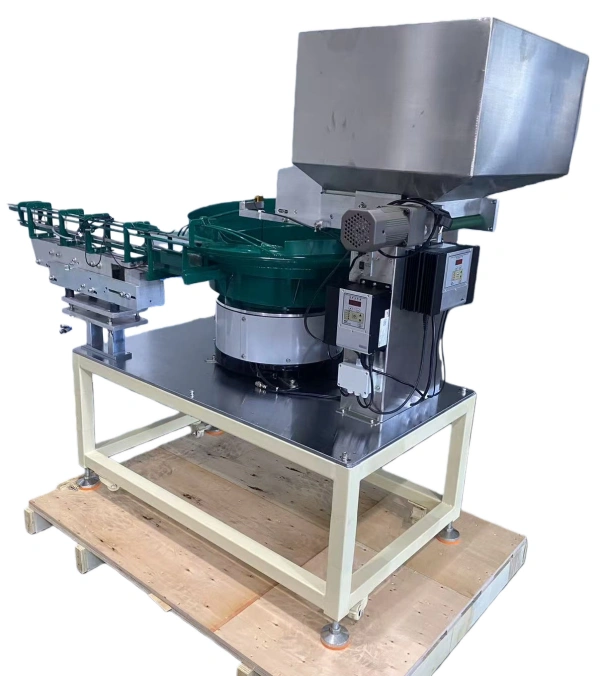
I. Typical Water Meter Components Suitable for Vibratory Feeding
| Component Type | Typical Characteristics | Feeder Suitability |
|---|---|---|
| Small metal parts (e.g., screws, pins, shafts, gears) | Rigid, symmetrical, robust | ✅ Excellent – easy to orient and feed |
| Plastic housing parts (e.g., lids, covers, rings, inserts) | Lightweight, moderate complexity | ✅ Good – may require special coating (e.g., Teflon) to prevent sticking |
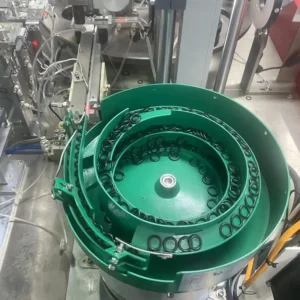
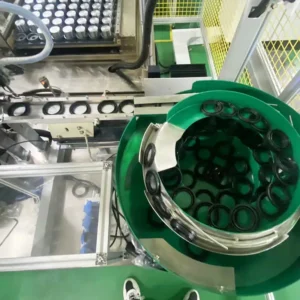
| O‑rings / seals (rubber) | Soft, elastic, tangle‑prone | ⚠️ Moderate – requires special tooling; a centrifugal feeder or pusher may be better |
| Ceramic / glass parts (e.g., sensor housings, insulators) | Hard, brittle, easily scratched | ⚠️ Moderate – requires gentle handling and a non‑stick coating |
| Non‑standard / complex geometries (e.g., valve bodies, irregular inserts) | Asymmetric, delicate | ⚠️ Moderate – may require custom tooling or a vision‑guided flexible feeder |
II. Factors Affecting Feasibility
| Factor | Consideration |
|---|---|
| Part size | Most water meter parts are small (typically < 50–80 mm) and well within the capacity of vibratory bowls. |
| Part weight | Water meter components are usually lightweight (< 200–500 g), suitable for standard bowls. |
| Material | Brass, stainless steel, and engineering plastics feed well. Soft rubber or very brittle materials need special handling. |
| Orientation requirement | Most bowls can orient parts by using tooling (e.g., wiper blades, gaps, air jets) to achieve the required output orientation. |
| Surface condition | Oily or greasy parts may need a Teflon coating or additional cleaning; dry parts feed better. |
| Feed rate | Standard bowls can easily achieve 30–120 parts/min for most water meter components. |
III. Common Applications in the Water Meter Industry
| Aplicație | Bowl Design Consideration |
|---|---|
| Feeding brass valve cores | Use stainless steel bowl with wear‑resistant track |
| Feeding plastic meter covers | Add anti‑static device; consider Teflon coating to prevent sticking |
| Feeding O‑rings / seals | Consider a flexible feeder or centrifugal feeder instead of a vibratory bowl |
| Feeding small screws for assembly | Standard bowl with wiper blades and sensor for orientation check |
| Feeding ceramic sensor housings | Use soft track coating (e.g., polyurethane) and lower amplitude to prevent chipping |
IV. When a Vibratory Bowl May NOT Be Suitable
| Condition | Alternative Solution |
|---|---|
| Very soft or tacky rubber parts | Pusher feeder, flexible feeder, or centrifugal feeder |
| Extremely fragile parts | Flexible feeder with vision + robot (gentle pick‑up) |
| Parts that are heavily oiled or sticky | Centrifugal feeder (less friction‑dependent) or pre‑cleaning before feeding |
| Very complex or asymmetric shapes | Flexible feeder + vision system (no tooling required) |
| High‑mix / frequent changeover | Flexible feeder (quick software‑based changeover) |
V. Summary Table
| Component | Vibratory Bowl Suitable? | Recommended Feeder / Coating |
|---|---|---|
| Brass valve parts | ✅ Yes | Standard stainless steel bowl |
| Plastic housing / lids | ✅ Yes | Teflon coating + anti‑static device |
| Rubber O‑rings / seals | ⚠️ Maybe (hard) | Pusher feeder or alimentator centrifugal recommended |
| Ceramic / glass parts | ⚠️ Yes, with care | Soft track coating + low amplitude |
| Screws / pins / small hardware | ✅ Yes | Standard bowl with orientation tooling |
| Complex / irregular shapes | ⚠️ Yes, but custom tooling needed | Flexible feeder + vision may be better |
 Romanian
  English
  Spanish (Mexico)
  Czech
Czech  Arabic
  Russian
  German
  French
  Turkish
  Italian
  Ukrainian
  Polish
  Bengali
  Portuguese (Portugal)
  Thai
Thai  Japanese
  Korean
  Hebrew
  Uzbek
Uzbek  Hindi
Hindi  Slovak
  Vietnamese
  Portuguese (Brazil)
  Spanish (Peru)
  Spanish (Spain)
  Spanish (Venezuela)
Recenzii
Nu există recenzii până acum.