
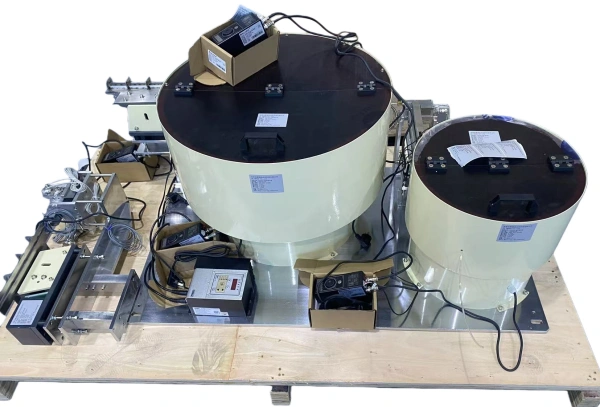
The stability of a vibratory bowl versus a alimentador centrífugo depends heavily on the part characteristics and application requirements. Below is a comparative analysis:
I. General Comparison of Stability
| Factor | Vibratory Bowl | Alimentador Centrífugo |
|---|---|---|
| Part Flow | Pulsating / intermittent vibration | Continuous rotary motion |
| Sensitivity to Part Variations | High (jams with irregular shapes) | Moderate (better at handling some variation) |
| Speed Fluctuation | Can vary with voltage, load, wear | Very steady once set |
| Noise Stability | Noise level can vary | Generally consistent |
| Orientation Consistency | Very high with proper tooling | Good, but tooling is simpler |
II. When Vibratory Bowl Offers Better Stability
Highly uniform, symmetrical parts (standard screws, washers, electronic components).
Applications requiring precise, complex orientation (e.g., polarized components).
Lower feeding speeds (under ~200 parts/min).
Well‑controlled part quality (consistent dimensions, no burrs, no oil).
With good part consistency, a well‑tuned vibratory bowl can achieve >99.5% orientation accuracy and reliable feeding.
III. When Centrifugal Feeder Offers Better Stability
High‑speed feeding (300–1000+ parts/min).
Parts with some variation (slightly sticky, flexible, or prone to clinging).
Simple orientation needs (only separation, no complex direction sorting).
Applications where continuous, non‑pulsating flow is critical (e.g., direct integration with high‑speed counting or weighing).
The rotary motion of a centrifugal feeder is naturally smoother and less affected by part‑to‑part friction variations.
IV. Key Stability Differences
Flow Consistency
Vibratory bowl: Pulsating – parts advance in tiny jumps. Can cause small speed variations.
Centrifugal: Continuous rotary flow – very smooth, uniform discharge.
Effect of Part Jams
Vibratory bowl: A single jam can stop the entire bowl.
Centrifugal: Jams are less frequent; if one occurs, only the jammed part is affected (the disc keeps rotating).
Sensitivity to External Factors
Vibratory bowl: Affected by voltage fluctuations, spring wear, contamination buildup.
Centrifugal: Less sensitive; main factors are motor speed and tooling wear.
Long‑Term Drift
Vibratory bowl: Springs and rubber mounts degrade over time, requiring periodic retuning.
Centrifugal: Fewer wear parts; performance remains stable longer with basic maintenance.
V. Conclusion
| If your priority is… | Then the more stable choice is… |
|---|---|
| Complex orientation + uniform parts | Vibratory bowl (after proper tuning) |
| High speed + continuous smooth flow | Centrifugal feeder |
| Tolerance to part variation | Centrifugal feeder |
| Simple parts with no orientation requirement | Either, but centrifugal is often smoother |
Bottom Line:
For stable orientation accuracy: a well‑designed vibratory bowl is excellent.
For stable flow continuity and speed: the alimentador centrífugo typically wins.
The best choice depends on your specific part shape, required orientation precision, target speed, and acceptable maintenance level. In many high‑volume packaging lines (e.g., caps, seals, small pills), centrifugal feeders are preferred for their superior flow stability. In precision electronics assembly, a vibratory bowl with good tooling is hard to beat.

 Portuguese (Portugal)
  English
  Spanish (Mexico)
  Czech
Czech  Arabic
  Russian
  German
  French
  Turkish
  Italian
  Ukrainian
  Polish
  Romanian
  Bengali
  Thai
Thai  Japanese
  Korean
  Hebrew
  Uzbek
Uzbek  Hindi
Hindi  Slovak
  Vietnamese
  Portuguese (Brazil)
  Spanish (Peru)
  Spanish (Spain)
  Spanish (Venezuela)