
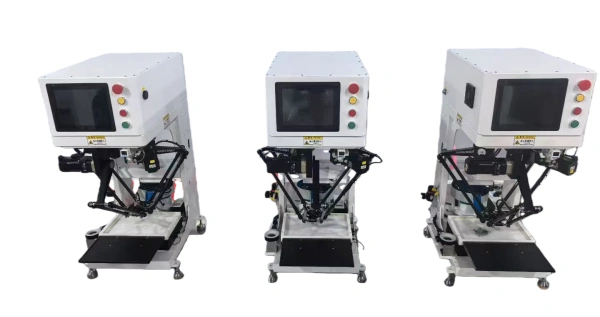
How long is the typical lifespan of a parallel robot?
I. Typical Lifespan Overview
| Component | Typical Lifespan |
|---|---|
| Main robot structure (base frame, arms, moving platform) | 10 – 15+ years (with proper maintenance) |
| Servo motors | 30,000 – 50,000 hours (~5 – 8 years at 2 shifts/day) |
| Reducers / gearboxes | 15,000 – 25,000 hours (~3 – 5 years) |
| Spherical joints / ball joints | 8,000 – 12,000 hours (~1.5 – 2.5 years) |
| Synchronous belts (if used) | 10,000 – 15,000 hours (~2 – 3 years) |
| Cables (motor power, encoder, air tubing) | 15,000 – 25,000 hours (~3 – 5 years) |
| Controller (main CPU, drives) | 10+ years (with proper cooling and clean power) |
| Controller backup battery | 1 – 3 years |
| End‑effector (vacuum cups, gripper jaws) | 3 – 12 months (depends on usage and part abrasiveness) |
Overall robot life: A well‑maintained parallel robot can operate reliably for 10–15 years. The mechanical structure is durable, and most wear parts (joints, belts, cables) are replaceable, allowing the robot to be kept in service for much longer with regular component replacement.
II. Factors That Shorten Lifespan
| Factor | Impact |
|---|---|
| Heavy payload (near max capacity) | Accelerates wear on joints, motors, and gearboxes |
| High acceleration / cycle rate | Increases stress on spherical joints and belts |
| Dusty or abrasive environment | Wears joints and bearings faster |
| Corrosive atmosphere (chemicals, moisture) | Reduces life of metal parts, bearings, and electronics |
| Poor power quality (voltage spikes, brownouts) | Damages servo drives and controllers |
| Lack of regular maintenance | Leads to unexpected failures |
| Poor cooling (blocked vents, hot environment) | Shortens life of drives and motors |
III. Recommended Replacement Schedule (2‑Shift Operation)
| Component | Replacement Interval | Notatki |
|---|---|---|
| Spherical joints | 8,000 – 12,000 hours (~1.5 – 2.5 years) | Most wear‑prone part; check for play every 3–6 months |
| Synchronous belts (if used) | 10,000 – 15,000 hours (~2 – 3 years) | Inspect for cracks, wear, or loosening |
| Gearboxes / reducers | 15,000 – 25,000 hours (~3 – 5 years) | Replace when backlash increases beyond spec |
| Cables (moving flex cables) | 15,000 – 25,000 hours (~3 – 5 years) | Inspect for cracks; replace if intermittent signals occur |
| Controller battery | 1 – 3 years | Replace before low‑battery alarm to avoid losing parameters |
| Servo motors | 30,000 – 50,000 hours (~5 – 8 years) | Replace bearings if noisy; motors often last robot life |
| End‑effector wear parts | 3 – 12 months | Depends on part abrasiveness |
IV. Maintenance Practices to Extend Lifespan
A. Daily / Per Shift
| Task | Action |
|---|---|
| Visual inspection | Check for loose screws, damaged cables, or oil leaks. |
| Clean end‑effector | Remove dust and debris from vacuum cups, grippers, and sensors. |
| Listen for abnormal noise | Unusual sounds indicate a worn joint or bearing. |
B. Weekly
| Task | Action |
|---|---|
| Check spherical joints | Feel for play or binding; tighten if adjustable. |
| Inspect belts | Check tension and look for cracks or wear. |
| Clean cooling fans | Use compressed air to clean controller and drive vents. |
C. Monthly
| Task | Action |
|---|---|
| Check gearbox backlash | Measure and compare to factory spec. |
| Verify repeatability | Run a test cycle and measure position accuracy. |
| Lubricate joints (if applicable) | Follow manufacturer’s lubrication schedule. |
D. Yearly
| Task | Action |
|---|---|
| Full system calibration | Re‑calibrate robot and vision system (if used). |
| Replace worn joints | Replace spherical joints that have developed play. |
| Replace controller battery | Replace before battery warning appears. |
| Check all electrical connections | Tighten terminal screws; check for corrosion. |
V. Signs That Maintenance or Replacement is Needed
| Symptom | Possible Cause | Action |
|---|---|---|
| Position accuracy declining | Worn joints, belt stretch, gearbox backlash | Replace worn parts; re‑calibrate |
| Unusual noise at high speed | Worn spherical joint or bearing | Inspect and replace joint |
| Robot vibrates during motion | Loose belt, worn gearbox, or bad motor bearing | Check belt tension; inspect gearbox |
| Motor overheating | Overload, poor cooling, or worn bearing | Reduce load; clean cooling fans; replace bearing |
| Intermittent signal loss | Damaged cable | Replace flex cable |
VI. Summary Table
| Aspect | Value / Interval |
|---|---|
| Overall robot life | 10 – 15 years (with maintenance) |
| Spherical joints | Replace every 1.5 – 2.5 years |
| Belts | Replace every 2 – 3 years |
| Gearboxes | Replace every 3 – 5 years |
| Cables | Replace every 3 – 5 years |
| Controller battery | Replace every 1 – 3 years |
| Servo motors | Often last robot life; bearings may need replacement |
 Polish
  English
  Spanish (Mexico)
  Czech
Czech  Arabic
  Russian
  German
  French
  Turkish
  Italian
  Ukrainian
  Romanian
  Bengali
  Portuguese (Portugal)
  Thai
Thai  Japanese
  Korean
  Hebrew
  Uzbek
Uzbek  Hindi
Hindi  Slovak
  Vietnamese
  Portuguese (Brazil)
  Spanish (Peru)
  Spanish (Spain)
  Spanish (Venezuela)
Opinie
Na razie nie ma opinii o produkcie.