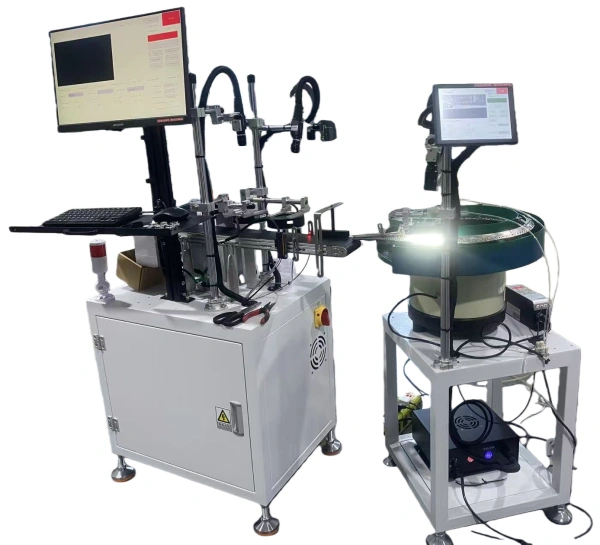
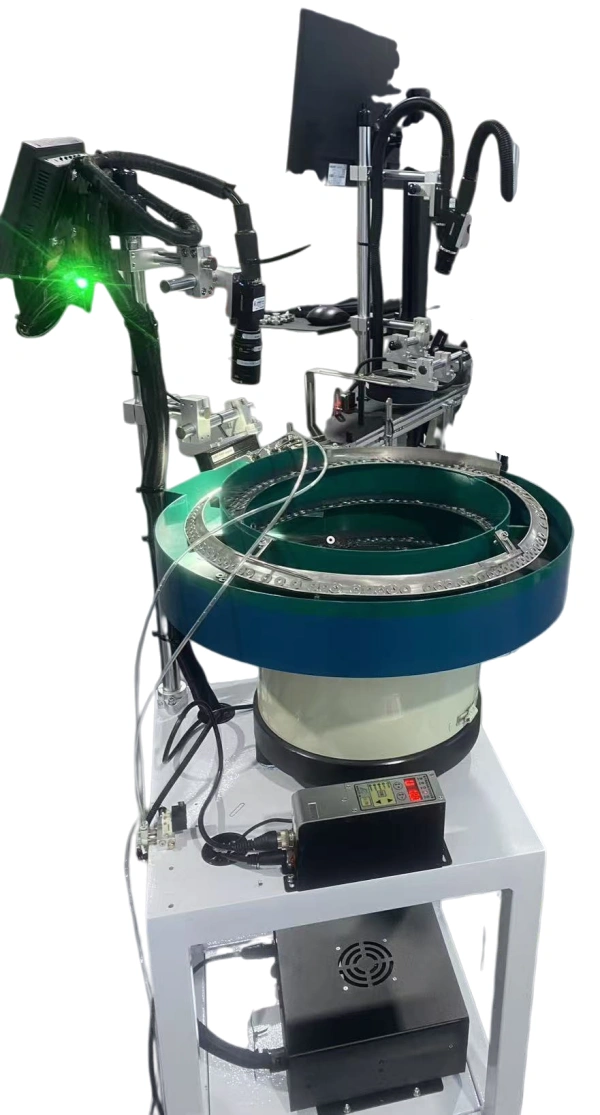
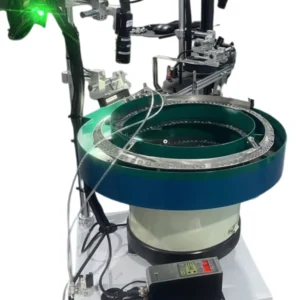
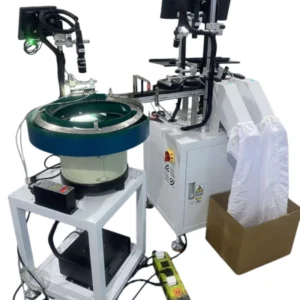
Functions and Advantages of a Vibratory Bowl with an Inspection / Detection Structure
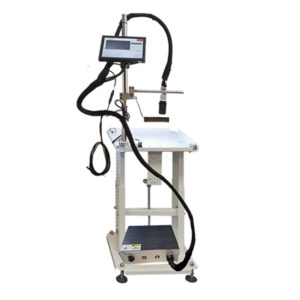
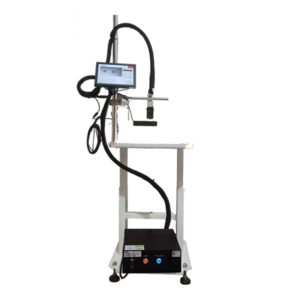
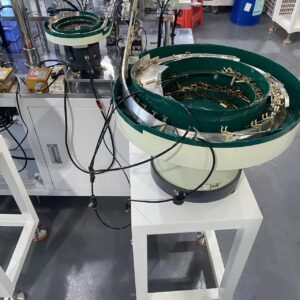
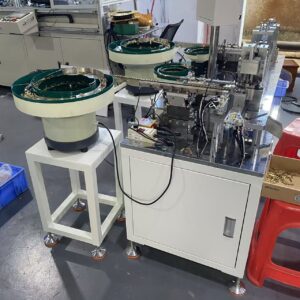
Adding an inspection or detection structure (such as a vision system, sensors, or mechanical gauging) to a vibratory bowl feeder transforms it from a simple feeding device into an intelligent quality control station. The functions and advantages are as follows:
I. Functions of a Vibratory Bowl with an Inspection Structure
1. Real-Time Orientation Verification
समारोह: Confirms that every part leaving the bowl is in the correct orientation (e.g., right-side up, correct angular position).
आवेदन: Detects and rejects parts that pass through orienting tooling in the wrong orientation.
2. Dimensional Inspection
समारोह: Measures critical dimensions of parts during feeding, such as length, diameter, thread presence, or hole depth.
आवेदन: Ensures parts meet specified tolerances before reaching downstream assembly.
3. Surface Defect Detection
समारोह: Identifies surface flaws including scratches, dents, burrs, corrosion, or contamination.
आवेदन: Prevents defective parts from being assembled into finished products.
4. Presence / Completeness Checking
समारोह: Verifies that all required features are present, such as washers on screws, threads on bolts, or holes in stamped parts.
आवेदन: Catches missing components or incomplete parts early in the process.
5. Mixed Part Detection
समारोह: Distinguishes between different part types and identifies when a foreign or incorrect part has entered the feed stream.
आवेदन: Prevents costly assembly errors caused by mixed batches.
6. Counting and Data Logging
समारोह: Counts parts as they pass the inspection point and records pass/fail data.
आवेदन: Provides real-time production metrics and traceability.
7. Actuation of Rejection Mechanism
समारोह: Sends a signal to a reject device (air blast, solenoid pusher, diverter gate) when a defective part is detected.
आवेदन: Removes non-conforming parts from the material stream automatically.
II. Advantages of a Vibratory Bowl with an Inspection Structure
1. 100% In-Line Inspection
फ़ायदा: Every single part is inspected before assembly, eliminating sampling risks.
Benefit: No defective parts reach downstream processes, preventing costly rework or field failures.
2. Early Defect Detection
फ़ायदा: Defects are caught at the earliest possible stage—at the feeder, before assembly.
Benefit: Reduces waste of value-added processes (assembly time, other components) on bad parts.
3. Reduced Downstream Rework
फ़ायदा: Prevents defective parts from entering assembly machines, robots, or manual workstations.
Benefit: Minimizes machine jams, reduces downtime, and lowers rework labor costs.
4. Improved Product Quality
फ़ायदा: Ensures only correctly oriented, dimensionally accurate, defect-free parts are assembled.
Benefit: Higher final product quality and reliability; reduced warranty claims.
5. Increased Overall Equipment Effectiveness
फ़ायदा: Fewer jams and stoppages caused by bad parts reaching downstream equipment.
Benefit: Higher uptime, smoother production flow, and better OEE metrics.
6. Fast Changeover with Vision Systems
फ़ायदा: When using a vision-based inspection system, changeover to a new part type requires only a software recipe change.
Benefit: Minutes vs. hours for mechanical retooling; ideal for high-mix production.
7. Data Collection and Traceability
फ़ायदा: The inspection system can count good vs. bad parts and record defect types.
Benefit: Enables statistical process control, quality reporting, and traceability to specific production batches.
8. Non-Contact Inspection (When Using Vision)
फ़ायदा: Vision-based inspection does not physically contact parts.
Benefit: No risk of scratching, bending, or damaging delicate parts during inspection.
9. Consistent, Objective Judgment
फ़ायदा: Machines do not get tired, distracted, or apply inconsistent standards.
Benefit: Highly repeatable inspection results, eliminating human error.
10. Reduced Labor Costs
फ़ायदा: Automated inspection replaces manual visual inspection stations.
Benefit: Lower labor costs and redeployment of personnel to higher-value tasks.
III. Summary Table: Key Advantages
| फ़ायदा | विवरण |
|---|---|
| 100% In-Line Inspection | Every part inspected before assembly |
| Early Defect Detection | Catches defects at the feeder stage |
| Reduced Downstream Rework | Prevents bad parts from entering assembly |
| Improved Product Quality | Higher final product reliability |
| Increased OEE | Less downtime from jams and defects |
| Fast Changeover (Vision) | Software-based recipe changes |
| Data Collection | Real-time quality metrics and traceability |
| Non-Contact | Safe for delicate parts (vision systems) |
| Consistent Judgment | Eliminates human fatigue and variability |
| श्रम लागत में कमी | Replaces manual inspection stations |
सारांश: Adding an inspection structure to a vibratory bowl feeder provides 100% real-time quality control at the earliest possible point in the production process. And the key benefits are preventing defective parts from reaching downstream assembly, reducing rework and downtime, improving final product quality, और enabling fast changeover for high-mix production. For applications where part quality is critical, an integrated inspection-equipped bowl is a powerful investment in quality assurance and operational efficiency.
 Hindi
Hindi  English
  Spanish (Mexico)
  Czech
Czech  Arabic
  Russian
  German
  French
  Turkish
  Italian
  Ukrainian
  Polish
  Romanian
  Bengali
  Portuguese (Portugal)
  Thai
Thai  Japanese
  Korean
  Hebrew
  Uzbek
Uzbek  Slovak
  Vietnamese
  Portuguese (Brazil)
  Spanish (Peru)
  Spanish (Spain)
  Spanish (Venezuela)
समीक्षा
अभी तक कोई समीक्षा नहीं।