Why Small and Medium Manufacturers in France Use Assembly Machines
Small and medium manufacturers often face pressure to control labor costs and maintain stable production.
Manual assembly can work for low production volumes. However, repetitive tasks can become difficult when orders increase.
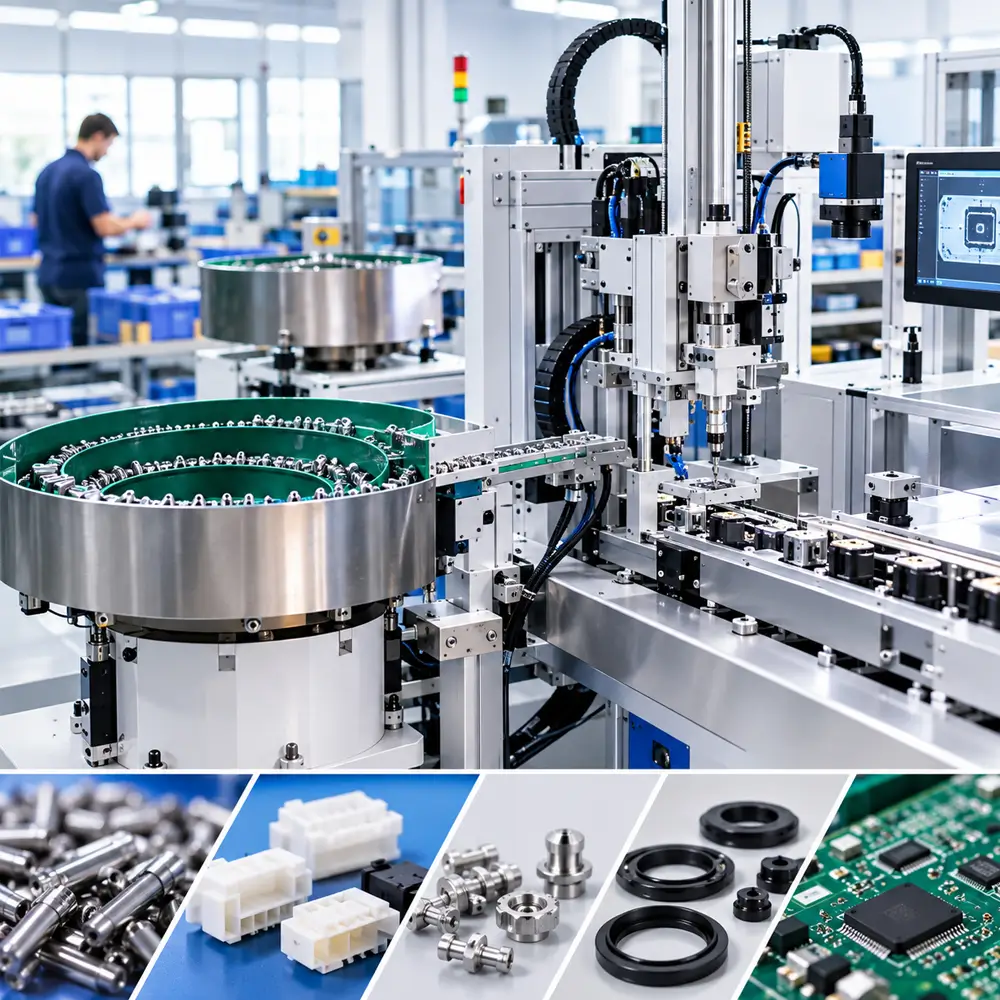
Assembly machines can automate feeding, positioning, assembling, testing, inspection, and packaging.
Common benefits include:
- Less manual handling
- More stable production speed
- Better assembly consistency
- Lower risk of human errors
- Easier production monitoring
- Better use of factory labor
Production requirements vary from one company to another. Machine design should match the product, process, and target output.
Common Assembly Machines for Small and Medium Manufacturers
Different products require different automation systems. Manufacturers can choose individual machines or combine several processes into one production line.
| Assembly Machine Type | Common Application | Main Function |
| Automatic Assembly Machine | Connectors, switches, small components | Product assembly |
| מזין קערות רוטט | Screws, springs, pins, connectors | Part feeding and orientation |
| מזין גמיש | Small and delicate parts | Flexible part feeding |
| Vision Inspection Machine | Electronic and precision parts | Defect and position inspection |
| Screw Assembly Machine | Screws and threaded components | Automatic screw feeding and tightening |
| Packaging Machine | Small finished products | Automatic packing |
| Custom Assembly Line | Multi-step products | Complete production process |
Small production lines can also combine several functions. For example, a vibratory bowl feeder can supply parts to an automatic assembly machine.
Vision inspection can then check the assembled products before packaging.
How to Choose an Assembly Machine in France
Choosing an assembly machine should start with the production process rather than the machine name.
Several factors affect the machine design and cost.
1. Check Production Volume
Production volume determines the required machine speed.
Low-volume production may need a semi-automatic system. Higher volumes may justify fully automatic assembly equipment.
2. Check Product Structure
Product size, shape, material, and assembly steps affect machine design.
Small electronic components often need precise feeding and positioning. Larger mechanical parts may need different handling systems.
3. Check Available Factory Space
Factory space can limit machine size.
Compact assembly equipment can suit workshops with limited floor space. Larger production lines need more room for feeding, assembly, inspection, and operator access.
4. Check Required Automation Level
Some companies need one automatic process. Others need a complete production line.
Automation can cover:
- Part feeding
- Part orientation
- Pick and place
- Press fitting
- Screw fastening
- Gluing
- Testing
- Vision inspection
- אריזה
Custom Assembly Machines for French Manufacturers
Standard machines may not match every product or production process.
Custom assembly machines can combine feeding, assembly, inspection, and other processes based on specific requirements.
SWOER develops custom assembly solutions based on the customer’s product structure and production requirements.
The process can include:
- Customer provides product drawings and production requirements.
- SWOER designs a 3D machine model for customer confirmation.
- Both sides confirm the machine design and sign the contract.
- SWOER manufactures and tests the equipment.
- The machine ships after production and testing.
- SWOER provides installation guidance and technical support after delivery.
Custom automation can also connect with existing production equipment when the process requires it.
Assembly Machine Applications in France
Assembly automation can support many manufacturing industries in France.
ייצור אלקטרוניקה
Electronic components often require precise feeding and positioning.
Automatic connector assembly machines, chip assembly machines, and inspection systems can automate repetitive production tasks.
חלקי רכב
Automotive components often require stable assembly quality and repeatable production.
Custom assembly machines can combine part feeding, pressing, fastening, inspection, and testing.
Electrical Products
Switches, circuit breakers, terminals, and other electrical components can use automatic assembly equipment.
Feeding systems can supply small parts to the assembly station at a controlled rate.
Hardware and Mechanical Parts
Small mechanical components can use vibratory bowl feeders, step feeders, and automatic assembly machines.
These systems can reduce manual sorting and part handling.
Assembly Machines for Different Production Volumes
Machine selection should match the actual production target.
| Production Situation | Suitable Solution | Typical Features |
| Low volume | Manual or semi-automatic equipment | Lower investment and flexible operation |
| Medium volume | Semi-automatic or automatic machine | Balanced speed and automation |
| High volume | Fully automatic assembly line | Continuous production and less manual work |
| Multiple product models | Flexible custom system | Easier product changeover |
| Complex assembly process | Integrated custom line | Feeding, assembly, inspection, and testing |
Production volume should not be the only factor.
Product complexity, labor availability, quality requirements, and future production plans also matter.
Why Choose a Custom Assembly Solution?
Custom automation can make sense when standard equipment cannot complete the required process.
Common reasons include:
- Special product shapes
- Multiple assembly steps
- Limited factory space
- High precision requirements
- Multiple feeding systems
- Integrated visual inspection
- Automatic product testing
- Connection with existing assembly lines
SWOER can design the feeding, assembly, inspection, and handling processes around the customer’s product.
This approach allows small and medium manufacturers to start with the processes that need automation most.
Get the Right Assembly Machine for Your Production
Finding the right assembly machine starts with understanding the product and production process.
Product drawings, part samples, assembly steps, target output, and factory space can help define the machine requirements.
If you are looking for assembly machines in France, SWOER can develop a custom solution based on your production needs.
Send your product drawings and production requirements to SWOER to discuss a suitable assembly machine solution.

 Hebrew
  English
  Spanish (Mexico)
  Czech
Czech  Arabic
  Russian
  German
  French
  Turkish
  Italian
  Ukrainian
  Polish
  Romanian
  Bengali
  Portuguese (Portugal)
  Thai
Thai  Japanese
  Korean
  Uzbek
Uzbek  Hindi
Hindi  Slovak
  Vietnamese
  Portuguese (Brazil)
  Spanish (Peru)
  Spanish (Spain)
  Spanish (Venezuela)