
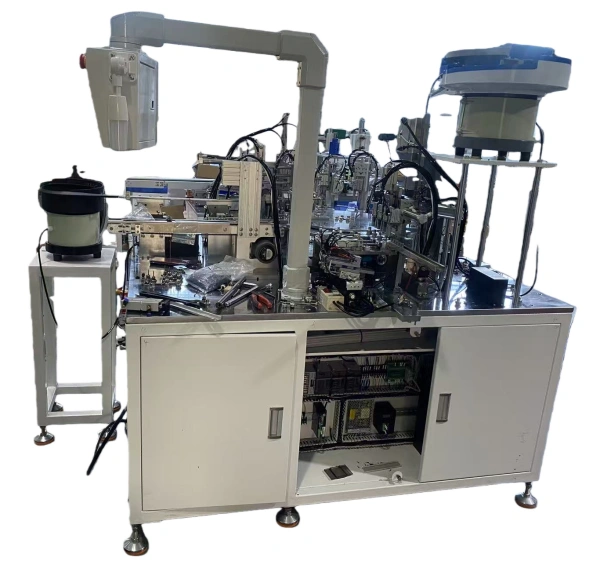
I. Quick Answer
Yes, modern assembly machines can detect defective products during the assembly process Und automatically reject them without stopping the production line. This is a standard feature in advanced automated assembly systems.
II. How It Works
| Step | Action |
|---|---|
| 1 | Parts are fed into the assembly machine (e.g., via a vibratory bowl feeder). |
| 2 | Inspection stations are placed at key points in the assembly sequence (e.g., after part insertion, after fastening, after final assembly). |
| 3 | Sensors or vision systems check each product for defects. |
| 4 | If a product passes inspection, it continues to the next station. |
| 5 | If a product fails inspection, the machine triggers a reject mechanism (air blast, pusher, diverter) to remove the defective part from the line. |
| 6 | The defective part is collected in a reject bin for later analysis or rework. |
III. Common Defect Detection Methods
| Method | What It Detects | Hinweise |
|---|---|---|
| Vision system (camera + software) | Missing parts, incorrect orientation, surface defects, scratches, wrong color, misalignment, foreign objects | Most flexible method; can detect many types of defects in one station. |
| Torque sensor | Insufficient or excessive fastening torque (screws, bolts) | Monitors screwdriving or press‑fit operations. |
| Force / pressure sensor | Insufficient insertion force, missing components, press‑fit depth | Detects abnormal resistance during insertion. |
| Presence sensor (photoelectric, inductive, or fiber optic) | Missing components or parts | Simple and fast but limited to presence/absence only. |
| Leak tester (pressure or vacuum) | Leaks in sealed or fluid‑containing products | Used in automotive, medical, and pneumatic applications. |
| Electrical test | Continuity, resistance, short circuits | Used for electronic or wired assemblies. |
| Dimension gauge (laser or mechanical) | Out‑of‑tolerance dimensions | Verifies critical dimensions (e.g., height, width, diameter). |
| Weight check (checkweigher) | Missing components or material | Detects missing screws, seals, or liquids. |
IV. Rejection Mechanisms
| Mechanism | How It Works | Suitable For |
|---|---|---|
| Air blast nozzle | Blows the defective product off the conveyor or track | Small, lightweight parts |
| Pusher / solenoid plunger | Pushes the product sideways into a reject chute | Most products; reliable and simple |
| Diverter gate / flipper | Redirects the product to a reject conveyor | Products on conveyors; can handle heavier items |
| Robotic pick‑and‑place reject | Robot picks the defective item and places it into a reject bin | Flexible reject handling for many product types |
| Drop‑out / trapdoor | A trapdoor opens, allowing the part to fall into a reject bin | Gravity‑fed systems; parts that can fall freely |
V. Reject Handling Workflow Example
Assembly → Inspection (vision + torque) → If PASS → Continue to next station
                                       → If FAIL → Air blast or pusher removes the part → Part goes to reject bin
VI. Important Considerations
| Factor | Recommendation |
|---|---|
| Inspection position | Place inspection stations after each critical operation to catch defects early. |
| Reject delay time | Program a small delay to allow the defective part to reach the reject mechanism. |
| Data logging | Record reject count and defect type for quality analysis (helps identify recurring issues). |
| Operator alert | Sound an alarm or show a message on the HMI when a high reject rate is detected. |
| Reject bin | Provide a clearly marked bin with separate compartments for different defect types. |
| Rework loop | For some parts, include a manual rework station near the reject bin for minor defects. |
VII. Summary Table
| Inspection Type | Defects Detected | Reject Method | Typical Cycle Time |
|---|---|---|---|
| Vision | Missing parts, orientation, scratches, misalignment | Air blast or pusher | 0.1–0.5 seconds |
| Torque | Under‑torqued or over‑torqued fasteners | Pusher or diverter | 0.3–0.8 seconds |
| Force | Insufficient insertion depth | Pusher or diverter | 0.3–0.6 seconds |
| Presence | Missing components | Air blast or pusher | 0.05–0.1 seconds |
| Leak test | Air/fluid leaks | Pusher or diverter | 1–5 seconds |
| Electrical test | Shorts, open circuits, wrong resistance | Pusher or diverter | 0.5–2 seconds |

 German
  English
  Spanish (Mexico)
  Czech
Czech  Arabic
  Russian
  French
  Turkish
  Italian
  Ukrainian
  Polish
  Romanian
  Bengali
  Portuguese (Portugal)
  Thai
Thai  Japanese
  Korean
  Hebrew
  Uzbek
Uzbek  Hindi
Hindi  Slovak
  Vietnamese
  Portuguese (Brazil)
  Spanish (Peru)
  Spanish (Spain)
  Spanish (Venezuela)